


Rice and Cats: Safe to Share, but Not for the Reason You Think
Plain cooked rice won't hurt your cat, and the carb panic around it is mostly overblown. The real limit is simpler: rice takes the place of the protein a cat is built to run on.

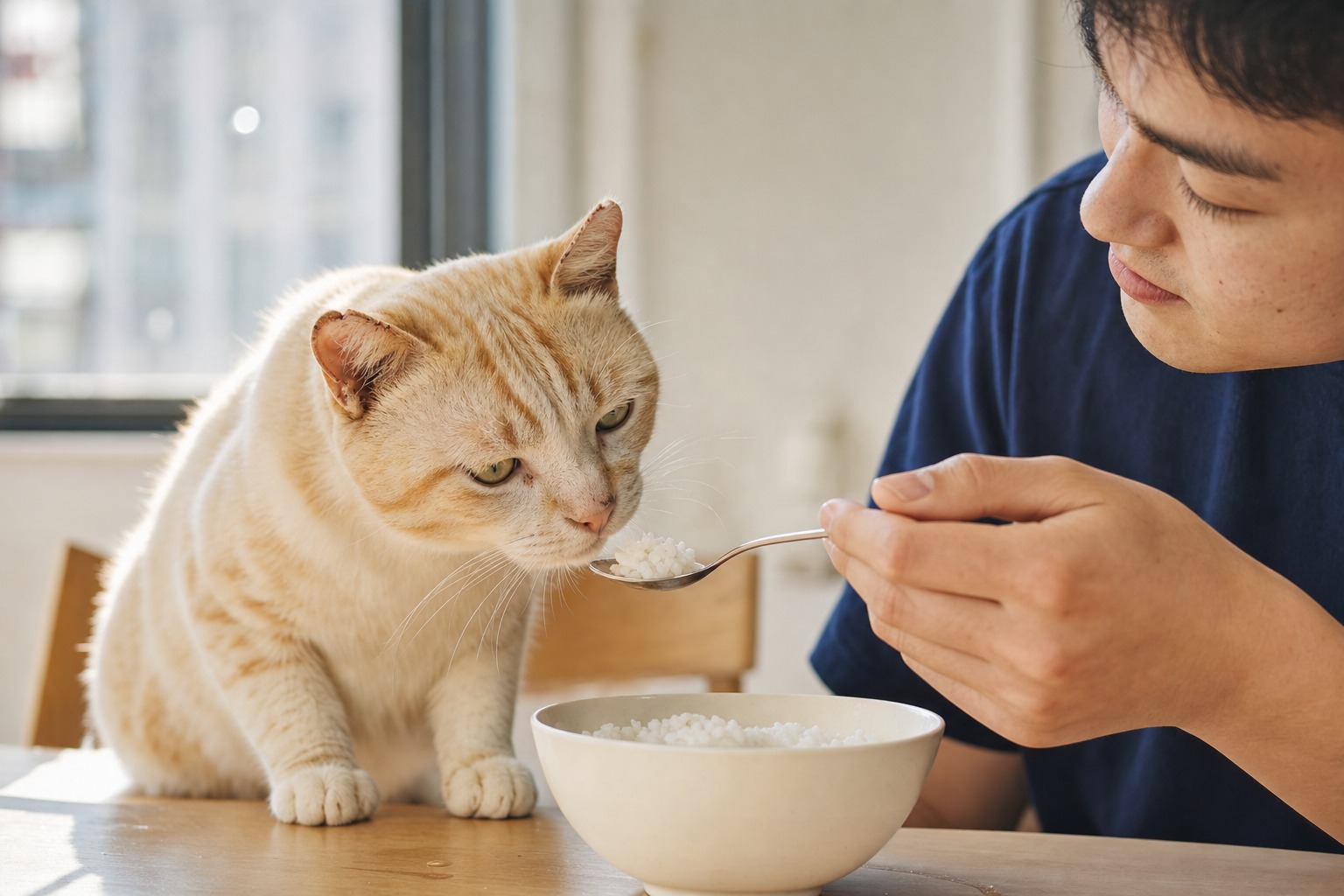
Here is the short version: a spoonful of plain cooked rice will not hurt a healthy cat, and most of the alarm you will read about it online is aimed at the wrong target. The internet worries that rice, as a carbohydrate, will make your cat fat or diabetic. The more useful worry is quieter. Rice has almost nothing a cat actually needs, so its only real cost is the space it takes up in a stomach that should be filling with protein and fat.
That reframing matters, because it changes what “moderation” means. It is not that rice is a little bit dangerous and you should ration the danger. It is that rice is harmless and nearly pointless, so you offer it the way you would offer a cat a cardboard box: as a small novelty, not as food that earns its keep.
Cats are built to run on meat, and it shows in their biology
Cats are obligate carnivores, and that is not a lifestyle label. It is anatomy. Their wild ancestors ate mice, birds, and insects, meals that are high in protein, moderate in fat, and almost free of carbohydrate. Domestic cats inherited that machinery. One telling detail: cats do not produce salivary amylase, the enzyme that starts breaking down starch in the mouth in animals that evolved to eat it. Their bodies never expected much starch, so they never built the front end of the assembly line for it.
They can still handle a modest amount of cooked starch further down the digestive tract. Most healthy cats digest a spoonful of rice without any trouble. But “can process it” is a long way from “needs it,” and that gap is the whole story with rice.
I tell clients to picture rice as a garnish, never the plate. A cat’s body is designed to pull energy and building blocks from animal protein and fat. Rice can ride along in small amounts, but the moment it starts replacing meat in the bowl, you are feeding the cat your logic instead of theirs.
What rice actually gives a cat
Rice has fed people for thousands of years, and there are more than 40,000 cultivated varieties of Oryza sativa, the plant it comes from. As cats domesticated themselves around human settlements, a stray grain here and there was probably unavoidable.
The one real fork is processing. Brown rice keeps its bran layer; white rice has it stripped away, which removes much of the fiber and a chunk of the micronutrients with it. Either way, what rice can offer a cat is modest:
- A little fiber, more in brown than white, which adds bulk in the gut and can help a cat that tends toward constipation.
- Trace B vitamins, mainly thiamine and B6, which support energy metabolism and nerve function.
- Small amounts of minerals like magnesium, phosphorus, and selenium.
Notice what is missing: the complete animal protein and taurine a cat cannot live without. Rice supplies calories and a trickle of nutrients your cat is almost certainly already getting from a complete diet. It fills a gap that does not exist.
The carb panic, examined honestly
For years the standard warning was blunt: carbohydrates make cats fat and give them diabetes, so keep the rice away. The science has grown more careful than that. A 2022 review in the Journal of the American Veterinary Medical Association concluded that the evidence does not support blaming dietary carbohydrate for feline obesity or diabetes, and a large meta-analysis found that carbs across a wide range of the diet were not a standalone risk factor for higher body fat, insulin, or blood glucose. The plainer culprit is the one that has always been there: too many calories, from any source, in a cat that does not move enough.
This does not turn rice into health food. Two things are still true and still matter:
Diabetic and overweight cats are the real exceptions. The evidence that low-carbohydrate diets help is strongest exactly here: diabetic cats on lower-carb food have better odds of good glucose control and even remission. So a cat already managing diabetes or carrying extra weight is precisely the cat that should skip the rice, and prescription lower-carb diets exist for this reason.
Calories still count. A tablespoon of rice is not a metabolic event, but a habit of topping every meal with starch is a habit of adding calories a cat does not need. That is how the weight creeps on, not through some special property of the grain.
The one genuine safety footnote: arsenic
Rice grown in arsenic-contaminated soil or water absorbs more of it, and brown rice holds more than white because arsenic concentrates in the bran. At high, daily, lifelong intakes this is a real toxin, which is why regulators watch it closely in human diets, especially infant rice cereal. For a cat nibbling a tablespoon now and then, it is a non-issue. The dose that would matter is one no cat will ever eat.
Recent regulatory pressure has, if anything, made this footnote smaller. U.S. authorities have pushed manufacturers toward lower inorganic-arsenic levels through selective sourcing and ingredient testing, with the tightest limits reserved for infant products, and measured arsenic in finished rice has trended down over the past decade.
How to share rice the right way
If you want to offer rice, the rules are simple and mostly about restraint:
- Serve it plain and fully cooked, cooled to room temperature, in bite-sized amounts. No butter, salt, broth, or seasoning.
- Keep the portion to about a tablespoon for an average adult cat, and count it toward the 10 percent of daily calories reserved for treats and extras.
- Check any rice-based product for ingredients that are genuinely toxic to cats, including onion, garlic, grapes, raisins, and chocolate, and skip anything high in sugar.
- Start tiny. Many cats will sniff rice and walk away, which is a perfectly normal response from a finicky obligate carnivore.
- If your cat has diabetes, is overweight, or eats a prescription diet, ask your vet before adding anything, rice included.
The bigger picture: cats and human food
At least 90 percent of a cat’s diet should come from complete and balanced cat food, because their nutritional needs are narrow and unforgiving. Beyond that, a few human foods can round out the occasional treat, as long as you confirm each one is non-toxic and keep portions small.
Safe-in-moderation nibbles include blueberries, a spoon of plain pumpkin for fiber, and a dab of unsweetened peanut butter. The hard no’s are the toxins: onion, which can trigger anemia; garlic, for the same reason; and chocolate, which is poisonous to cats. Whatever you share, serve it cooled, bite-sized, and free of bones, shells, or anything else a cat could choke on.
FAQs
How much rice can a cat eat?
About a tablespoon of plain, cooked, cooled rice is a reasonable occasional serving for an average adult cat, counted within the 10 percent of daily calories reserved for extras. If rice is already in your cat’s food, add none.
Does rice cause diabetes in cats?
Not by itself. Recent research has walked back the old “carbs cause feline diabetes” claim, pointing instead to excess calories and weight. Diabetic cats are still better off on lower-carb diets, so they are the ones to keep rice away from.
Can cats eat rice milk?
A lick or two is unlikely to hurt, but it is usually sweetened and carb-heavy with no benefit for a cat, so keep it to an accident rather than a routine.
References
- Verbrugghe A, Hesta M. Cats and Carbohydrates: The Carnivore Fantasy? Veterinary Sciences, 2017.
- Evidence does not support the controversy regarding carbohydrates in feline diets. Journal of the American Veterinary Medical Association, 2022.
- Dietary carbohydrates do not increase body fat or fasted insulin and glucose in cats: a meta-analysis. Journal of Animal Science, 2025.
- U.S. FDA: Arsenic in Rice and Rice Products Risk Assessment.
Not a substitute for your vet. Our guidance is educational. For urgent symptoms, contact a vet or emergency clinic right away. Editorial standards
Dr. Mehta is a board-certified veterinary nutritionist who evaluates pet food formulations, ingredient quality, and the science behind dietary trends. He writes and reviews all nutrition content at The Pet Times, including our food rankings and feeding guides.
Meet our experts ↗Keep reading
 FoodThe 'Superfood' Strawberry Does Nothing for Your Cat. They Can't Even Taste ItDr. Priya Nair · 5 min
 FoodFor a Carnivore, 'Is It Safe?' Is the Wrong Question About Human FoodDr. Priya Nair · 6 min
 FoodYour Cat Is Built to Eat Pork. The Deli Counter Is Where It Goes WrongDr. Amara Solis · 6 min
 FoodCats Can Eat Pineapple. They Literally Can't Taste the Point.Dr. Ravi Mehta · 3 min
 FoodThe Real Problem With Feeding Your Cat Ham Isn't Toxicity. It's MathDr. Ravi Mehta · 4 min
 FoodYogurt Won't Fix Your Cat's Gut. Here's What Actually Might.Dr. Lena Park · 6 min