


Can Cats Eat Honey? Why It's Mostly a Skip
Honey is a wellness darling for humans, but cats don't need it and probably won't even want it. Here is when honey might help a cat, when it can hurt, and what to offer instead.

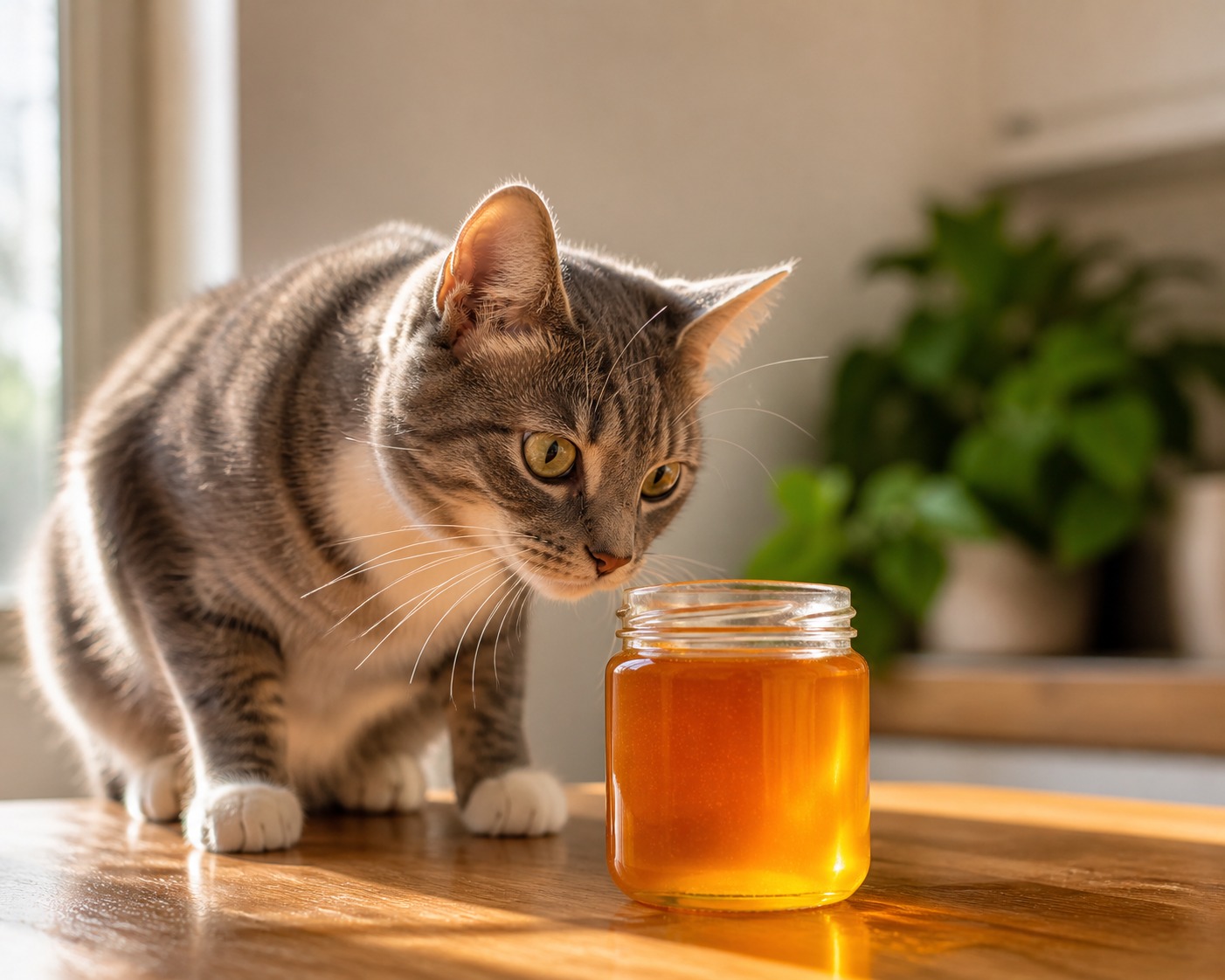
It feels like every day scientists, doctors, or nutritionists are discovering new and exciting uses for honey. Whether as a natural sweetener or an antimicrobial wound healer, honey offers plenty of benefits for humans, which can make you wonder whether your cat should get in on the sweetness.
Here is the reality check, and the through-line of this whole piece: almost every wellness benefit honey offers is a benefit for an omnivore who can taste sweetness and digest sugar. A cat is neither. Cats are obligate carnivores, they cannot even taste sweet, and their bodies are built to run on meat, not nectar. So the honest answer is not a flat “toxic” or a cheerful “sure,” it is that honey is mostly pointless for a cat, occasionally useful in a couple of narrow ways that have nothing to do with feeding it, and genuinely risky for a few cats. Here is how to tell those apart.
What Is Honey?
You may have heard honey described, unappetizingly, as bee vomit. That is not quite right, but it is a product made by honeybees from the nectar of flowers. It is hugely important to the bees as their main source of energy, it helps keep the hive warm, and it stores well for leaner months.
The reason honey tastes so sweet is that it is mostly sugar, about 80 percent. Alongside the sugars, honey contains amino acids, some vitamins and minerals, and antioxidants.
So why use honey when we already have sugar? Because less is more: honey tends to be higher in fructose than table sugar, which makes it sweeter overall, so you can use less in recipes. Beyond sweetness, honey’s antioxidants can help ward off and treat chronic illnesses including heart disease and some cancers, its antimicrobial and healing properties make it useful as a natural wound dressing (especially for burns), and it may ease anxiety, depression, coughs, and scratchy throats. But where do cats fit into all this?
Can Cats Eat Honey?
Is honey safe for cats?
Here is the thing: your cat does not need honey. Nutritionally, a cat should be getting everything they need from a high-quality cat food. There is also a safety concern. Because honey is mainly sugar, your cat’s digestive system may protest, a little or a lot. High amounts of sugar can cause vomiting, diarrhea, and stomach pain, and over time the extra calories can really expand a cat’s waistline.
Worth adding, and it is the detail that reframes the whole question: cats genuinely cannot taste sweetness. They carry a broken version of the gene that builds the sweet taste receptor, so the flavor we love most in honey simply does not register for them. “Offering a cat honey as a treat is like offering them a flavor they can’t perceive, with a sugar load their body isn’t built to process,” says veterinary nutrition consultant Dr. Nina Kohl. “If they lap it up, it is curiosity or the fat-and-texture of it, not a sweet tooth, because they don’t have one.” So you are not denying your cat a pleasure by skipping honey. There is no pleasure there to deny.
Possible benefits of honey
If you are interested in honey for your cat because of its other properties rather than its taste, there may be a place for it, just not in their food bowl. Used topically, honey can make a great wound treatment that helps prevent infection, reduce swelling, and promote blood vessel formation. Apply it somewhere your cat cannot lick, or cover it so they cannot eat it.
Honey can also play a narrow role in a cat’s diet in specific situations. Some homemade kitten milk replacer formulas call for honey as a source of concentrated calories, though these are usually only recommended short-term. Honey may likewise help a cat who is struggling to gain weight, but there is often a better option, so check with your vet first.
The Risks of Honey for Cats
We have covered the big, potentially messy risk: digestive upset. A cat’s gastrointestinal tract is not built to handle large amounts of sugar, and since most cats do not burn much energy in a day, those extra calories add up.
Honey can also be contaminated with the bacterium Clostridium botulinum, which can produce a toxin responsible for botulism in cats. It is rare, but it can occur from eating honey or contaminated meat. Pasteurization does not destroy the botulism toxin, so think twice before giving honey to cats with immune system issues.
Better Alternatives to Honey
Again, your cat does not need honey and may not be interested anyway. If you want a different flavor for homemade cat treats or something to liven up a meal, go savory. Cats prefer meat and will happily take some lean, cooked chicken, turkey, or beef.
For wound healing, keep the area clean with warm water and a mild disinfectant, which often does the trick. More serious wounds should be seen by a veterinarian. And for a cough, skip the honey and consult your vet to find the underlying cause and the right treatment.
References
- Li, Xia, et al. “Pseudogenization of a Sweet-Receptor Gene Accounts for Cats’ Indifference Toward Sugar.” PLoS Genetics, vol. 1, no. 1, 2005. https://pmc.ncbi.nlm.nih.gov/articles/PMC2063449/. Accessed June 2026.
- U.S. Department of Agriculture, FoodData Central. “Honey.” https://fdc.nal.usda.gov/food-details/169640/nutrients. Accessed June 2026.
- Çetinkaya, Mehmet Ali, et al. “Evaluation of the Effectiveness of Medical-Grade Honey and Hypericum Perforatum Ointment on Second-Intention Healing of Full-Thickness Skin Wounds in Cats.” Animals, vol. 14, no. 1, 2023. https://pmc.ncbi.nlm.nih.gov/articles/PMC10778018/. Accessed June 2026.
- Williams, Krista, and Catherine Barnette. “Botulism in Cats.” VCA Animal Hospitals. https://vcahospitals.com/know-your-pet/botulism-in-cats. Accessed June 2026.
Common questions
Can cats have honey for a cough?
Given the risks, avoid honey even for a cough. Instead, see your veterinarian, since the cause of a cat's cough should be diagnosed and properly treated.
Not a substitute for your vet. Our guidance is educational. For urgent symptoms, contact a vet or emergency clinic right away. Editorial standards
Dr. Nair is a veterinarian focused on diet and feeding. She covers everyday nutrition, treats, and the many "can they eat this?" questions owners ask, grounding each answer in what is actually safe and sensible for dogs and cats.
Meet our experts ↗Keep reading
 FoodThe Tomato Is Safe for Your Cat. The Plant Can Poison Them.Dr. Priya Nair · 6 min
 FoodYour Cat Wants Your Salad. Here's What Lettuce Actually Does.Dr. Amara Solis · 4 min
 FoodThe Foods That Poison Cats Are Hiding in Plain SightDr. Lena Park · 8 min
 FoodYour Cat Ate a Cockroach. The Bug Isn't the Problem. What's on It Is.Dr. Priya Nair · 5 min
 Health & WellnessCinnamon Won't Hurt Your Cat. Cinnamon Oil Can.Dr. Priya Nair · 5 min
 FoodCats Can Eat Eggs. Just Never Raw.Dr. Mara Chen · 4 min