


Blueberries Are a 'Superfood' for You. To Your Cat, They're Barely Food
Blueberries are safe for cats, but the superfood label is borrowed from human nutrition and doesn't transfer. Your cat is an obligate carnivore who can't even taste their sweetness. Here's the honest carnivore's take.

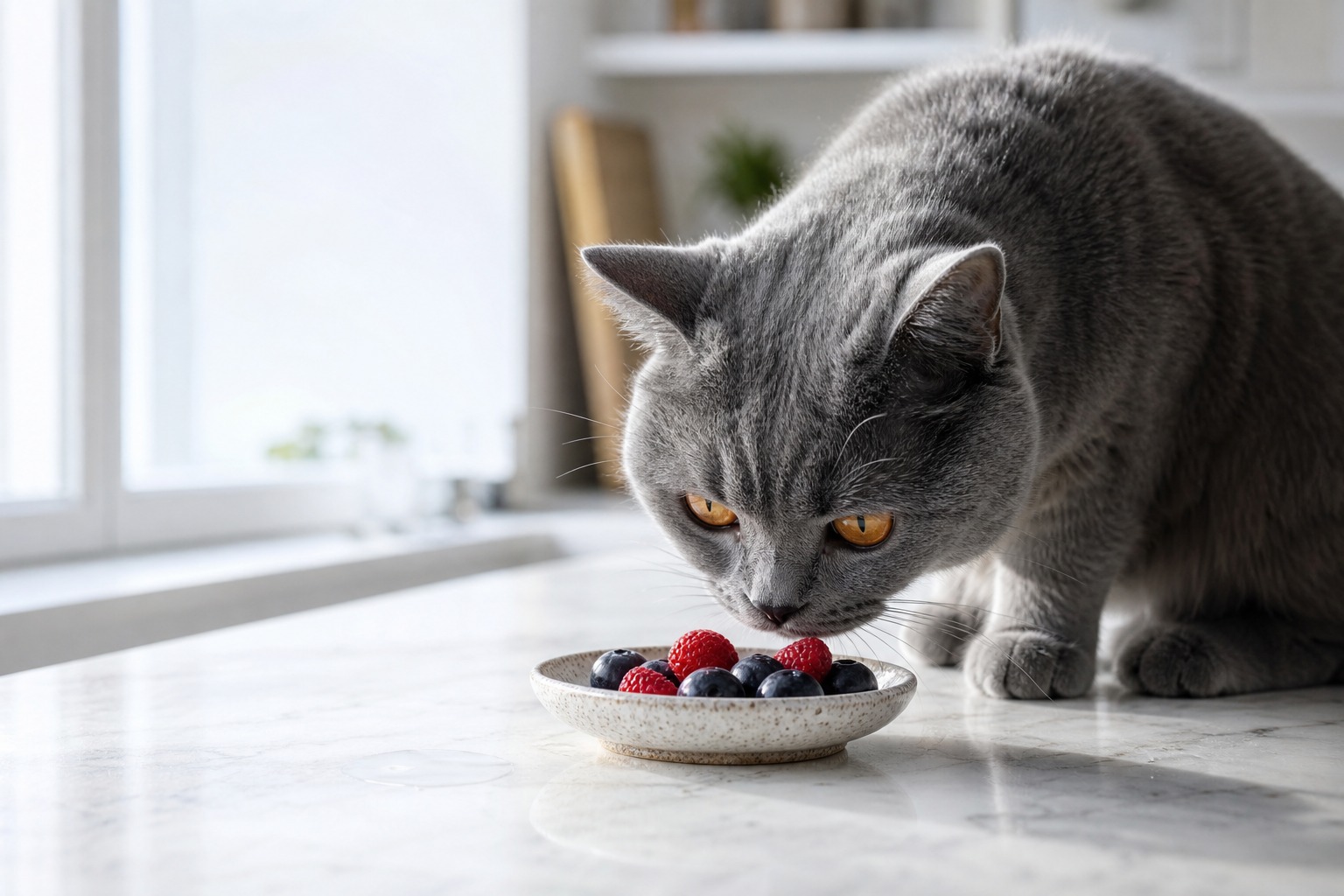
Type “blueberries for cats” into a search bar and you will be told, over and over, that they are a superfood. They are, for you. That word was minted in human nutrition, where blueberries genuinely deliver antioxidants and vitamins to an omnivore that evolved to use them. Your cat is not that animal. Your cat is an obligate carnivore, built to run on meat, and to a cat a blueberry is not a superfood so much as a small, damp, faintly interesting object it probably will not want. The honest verdict is not “yes, this superfood is great for your cat.” It is “yes, it is safe, and no, it is not doing much of anything, and your cat may agree by walking away.”
That is a more useful thing to know than a recycled human health claim, so let us take blueberries from the cat’s point of view.
Your cat can’t even taste the appeal
Start with the most telling fact, because it reframes everything: cats cannot taste sweetness. This is not a preference, it is genetics. The gene that codes for the sweet-taste receptor, Tas1r2, is broken in cats, carrying a large deletion and other disabling mutations that turn it into a non-functioning pseudogene. Without a working sweet receptor, a cat is simply blind to sugar the way we are blind to ultraviolet light.
This trait traces back tens of millions of years, to when the ancestors of modern cats became strict meat-eaters. With no plants to sweeten the diet, the sweet receptor was useless, and evolution let it decay, the same loss has happened independently in other pure carnivores. So when your cat sniffs a blueberry and loses interest, it is not being fussy. The whole reason a blueberry is pleasant to you, its sweetness, does not register for your cat at all.
That is why the superfood framing falls apart at the first step: it assumes a taste and a nutritional need your cat does not have.
Safe, though, and that part is real
None of this makes blueberries dangerous. They are genuinely safe for cats to eat, and there is no toxic compound to worry about. Some commercial cat foods and treats even include blueberries on the ingredient list.
A blueberry poses zero toxicity risk to a cat, and if sharing one amuses you both, go right ahead. What I gently push back on is the idea that it is medicine. A cat is a carnivore. The antioxidants that help us are not something a cat’s body is set up to use the way ours is. Feed a blueberry because it is a harmless novelty, not because you think you are boosting their health.
The blueberry’s human résumé, antioxidants, vitamin C, vitamin K, fiber, is real, but it is a résumé written for omnivores. In a cat, those perks are largely unproven and, in the case of vitamin C, unnecessary, since cats make their own. Safe and pointless can both be true, and here they are.
If you offer one anyway, do it right
Plenty of cats will bat a blueberry around like a toy or take a curious lick, and there is no harm in letting them. A few ground rules keep it genuinely safe:
- Keep it tiny. Treats of all kinds should stay under 10 percent of a cat’s diet. For an animal that size, that is one or two berries, not a handful.
- Cut large berries down, and for kittens, cut or puree them, small airways make a whole berry a choking hazard.
- Fresh only, nothing processed. Skip blueberry pie, scones, pancakes, muffins, and jelly, which carry sugar and sometimes ingredients toxic to cats.
- Introduce it slowly and watch for vomiting, diarrhea, or other stomach upset, as you would with any new food.
And never let a blueberry, or any treat, crowd out the complete, balanced, meat-based food that does your cat’s real nutritional work.
Other fruits, sorted for cats
If you like handing your cat the occasional bit of produce, here is the short, carnivore-aware list.
Safe in tiny amounts (though your cat may shrug):
- Peaches (flesh only, no pit) and strawberries, both fine in small pieces.
- Banana, high in potassium, safe as a rare nibble.
Genuinely off limits:
- Grapes and raisins, toxic to cats and capable of causing kidney problems, avoid entirely.
- Garlic and onion, toxic to cats and damaging to red blood cells, keep all allium away.
- Avocado, too high in fat and best skipped.
The bottom line
Blueberries are safe for cats, and that is where the good news ends and the marketing begins. The superfood label is borrowed from human nutrition and does not transfer to an obligate carnivore who cannot even taste a blueberry’s sweetness and gets its real nourishment from meat. Offer one as a harmless plaything if your cat is curious, keep it to a berry or two, always fresh, and do not expect a health boost that a cat’s biology was never built to receive. If your cat turns up its nose, it is not being difficult. It is being a cat.
References
- Li, X., et al. “Pseudogenization of a Sweet-Receptor Gene Accounts for Cats’ Indifference toward Sugar.” PLOS Genetics. https://journals.plos.org/plosgenetics/article?id=10.1371/journal.pgen.0010003
- Jiang, P., et al. “Major taste loss in carnivorous mammals.” PNAS. https://www.pnas.org/doi/10.1073/pnas.1118360109
- ASPCA Animal Poison Control. “People Foods to Avoid Feeding Your Pets.” https://www.aspca.org/pet-care/animal-poison-control/people-foods-avoid-feeding-your-pets
Common questions
Why doesn't my cat care about blueberries?
Because your cat literally cannot taste their sweetness. Cats carry a broken version of the sweet-taste receptor gene, so the appeal that draws humans to blueberries does not exist for them. A cat that ignores a blueberry is behaving exactly as its biology predicts.
Are blueberries actually good for cats?
The antioxidants and vitamins that make blueberries a human superfood have little proven benefit for cats, who meet their needs through a meat-based diet. Blueberries are not harmful, but do not feed them expecting a health boost.
How many blueberries can a cat have?
Very few. Treats of any kind should stay under 10 percent of a cat's diet, and for a small animal that is one or two berries at most. Cut large berries down, and puree or cut them for kittens, whose small airways make whole berries a choking risk.
Not a substitute for your vet. Our guidance is educational. For urgent symptoms, contact a vet or emergency clinic right away. Editorial standards
Dr. Nair is a veterinarian focused on diet and feeding. She covers everyday nutrition, treats, and the many "can they eat this?" questions owners ask, grounding each answer in what is actually safe and sensible for dogs and cats.
Meet our experts ↗Keep reading
 FoodPopcorn Is Safe for Cats. The Stuff We Put on It Is the ProblemDr. Ravi Mehta · 6 min
 FoodCats Can Eat Eggs. Just Never Raw.Dr. Mara Chen · 4 min
 FoodThe 'Superfood' Strawberry Does Nothing for Your Cat. They Can't Even Taste ItDr. Priya Nair · 5 min
 FoodMango and Cats: The Flesh Is Fine, the Family Tree Is the CatchDr. Nina Kohl · 6 min
 FoodFor a Carnivore, 'Is It Safe?' Is the Wrong Question About Human FoodDr. Priya Nair · 6 min
 FoodCats and Marshmallows: The Bag Your Dog Should Worry About MoreDr. Priya Nair · 6 min