


Cat Wine Is Real, and It's Basically a Catnip Cocktail in a Wine Glass
No grapes, no alcohol, no hangover. Here's what's actually inside those tiny bottles of feline rosé, whether your cat will care, and how to pour one safely.

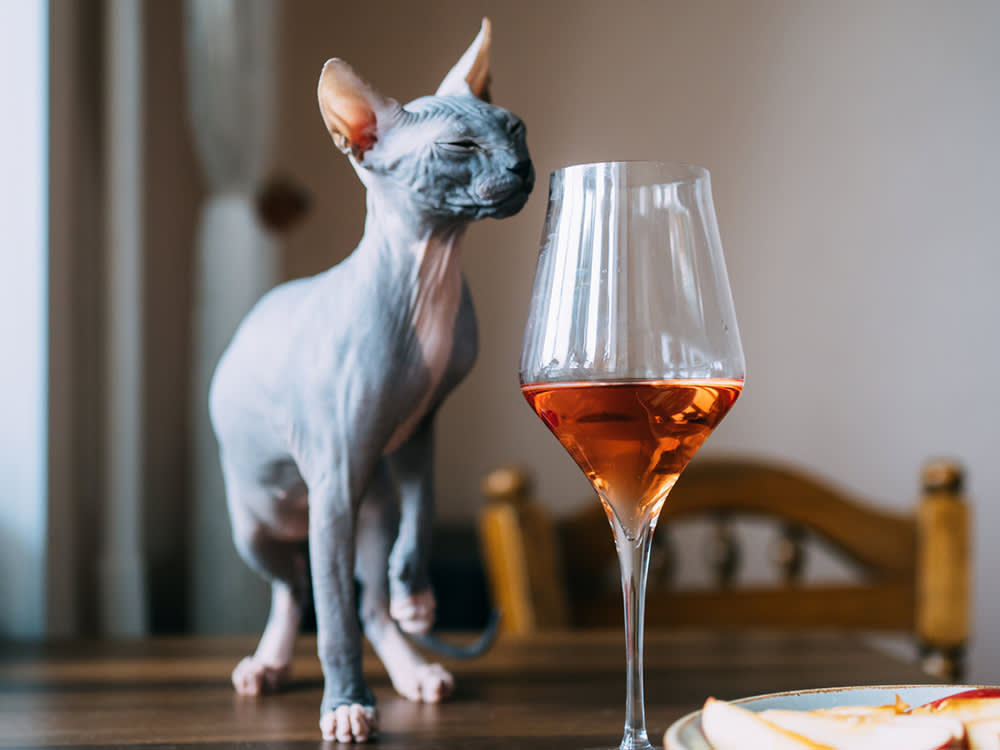
If you have ever looked at your cat across the room during a glass of wine and thought, I wish you could join me, the pet industry has already read your mind and put it in a tiny bottle. Cat wine exists. It has for about a decade. And once you know what is actually in it, the whole thing gets a lot less baffling and a little more charming.
Here is the reframe worth leading with, because the name does all the misleading: cat wine is not wine. It is a catnip drink wearing a cocktail dress. Understanding that one fact tells you everything about whether to buy it, how your cat will react, and how to serve it without worrying.
What’s actually in the bottle
Cat wine is not alcoholic, not fermented, and not made from grapes. Strip away the branding and you are looking at catnip steeped in water, tinted with beet juice to mimic the color of a red or a rosé, sometimes with a pinch of salt or a stabilizer like ascorbic acid. That is it. The “vintage” on the label is theater. The active ingredient is the same herb in your cat’s favorite mouse toy.
The product traces back to around 2015, when a former pet-industry salesman named Brandon Zavala started making it so he could share a social moment with his cat, Apollo. The idea was novelty, and it worked: the little bottles are cheap, usually somewhere in the five-to-twenty-dollar range, they photograph adorably on a shelf, and they scratch an itch that is honestly more about the human than the cat. Dogs already had “beer” and pupaccinos, so it was arguably just cats’ turn.
Whether your cat will actually care
This is where expectations need managing. Cat wine only lands if your cat is wired to respond to catnip, and that is not a given. The catnip response is an inherited trait, and roughly a third of cats simply do not have it. Feed those cats a whole bottle and they will look at you like you have lost it.
For the cats that do respond, the reaction is the familiar one: the mellow, blissed-out, rolling-and-purring routine that regular catnip produces. But do not expect most cats to drink it like a beverage. In practice, a lot of cats get more out of sniffing and face-rubbing the bottle than lapping at the liquid, which makes sense given that catnip’s biggest effect comes through the nose, not the mouth.
How to pour one without worrying
Because the ingredients are simple, an occasional cat-wine treat is low-stakes for a healthy cat, but “simple” is not the same as “unlimited.”
“The thing to remember is that this is a novelty treat, not a supplement or a drink your cat needs,” says Dr. Lena Park. “Read the label the way you’d read any treat, keep the pour small, and make sure real water is always the main thing in the bowl. If your cat has kidney issues, heart disease, or is on a sodium-restricted diet, I’d skip the salted versions entirely and check with your own vet first.”
A few practical guardrails. Keep it treat-sized, a splash rather than a full glass, and offer it once in a while rather than daily. Scan the ingredient list for added salt or anything you do not recognize. And never let a cute bottle displace fresh water, which is the drink that actually matters for a cat’s health. If your cat ignores it, that is not a defect, it is genetics, and you have your answer for free.
What’s new since this was written
The original novelty has settled into a small but durable corner of the pet market. Apollo Peak, the brand that popularized the category with its “Pinot Meow” and “MosCATo” lines after a memorable turn on Shark Tank, still sells cat wine directly, and the concept has spawned plenty of copycats and “pet wine” variety packs from other sellers. The formula has stayed essentially the same over the years: catnip, water, beet coloring, and a wink.
The honest takeaway a decade in is that cat wine remains what it always was, a treat designed to delight the person as much as the pet. If it makes your Friday night a little sillier and your cat gets a catnip buzz out of the deal, everybody wins. Just pour it like the novelty it is, keep the water bowl full, and do not expect your cat to discuss the tasting notes.
References
- Apollo Peak. “World Famous Cat Wine.” https://www.apollopeak.com/catwine
- Espín-Iturbe, L. T., et al. “Active and passive responses to catnip (Nepeta cataria) are affected by age, sex and early gonadectomy in male and female cats.” Behavioural Processes, 2017. https://pubmed.ncbi.nlm.nih.gov/28189821/
Common questions
Is cat wine safe for cats?
For most healthy cats, an occasional serving of a catnip-water product is low-risk, since the active ingredients are just catnip and food-safe coloring. Check the label for added salt or other ingredients, keep it to a small treat-sized pour, and skip it if your cat has health issues or doesn't react to catnip.
Will my cat even like cat wine?
Only if your cat responds to catnip, and roughly a third of cats don't inherit the trait at all. Cats that do respond may lap at it or, more often, get more interested in sniffing and rubbing the bottle than actually drinking.
Jordan Ellis is a certified professional dog trainer with a decade of experience working with rescue organisations and private clients. They specialise in anxiety, reactivity, and positive reinforcement methods, and review all training and behaviour content at The Pet Times.
Meet our experts ↗Keep reading
 FoodBlueberries Are a 'Superfood' for You. To Your Cat, They're Barely FoodDr. Priya Nair · 5 min
 FoodThe 'Superfood' Strawberry Does Nothing for Your Cat. They Can't Even Taste ItDr. Priya Nair · 5 min
 FoodYour Cat Begs for Olives and Cheetos. There's a Chemical Reason Why.Dr. Priya Nair · 7 min
 FoodFor a Carnivore, 'Is It Safe?' Is the Wrong Question About Human FoodDr. Priya Nair · 6 min
 Food'All-Natural' Is Just a Word on the Bag. Read the Ingredients Instead.Dr. Priya Nair · 8 min
 FoodShrimp Is the Rare Cat Treat That's Actually Lean, If You Lose the ShellDr. Priya Nair · 6 min