


Your Cat Isn't Acting Out. The Timing Says It's Anxiety.
A cat who shreds the couch and skips the litter box the moment you leave isn't being spiteful. The clue to real separation anxiety isn't the mess, it's when the mess happens.

Your cat destroyed the couch arm and peed on the bath mat while you were at work. It is tempting to read that as protest, as if your cat waited for you to leave and then took revenge. Cats do not work that way. But the behavior might be telling you something real, and the way to decode it is not to look at what your cat did. It’s to look at when.
That single question, “did this happen while I was home or only while I was gone?”, is the most useful diagnostic tool a cat owner has for separation anxiety. It separates a bored cat from an anxious one, and it separates both from a cat with a medical problem. Everything else follows from it.
First, what separation anxiety actually is
Separation anxiety is when a pet becomes genuinely distressed at being apart from its person. In cats, it is easy to misname as loneliness, but that is not quite it. It is closer to over-dependence: the cat has built its sense of security so tightly around one caretaker that the caretaker’s absence tips it into real stress.
We can’t ask a cat how it feels. What we can do is watch behavior and body language, which is how we infer that a cat is struggling rather than simply misbehaving.
Owners hear ‘anxiety’ and picture a sad, clingy cat, but what we’re really describing is a cat whose entire safety system is wired to one person. When that person walks out the door, the cat doesn’t feel lonely so much as unmoored, and the behavior you find later is the fallout from that.
The timing test, in practice
Here is why timing matters so much. A cat who over-vocalizes, scratches furniture, and demands attention while you are sitting right there is almost certainly bored or looking for engagement, not anxious. The same cat doing those things only in your absence is a different story. And a cat doing them constantly, whether you are home or not, may not have a behavior problem at all, but a medical one, and that cat needs a vet.
So before anything else, figure out the pattern. The signs that point toward separation anxiety, when they cluster around your departures, include over-vocalizing, pacing, over-grooming, loss of appetite, destructive behavior like aggression or furniture scratching, eliminating outside the litter box, and low or depressed energy. Any of these showing up around the clock is a flag to rule out illness first.
What tips a cat into it
Separation anxiety seems to have a temperamental component, and some cats are simply wired to form intense attachments, like a single bottle-fed kitten raised without littermates. On top of that baseline, specific life events can trigger or worsen it.
Being left alone is the obvious one, and cats vary enormously in how long they cope, from an hour to several days. The loss of a family member matters too; cats notice and respond to the absence of a person or another pet, and because they read our moods, their distress can deepen when we are grieving the same loss. Moving upends the familiar places and smells a cat relies on for security, throwing it back onto human company for reassurance. A change in daily routine can do it, because cats prize their routines as much as their territory. Breed plays a role, with Siamese and Burmese cats more prone to it, likely because they tend to be more codependent with their humans. And age is a quiet factor: senior cats losing hearing or vision, or developing cognitive decline that works like feline Alzheimer’s, cope less well with change and time alone.
How to actually help
The core technique is desensitization: gradually stretching the time your cat spends alone, starting with absences short enough that they don’t upset your cat and building from there. Around that, a handful of moves make solo time easier.
Stop the dramatic goodbye. The most common mistake, made with the best intentions, is smothering your cat with attention right before you leave, which only makes the contrast of your absence hit harder. Skip the fussing, don’t rattle around collecting your things, and just leave calmly. Save the affection for when you get back.
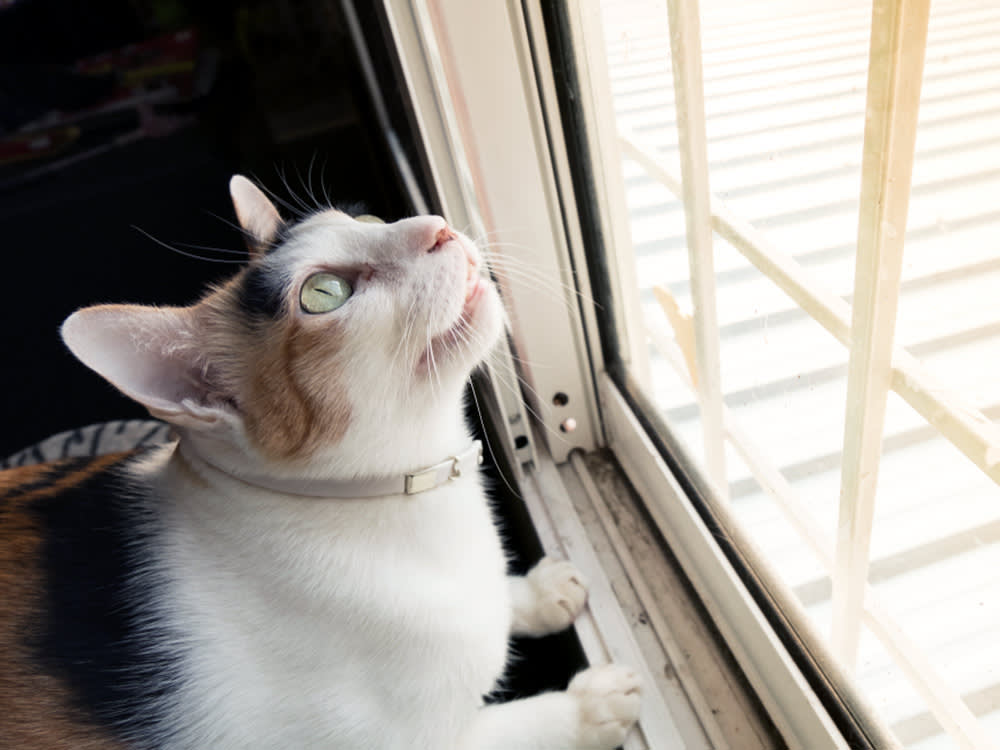
Build a richer environment. Food puzzles, bird videos, scratching posts, and window perches all cut stress by giving a cat something to do. Cat trees and enclosed “igloo” beds help too, especially with a worn piece of your clothing tucked inside, because cats feel secure both up high and in cozy hidden spaces.
Set a calming scene. There is music composed specifically to soothe cats, built from purrs, suckling sounds, and other friendly feline signals, and it pairs well with synthetic pheromones that mimic a cat’s own calming scent marks. If you’re considering calming treats, liquids, or CBD products, clear them with your vet first, since anything going into your cat’s body deserves a professional’s sign-off.
Bring in backup. A good pet sitter, found through a neighborhood network or a service like Rover or Meowtel, can break up a long absence with a short visit or stay over entirely, adjusting to what your cat needs.
The second-cat trap
The instinct to “get them a friend” is understandable and often wrong. Your anxious cat does not miss you because it is lonely for feline company; it misses you because it is over-attached to you. Dropping a strange cat into that dynamic can raise the stress level rather than lower it. It works for some households, but it is not a dependable cure, and it is a big, hard-to-reverse experiment to run on a hunch.
What newer research adds
For a long time, separation anxiety was treated as basically a dog problem, and plenty of people still insist cats are too independent to feel it. The research says otherwise. A questionnaire study of pet cats found that roughly 13 percent met the behavioral criteria for separation-related problems, a rate that is hard to dismiss as rare.
That same work put numbers on what the distress looks like, and the ranking is useful: destructive behavior was the most commonly reported sign, followed closely by excessive vocalization and inappropriate urination, then apparent depression, with aggression and agitation less common. It also flagged risk factors worth knowing, including homes without toys available and cats living without another animal, which lines up neatly with the enrichment-first advice above. The picture that emerges is not a fragile, needy cat, but a normal one whose environment and attachments can be adjusted to make time alone genuinely easier.
References
Common questions
Do cats really get separation anxiety?
Yes. It is less studied than the dog version, but research confirms cats can develop genuine separation-related distress. It tends to be over-dependence on a specific person rather than simple loneliness.
How do I know if it's anxiety or just boredom?
Look at the timing. Boredom behaviors like meowing, scratching, and demanding attention happen while you are home. Separation anxiety behaviors happen when you are away. Same actions, different trigger.
Will getting a second cat fix it?
Usually not. Your cat is attached to you, not craving any feline company, so a new cat can add stress instead of relieving it. It works for some households but is not a reliable fix.
Dr. Kohl is a board-certified veterinary dentist with a particular interest in preventive oral care. She reviews all dental health content at The Pet Times and contributes practical guides on home dental routines, professional cleaning, and oral disease prevention.
Meet our experts ↗Keep reading
 TrainingYour Cat Keeps Running Off. The Fix Is to Chase LessLeila Torres · 8 min
 LivingYour Cat's Stress Isn't Emotional. It's Sensory.Dr. Mara Chen · 8 min
 Health & WellnessYour Cat Isn't Being Spiteful. Almost Every 'Bad Cat' Behavior Is Anxiety.Dr. Priya Nair · 9 min
 TrainingYour Cat Is Probably Securely Attached. Here's Why That's the Useful PartNina Vasquez · 5 min
 TrainingThat Adorable Chirping Is the Sound of a Cat FailingDr. Nina Kohl · 7 min
 TrainingThe Cat-Anxiety Mistake That Actually Gets Cats KilledDr. Amara Solis · 8 min