


Your Cat's Stress Isn't Emotional. It's Sensory.
People look for the big upsetting event. Cats are usually reacting to a house you literally cannot perceive: sounds three octaves above your hearing, smells fourteen times stronger than yours. Seven triggers, most of them invisible to you.

Affiliate disclosure. This article contains affiliate links. We may earn a small commission if you buy through a link, at no extra cost to you. How we handle recommendations.
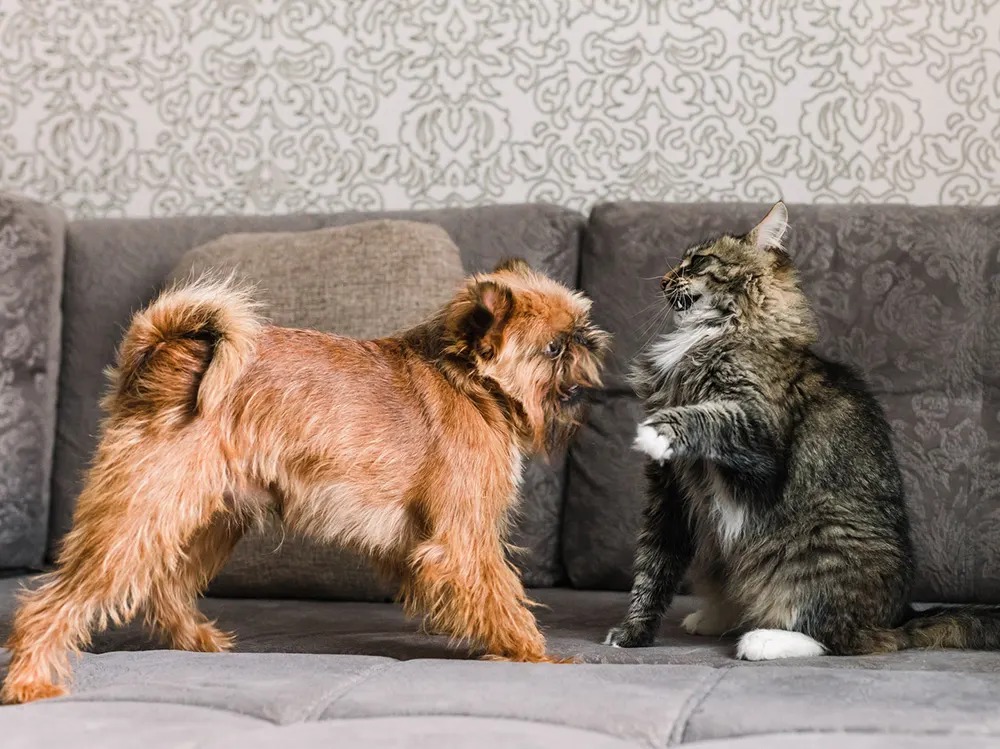
When someone tells me their cat seems stressed, the first thing they do is look for a reason a person would find stressful. Did we move? Did someone new arrive? Did something bad happen?
Usually the answer is no, and that’s where people get stuck. They conclude the cat is being dramatic, or that it’s “just how she is.”
Here is the reframe that fixes most of these cases. Your cat is not living in your house. Your cat is living in a version of your house that has three times your hearing range and roughly fourteen times your sense of smell, layered over a species that reads its whole environment as a territory to be defended. The stressors are not emotional events. They are sensory ones, and they are running all day, in a register you cannot detect.
Once you accept that, the fixes get very concrete. Here are the seven that come up most.
1. The sounds you can’t hear
Cats hear far above the human ceiling. That fact usually gets deployed to explain why they hate the vacuum, which is fine, but the vacuum is the easy one. You know when the vacuum is on.
The interesting part is the constant, low-grade stuff. The high whine of a dimmer switch. The whistle of a phone charger. The hum of a refrigerator compressor, a laptop fan, a monitor, a smoke detector with a battery going soft. To you, that’s silence. To a cat, that’s a room with a noise in it, and if the noise is next to the litter box or the food bowl, they are being asked to do something vulnerable inside a nuisance.
Practical version: don’t put the litter box, the food, or a favorite sleeping spot next to the fridge, the washer, the boiler, or the electrical panel. Nothing else on this list is that cheap to fix.
2. The smells you think are pleasant
The scented candle, the plug-in diffuser, the perfume you spritz on your way out the door, the lavender fabric softener. Your cat’s nose is roughly fourteen times more sensitive than yours. What reads to you as a nice ambient note reads to them as being locked inside it.
Some of this is beyond irritation and into genuine risk. Ammonia and hydrogen peroxide in cleaning products are harsh on feline eyes and airways. Essential oils are worse: cats lack an efficient liver pathway for clearing certain compounds, and oils can be absorbed through the skin or licked off the fur, with liver, respiratory, and neurological consequences at doses that seem trivially small. Tea tree oil is the classic offender, but it is not alone.
If you want a good-smelling home and a comfortable cat, the honest answer is that you get less of the first than you wanted. Ventilate, keep diffusers out of the rooms your cat lives in, and use unscented or pet-safe cleaners on the surfaces they walk on and then groom off their paws.
3. Furniture, which you moved, which was theirs
You bought a new sofa. You feel great. Your cat has just watched a large portion of their territory’s scent map be deleted and replaced with a foreign object that smells like a warehouse.
Cats mark their space by rubbing scent from glands on their cheeks and flanks onto its edges. That scent is the wallpaper of their sense of safety. Redecorating, rearranging, and yes, moving house, wipes it. This is why the cat who was fine last week is suddenly peeing on the new rug: not spite, not protest, just a territory that has stopped saying “yours.”
Go gradually where you can. Introduce one new thing at a time. Let them rub on it. Keep the old cardboard scratcher even though it is hideous, because it is soaked in their own signature.
4. A routine that’s yours, not theirs
Cats build strong expectations around when things happen and are visibly worse off when those expectations break. This does not mean you owe your cat a 6am alarm for the rest of your life. It means the more predictable you can be about the anchor points, particularly food and the time you tend to be home, the more slack the cat has for everything else.
People hear ‘cats need routine’ and think it means they can never sleep in. It doesn’t. It means the cat is running a prediction all day, and every time the prediction holds, they spend a little less energy on vigilance. Be boring where it’s cheap for you to be boring, and they’ll forgive the rest.
5. The other pets, and specifically the speed of them
Cats can absolutely live in social groups. What they are not is a pack species, and the mismatch shows up most in tempo. A dog housemate’s play style is fast, loud, and frontal. Even a dog with no intention of harming the cat produces a stream of sudden movements and barking in a home where the cat has to eat, drink, sleep, and use a litter box.
Two rules cover most of it. First, introduce slowly, on the cat’s clock, with barriers and separate spaces, and don’t rush the first face-to-face because it’s inconvenient. Second, and more permanently: the cat needs escape routes that the dog physically cannot follow. Vertical space, a baby gate the cat can clear, a room that is theirs. A cat with a reliable exit is a calmer cat even when they never use it.
6. Multi-cat resource math
If you have more than one cat, most “personality conflict” is actually a resource shortage that looks like a personality conflict. Two cats and one litter box in one location means one cat can control access to the only place the other one is able to relieve themselves. That is not a housemate problem, that’s a hostage situation.
The standard guidance is one litter box per cat plus one extra, in separate locations, and the same logic applies to food bowls, water, resting spots, and scratching posts. Separated, not just multiplied. Two bowls side by side are one resource.
7. Being looked at, held, and loved incorrectly
The visitor who scoops up a cat who does not want to be scooped is doing something to that cat’s nervous system, no matter how much they love cats. Sustained direct eye contact is a threat signal. Overhead approaches are a predator’s approach. Cornering a cat with affection is cornering a cat.
Let the cat initiate. Offer a hand and let them close the distance. If they leave, they get to leave. This is not indulgence, it’s the mechanism by which the cat learns you are safe.
How to tell whether any of this is landing
Cats broadcast stress with a fairly consistent set of signals, and they are easy to misread as bad behavior. Overgrooming, sometimes to a bald patch on the belly or thigh. Peeing or pooping outside the box. Eating notably more or less. Hiding for stretches that are new for them. More vocalizing, or, in a chatty cat, less. Aggression that arrives without an obvious trigger.
If you are seeing those, the first stop is a vet, because pain and illness produce every single one of those signs and a stressed cat and a sick cat look identical from the couch. Once medical causes are cleared, work down this list.
What newer research adds
The most useful development in feline behavior over the last decade is not a study, it’s a framework: the Five Pillars of a Healthy Feline Environment, published jointly by the American Association of Feline Practitioners and the International Society of Feline Medicine, and now the basic architecture behind how vets think about cat stress.
The pillars are worth having in your head, because they turn “my cat is stressed” into a checklist. Provide a safe place. Provide multiple, separated key resources — food, water, litter, resting, scratching. Provide opportunity for play and predatory behavior. Provide consistent, predictable, cat-initiated human interaction. And respect the cat’s sense of smell, which is the pillar most people have never heard and the one this whole article keeps landing on.
The other thing worth knowing is that the “untrainable, aloof cat” premise most of this stress is filtered through is simply wrong. Cats train readily with food and a clicker, and a trained cat is a cat with agency, which is itself a stress reducer. If you want the long version, the veterinary behaviorists behind Decoding Your Cat wrote the book on it, and it holds up.
References
- AAFP and ISFM Feline Environmental Needs Guidelines — American Association of Feline Practitioners / International Society of Feline Medicine.
- Essential Oils and Cats — ASPCA Animal Poison Control Center.
- Heffner, R. S. & Heffner, H. E., “Hearing range of the domestic cat,” Hearing Research — 1985.
- AAFP Feline-Friendly Handling Guidelines — American Association of Feline Practitioners.
Dr. Chen is a small-animal veterinarian who leads health and safety coverage at The Pet Times. She writes and reviews the bulk of our illness, condition, and safety content, translating clinical guidance into clear, practical advice owners can act on at home.
Meet our experts ↗Keep reading
 TrainingThat Old Sweater Isn't Comforting Your Cat. It's Just Soft.Dr. Mara Chen · 8 min
 FoodYour Cat Won't Eat Without You. That's Sweet Until It Isn't.Dr. Nina Kohl · 7 min
 TrainingYour Cat Isn't Guarding You in the Bathroom. They Hate the Door.Dr. Nina Kohl · 6 min
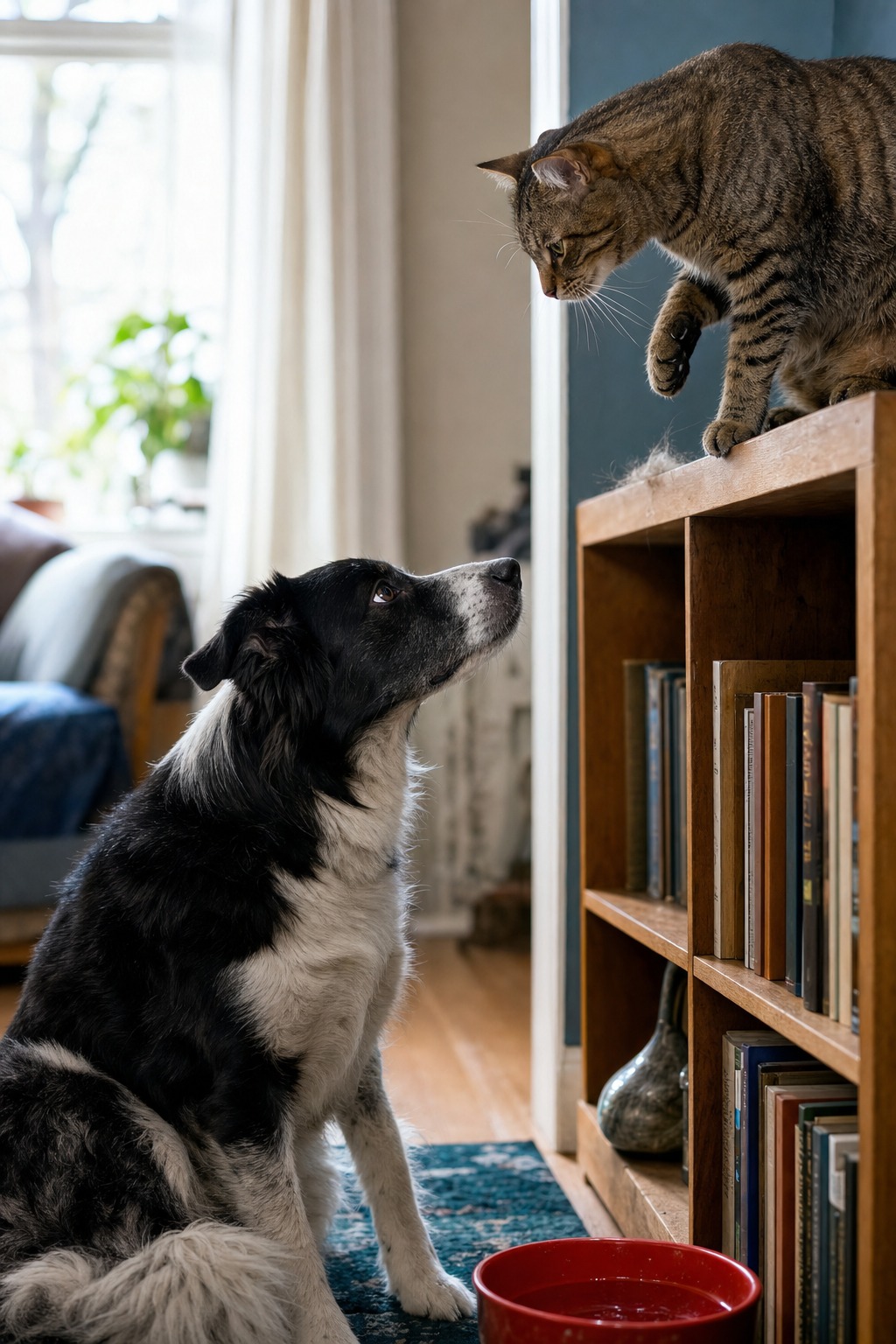 First DaysOne Bad Meeting Can Undo Everything: How to Introduce a Nervous Cat to a DogDr. Lena Park · 9 min
 First DaysHer Cat Hid Under a Dresser for Months. That Was the Adoption Working.Dr. Amara Solis · 7 min
 TrainingYour Cat Isn't Being a Jerk When They Swat Things Off the Table. They're Running an Experiment.Dr. Nina Kohl · 5 min