


Her Cat Hid Under a Dresser for Months. That Was the Adoption Working.
The founder of a cult fashion label adopted a tuxedo cat who disappeared for months and became the reason she stayed. Most people would have called that a failed match by week three.

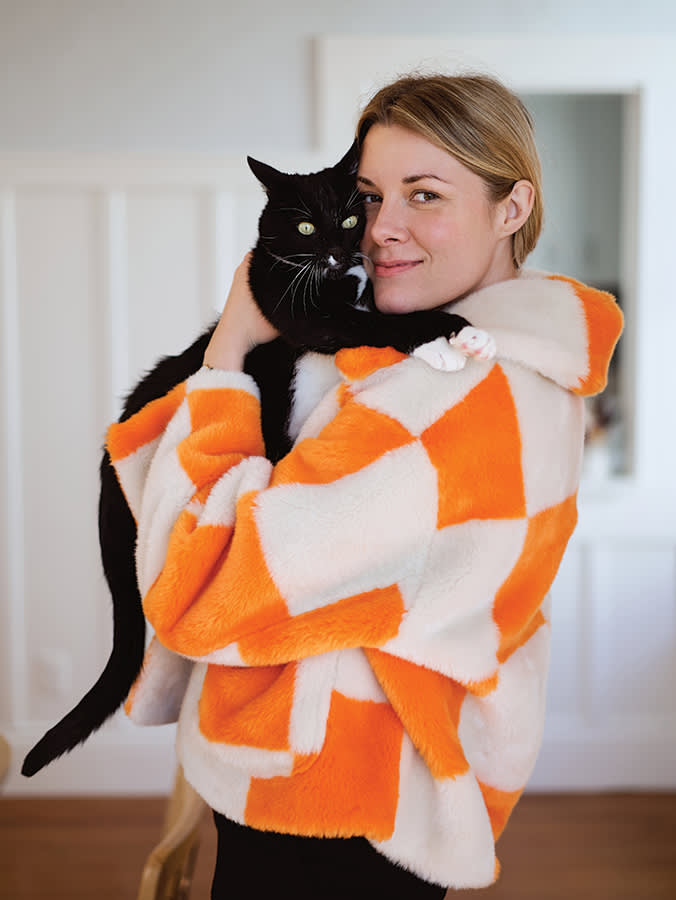
The most common way to fail a shelter cat is to be reasonable about it.
You bring home an adult cat. It vanishes. It stays vanished, under a bed or behind a dresser, for a week, then two, then a month. It comes out at 3 a.m. to eat and use the box and then it is gone again. You did everything right. You made it a room, you sat on the floor, you spoke softly.
And at some point a completely sensible thought arrives: this isn’t working. This cat doesn’t like it here. Maybe it would be happier somewhere else.
That thought is the failure. Not the cat.
Months, not weeks
Lisa Bühler founded Lisa Says Gah!, the independent fashion label with nearly 600,000 followers, a first store in Echo Park, and a reputation as one of the few brands that got bigger during 2020 while everything around it closed.
She got the cat first, more or less. She had left a buying job at NastyGal, moved to San Francisco in the summer of 2014, had no job, and started building the business that fall. It launched at the end of January 2015. Somewhere in there she and her now-husband Louis went to the SPCA to “consider” a cat and came home with George, a tuxedo.
George was not a kitten. He was about a year and a half old, which means he already had a past, and nobody knew what was in it.
He hid under the dresser for months.
Not days. Months. Bühler is entirely matter-of-fact about it: he took a long time to feel comfortable, and he was slow to warm up.
She did not return him. And the cat who came out from under that dresser turned out to be the animal that made a new city feel like a home. She has said that getting George was what made the move official, that he was what made the place a family.
Nine years later he is shy, extremely sweet, will let you scratch his belly without retaliating, is gentle in play, and does not scratch. He is also, when a bird once got into the house, capable of launching across a room in a state she describes as pure National Geographic.
That cat was always in there. He just needed considerably longer than anyone tells you.
What is actually happening under the dresser
The hiding is not rejection, and it is not depression. It is a nervous system running a completely appropriate program.
A cat’s entire safety model is built on a known territory: known exits, known smells, known sounds, known heights. Adoption deletes all of it at once. Every single reference point the animal used to decide whether it was safe is gone, replaced with a space that smells of strangers.
A cat in that situation does the only rational thing available: it finds the smallest defensible space in the environment and does not leave it until it has enough information to conclude the space is not lethal.
Gathering that information takes as long as it takes. For a confident cat with a good history, days. For an adult with an unknown past, weeks. For some cats, and George is one, months.
The cruelty is that everything you instinctively want to do makes it longer. Pulling them out to show them the house. Sitting near the hiding place and staring at it. Picking them up to “reassure” them. Each of those confirms the hypothesis the cat is testing, which is that this place contains a large creature that will corner them.
“Every week a cat spends hiding is a week it’s collecting evidence, and you don’t get to speed up the evidence,” says Dr. Lena Park. “What you can do is make sure the evidence it collects is boring. Boring is the goal. A cat that decides your house is uneventful will come out. A cat that keeps being surprised will not.”
The protocol, in order
You will see the “3-3-3 rule” repeated everywhere: three days to decompress, three weeks to settle, three months to feel at home. It is a decent slogan and a bad timetable, because it makes people panic at week four. Treat it as a floor, not a ceiling. George blew through all of it.
What actually helps:
One room, not the house. A small, quiet, closable room with the litter box, food, water, and at least two hiding spots. Not the whole home. A cat cannot map a house it is terrified of.
Two hiding spots, deliberately provided. A covered bed, a cardboard box on its side, the underside of a chair. If you provide the hiding place, you know where the cat is, and the cat learns that hiding is permitted rather than stolen. Never block the hiding spot. Never extract the cat from it.
Height. A shelf, a cat tree, the top of a dresser. Vertical space is worth more to a frightened cat than floor space, because up is where a cat feels safe looking down from.
Be present and profoundly boring. Sit in the room. Read out loud, quietly. Do not look at the cat. Do not approach the cat. Do not reach. Let your existence become the least interesting thing in the room.
Feed on a rigid schedule and, at first, leave the room while they eat. Then stay, further away than you want to be. Then closer. This is the whole relationship, built in inches.
Let them come to you. The first contact must be the cat’s decision, or it is not contact, it is an ambush. Bühler’s account of picking George at the shelter is instructive: they had just seen a wild, energetic cat, and then George came out slowly and was sweet. Slowly. He was doing it on his own terms in the shelter, and he did it on his own terms at home.
Do not add pressure to hit a deadline. There is no deadline.
Two things people get wrong about cats and babies
Bühler now has two young children, and her account of how George handled them is a useful correction to a piece of folklore that will not die.
She heard the usual warning: be careful, your cat will get in the crib and scratch the baby. It did not happen. What actually happened is that when she was nursing, George would come and sit nearby, on guard. Her read is that he registered vulnerability and posted up.
The “cat smothers the baby” story is folklore, and it has been circulating in essentially unchanged form for a couple of hundred years. Cats do like warmth and elevated resting places, so a crib is not inherently uninteresting to them, and basic hygiene arguments for keeping a cat out of the crib stand on their own. But the smothering myth is not a documented phenomenon, and it has cost an enormous number of cats their homes.
The real issue arrives later, and Bühler names it exactly: toddlers. A cat that was fine with an infant may become nocturnal when the infant becomes a small, fast, loud creature that runs, pokes, and shrieks. George has. Her hope is that as the kids gain control of their own bodies he will come back around, and that is the right expectation. A cat withdrawing from toddlers is not a behavior problem. It is a cat correctly assessing that toddlers are unpredictable, and giving them room. Give the cat an escape route the children cannot follow into, and this resolves itself with time.
Also: don’t dress them up
Bühler’s brand did a pet sweater collaboration with Little Beast, a green check design, one human version and one dog version, and it sold out the same day it launched. She has been clear it will now be a regular category, with more colors and prints.
Asked whether George wears one, her answer is honest and quietly instructive. He would look great in it. There was a shark costume one Halloween that he tolerated for a stretch. But her own observation is the telling one: drop so much as a leaf onto that cat and he goes rigid, because as far as he is concerned something has just landed on him.
That freeze is not tolerance. It is a stress response, and it is the single most misread thing in every pet-costume photograph ever taken. A cat who stops moving in a costume is not accepting it. It is doing the only thing it can think of.
She reads it correctly and does not push. That is the same instinct, exactly, that let her wait out the dresser.
What’s new since this was written
The evidence on adoption timelines has firmed up in the direction of patience. Work on shelter-cat stress consistently finds that hiding is not a sign of a poor match but a normal coping behavior, and that cats given adequate hiding opportunities show lower stress and adapt faster than cats denied them. The counterintuitive conclusion, now fairly well supported, is that giving a frightened cat a better place to hide gets it out from hiding sooner.
What has not changed is the shape of the failure. Cats returned to shelters in the first month are frequently returned for “not bonding” or “hiding all the time,” which is to say they are returned for behaving exactly the way an adult cat behaves in week three of the most disorienting event of its life.
If you are somewhere in that window right now, staring at a dresser: that is not a broken adoption. It is the adoption.
References
- Vinke, C.M., Godijn, L.M., & van der Leij, W.J.R. “Will a hiding box provide stress reduction for shelter cats?” Applied Animal Behaviour Science, 2014. sciencedirect.com
- International Cat Care. Helping a Cat Settle Into a New Home. icatcare.org
- ASPCA. Cat Behavior: Fearful Cats. aspca.org
- Shelter Animals Count. 2025 Annual Data Report. shelteranimalscount.org
Dr. Solis is a board-certified veterinary dermatologist with over twelve years of clinical experience. She advises on skin conditions, allergies, and grooming practices that affect coat and skin health. All dermatology and allergy content at The Pet Times is reviewed by her team before publication.
Meet our experts ↗Keep reading
 First DaysYour New Cat Is Going to Vanish. Plan for That, Not the Homecoming PhotoDr. Priya Nair · 10 min
 First DaysNew-Pet Chaos Isn't Bad Behavior. It's a Conversation You're Both Losing.Dr. Ravi Mehta · 8 min
 First DaysYou Want a Dog. You Have a Cat. Here's How to Not Blow It.Dr. Nina Kohl · 10 min
 First Days'Fighting Like Cats and Dogs' Is a Myth. Bad Introductions Aren'tDr. Amara Solis · 6 min
 First DaysBy the Time Your Cats Are Hissing, You Blew the Introduction Three Steps AgoDr. Mara Chen · 9 min
 First DaysYour Older Cat Doesn't Hate the Kitten. It Hates the Energy.Dr. Priya Nair · 7 min