


Blondshell Trained a 62-Pound German Shepherd Into a Lap Dog. That's No Accident
The indie musician Blondshell calls Chinchilla a "62-pound lap dog," but he didn't start that way. The story of how she got there is a quiet lesson in shaping a high-drive dog's behavior on the road.
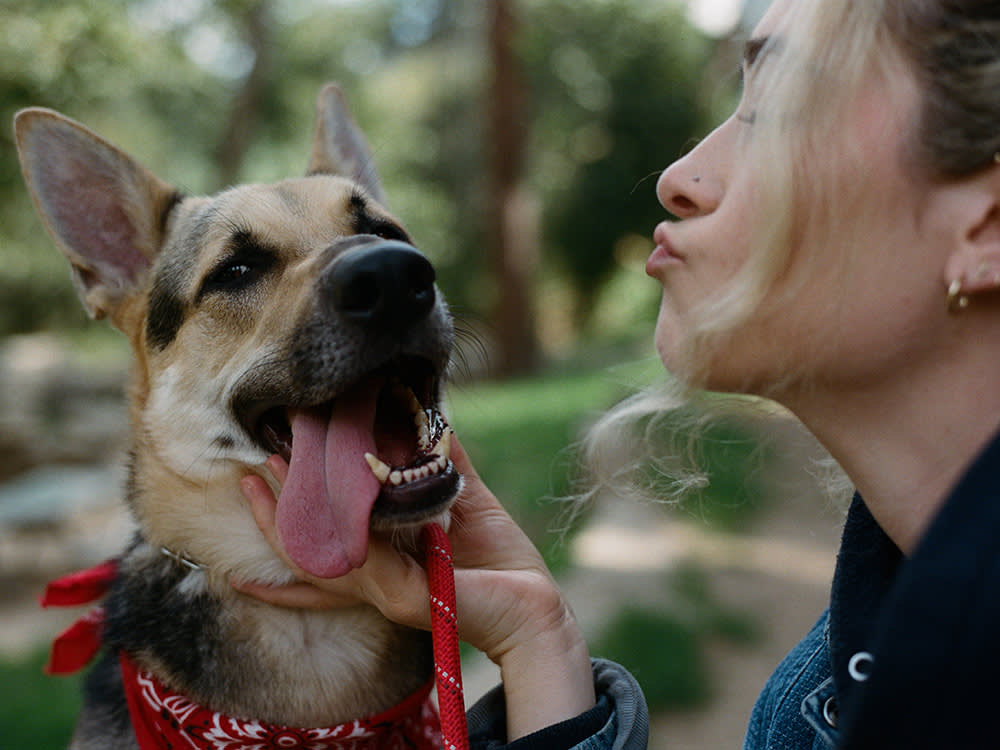
When Sabrina Teitelbaum, the indie musician the world knows as Blondshell, describes her German Shepherd Chinchilla as a “62-pound lap dog,” it sounds like a cute exaggeration. It is actually a small training story hiding in plain sight. Chinchilla was not a cuddler when she got him. He became one, on purpose, through exactly the kind of patient, reward-based shaping that behaviorists recommend and that most owners never realize they are doing. So while this is a conversation about a whirlwind year, a debut album, a headlining tour, an opening slot for Liz Phair, the thread worth pulling is how a self-described “crazy dog person” turned a routine-bound working breed into a snuggler without ever forcing it.
It started, fittingly, with a lap. A couple of years back, Blondshell tagged along when a guy she was talking to went to adopt a puppy, and the 10-pound German Shepherd who curled up in her lap sealed two relationships at once. “We like to joke that Chilla sealed the deal,” she tells us. Both stuck.
The lap dog was made, not born
The most useful thing in this whole interview is buried in an answer about cuddling, so let’s lead with it. Chinchilla, like a lot of Shepherds, is wired for routine and not naturally inclined to be handled while he sleeps. Blondshell changed that gradually.
On TikTok you called him a “62-pound lap dog.” Was he always like this?
He’s not by nature, but I wore him down. When we got him, he was really not snuggly at all. He would fall asleep, and I would try to pick him up to hold him while he was sleeping. Then he would wake up and move. He didn’t want to be a lap dog, but I think I conditioned him. And now he is. I think it was like training, like positive reinforcement.
She is more right than she may realize. What she describes, repeatedly pairing closeness with calm, low-pressure, rewarding moments until the dog reassociates being held with something good, is shaping. It works precisely because she never flooded him or forced it; she let him opt in over time. That is the same principle behind teaching any behavior with rewards instead of pressure, applied to affection rather than a sit. For a breed that values predictability, the slow version is the version that sticks.
Managing a working dog’s energy on a musician’s schedule
The other through-line is energy. A Shepherd needs a lot of it spent, and Blondshell’s life is not a steady nine-to-five, so she has had to get inventive.
When you’re home, what does Chinchilla’s day look like?
There’s not a really specific routine, so it changes. But he has his things. He’s a big park guy. He loves long walks. He requires a lot of exercise. I’m always trying to learn new ways to tire him out. I learned this the other day, do you know the food-in-the-towel thing?
I don’t. Walk me through it.
For dogs, since their main sensory thing is their nose, it tires them out to do a lot of sniffing because it takes up a lot of brainpower. You lay out a towel, put dog food on it, roll it up, and tie it in a knot, so they’re constantly smelling it and working to get to the food. They have to work to get the towel undone, and it takes a long time. I’ve learned these smart ways to get around his huge need for exercise and just get his energy out.
That instinct is exactly right, and worth underlining for any high-drive-dog owner reading: scent work is one of the most efficient ways to tire a dog, because processing smells is real cognitive labor. The rolled-towel puzzle she stumbled onto is a homemade snuffle mat, and a five-minute version of it can take the edge off a dog who would otherwise need a much longer walk. For a touring musician, mental exhaustion you can deliver in a hotel room is gold.
His favorite thing in the world?
The beach. We go to Malibu. I think it’s the sensory thing, saltwater in the air, birds. When we were there for my birthday in the spring, we came across a pack of Golden Retrievers, like five of them and a family. He tried to join. Some of them were nice, but they were kind of like, “This is our path.” He’s just a really, really sweet dog. He wants to be with everybody.
Life on the road, with the dog at home
This is a massive touring year. Where does Chinchilla land while you’re away?
He stays with my boyfriend. I can’t take him, first because it’s just not the right conditions, we’re in a van, but also he’s almost 70 pounds and he isn’t the type of dog to be excited about traveling. He’s very focused on his routine and wants to be in the same place every day doing the same stuff.
That is a genuinely responsible read of her own dog. Not every dog is a travel dog, and a routine-anchored Shepherd in a touring van is a recipe for a stressed animal. Knowing that about him is its own kind of good ownership.
How do you stay connected on the road?
I’m constantly asking for pictures. I FaceTime. I’m always like, “Can you put him on?” And my boyfriend knows who the “him” is. One of the hardest things about touring is being away from the people you love.
How would you sum up the year you’ve had?
Really exciting, very fast-paced. I’ve been on four tours in the last year. The first song came out in June of last year, but time doesn’t make much sense because I haven’t been home much. I’m gone six months, then home three.
The Liz Phair tour, did she reach out directly?
She didn’t call me. She heard the music and tweeted about it when the first song came out, which was kind of crazy because it was the first week I’d put the music out and I didn’t know how it was going to go. I was like, “Oh, it’s Liz Phair.” I think we probably said, “What if I open?” and she said, “Okay, yeah.”
The dog who doesn’t care about the charts
Have you ever written a song about Chilla?
I’ve tried. Good songs usually have conflict, and there’s just no conflict in my relationship with my dog. There’s no darkness. You always want to write about your dog because you love them so much, but it typically doesn’t make for the best songs. You’ll probably hear him on the next album, though, fun cameos.
So album two is in motion?
I’m starting to demo. It’s really early, but I’ve been writing, and Chilla pops in, because if you’re talking about your life, I’m always with my dog. He’ll sit next to me and smell the guitar while I practice. He’s unfazed by the music, which is nice. So much of being a musician gets wrapped up in identity and praise, so having someone who’s a huge part of your life and doesn’t care about any of that is grounding.
Does that help with nerves?
Yeah. I get nervous for shows sometimes, but something that’s helped this year is thinking, “This dog would have no idea if it was the world’s worst performance. If this was the end of music for me, my dog wouldn’t care.” That’s really comforting.
Which, in a way, brings the whole thing back around. The dog she patiently turned into a lap dog returns the favor by being completely indifferent to the part of her life that causes the most anxiety. She shaped him into a snuggler; he keeps her steady. Not a bad trade for a rolled-up towel and a lot of slow, gentle conditioning.
Nina Vasquez writes about life at home with pets and the relationships at the heart of it. Her work covers day-to-day living, people-and-pet stories, and the products that fit into a real household, with a warm, grounded take on everyday pet ownership.
Meet our experts ↗Keep reading
 LivingYour Dog Doesn't Love Grandma Because She's Family. Here's What They Respond ToLeila Torres · 6 min
 LivingPhotograph Your Dog Like a Portrait, Not a Snapshot: Lessons From Winnie AuJordan Ellis · 9 min
 LivingA 'Soul Dog' Isn't Magic. It's Fluency, and You Can Build It.Jordan Ellis · 8 min
 TrainingYour Dog Doesn't Know What 'Family' Means. They Know Exactly Who's in Their Group.Dr. Nina Kohl · 5 min
 LivingThis Painter Takes His Rescue Dog Everywhere, Even the GalleryLeila Torres · 5 min
 LivingThe 6 Cities With More Dogs Than Kids Share One Thing (Not What You Think)Jordan Ellis · 4 min