


Your Dog Doesn't Love Grandma Because She's Family. Here's What They Respond To
Dogs lose it over 'grandma's house,' but they have no concept of your family tree. The grandparent bond is really a window into how dogs attach at all: to individuals, through presence and predictability.

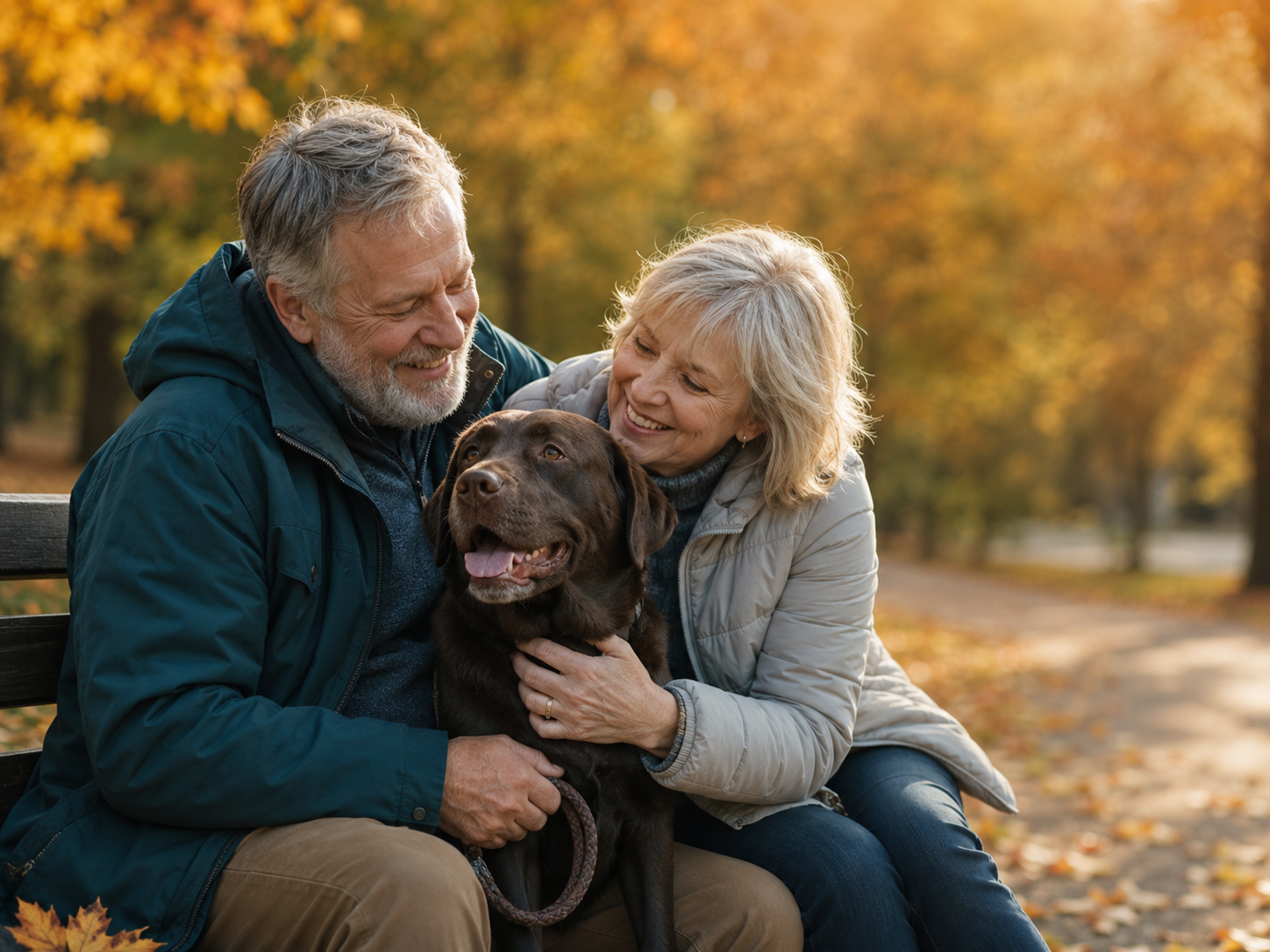
There is a specific kind of video that never stops circulating: a dog hears the words “grandma’s house,” loses its entire mind, and bolts across a lawn to a beaming older couple. It is easy to read as a family reunion, the grandkid with fur, delighted to see grandma and grandpa. But that framing quietly assumes something dogs cannot actually do. Your dog has no idea grandma is your mother. They do not track your family tree, because they do not track family trees at all.
Which raises a more interesting question than “why do dogs love their grandparents.” It is: if the bond has nothing to do with family ties, what is your dog responding to? The answer turns out to be a small window into how dogs form every attachment they have, including the one with you. The grandparent bond is not about family. It is about individuals, presence, and predictability, and that is genuinely worth understanding.
Dogs don’t do family trees, not even their own
Start with a fact that surprises most owners: dogs do not reliably recognize their own biological relatives. Reunite a dog with a littermate they have not lived with for a while, and there is a good chance they register nothing familiar at all. If a dog cannot pick out its own sibling, the odds it has worked out that your parents are related to you are essentially zero.
“People assume the dog sees a grandparent and thinks ‘family,’ but dogs don’t carry a concept of relatives, not even for their own kin,” says canine behavior specialist Dr. Nina Kohl. “So whatever your dog feels for grandma, it isn’t inherited loyalty. It’s affection for one specific person they have come to know and trust. There’s a faint chance dogs pick up some family scent signature, but I wouldn’t bet on it. The simpler explanation almost always wins: they just love that human.”
Stripped of the family story, what is left is more flattering to the grandparents, not less. The dog chose them on their own merits.
So what actually builds the bond?
If it is not a blood tie, it is the same handful of ingredients that build any dog attachment: repeated, predictable contact with a person who is reliably present and pleasant to be around. Grandparents tend to check every box. They show up on a schedule the dog can learn. They are usually calm and unhurried. And, crucially, they almost always break out the good treats.
The reliability matters more than the excitement. Dogs often form intense attachments to people who do nothing especially dog-oriented, no wrestling, no fetch, just a familiar figure who appears predictably and is kind. That predictability is a large part of why a once-a-week visitor can become a dog’s favorite human.
“I see dogs form these deep attachments to people who, on paper, do very little for them,” Dr. Kohl says. “Not the person with the ball, not the person with the steak, just someone who turns up regularly and is a steady, warm presence. Dogs are pattern animals. A person who reliably shows up and is pleasant becomes a fixed point in their world, and fixed points are exactly what a dog builds trust on.”
And yes, the treats help. There is no shame in a grandparent buying a little devotion; if your parents think of your dog as a grandchild, they are almost certainly deploying the premium snacks, and a dog is not going to pretend that does not register.
Is it good for your dog? Yes, and it is a strategy
A dog with more than one trusted human is a more resilient dog. If your primary person hits an emergency, a dog who already knows and trusts a second caretaker adjusts far more easily than one who has only ever bonded to you. Even in ordinary life, a familiar backup human, grandparents, a regular sitter, is a genuine asset the next time you travel.
“One of the most protective things you can build for a dog is a small circle of humans they know and trust, not just you,” says Dr. Nina Kohl. “When life gets disrupted, and it always eventually does, that familiar second or third person is a source of stability instead of a stranger the dog has to cope with on top of everything else. Grandparents are often the easiest way to build that circle.”
And no, the spoiling will not cost you your spot. No amount of grandparent indulgence is going to make your dog love you or your home less. For that, the gap would have to be absurd, sawdust at your house and steak at theirs.
The personality caveat, and how to smooth the visit
Not every dog rolls with a trip to a new house equally. A confident, social dog usually treats grandma’s place as an adventure. A more anxious dog may struggle at first, hanging back, hiding under furniture, or even having an indoor accident despite being fully house-trained at home. That is about temperament, not a failure of the bond, and most nervous dogs come around as the new people, sounds, and smells become familiar.
If your dog leans anxious, a few consistent anchors go a long way: bring the same bedding, the same food, and keep the feeding and walk schedule close to home. For a highly social, active dog, the time and exercise at the grandparents’ is often a real plus; a committed couch potato who is just as happy at home may simply not need the trip.
Coming home is the easy part
Whatever loose rules your dog followed at grandma and grandpa’s, you will rarely have to do much to reset them at home. After a stay somewhere else, most dogs are visibly happy to be back among their own smells and comforts, even if the treats are a little less generous under your roof. Slipping back into the home routine tends to happen on its own; simply being home with their family is usually all it takes.
The takeaway
The “grandma’s dog” phenomenon is real, but it is not what it looks like. Your dog is not honoring a family bond, because they have no concept of one. They have singled out specific people, through steady presence, predictability, and yes, good snacks, and grown to trust them. Understood that way, the grandparent bond is not a novelty. It is a small demonstration of how your dog builds every relationship they have, and a nudge to give them a couple of trusted humans beyond you. It makes their world both bigger and steadier.
References
- Wynne, Clive D. L. Dog Is Love: Why and How Your Dog Loves You. Houghton Mifflin Harcourt, 2019.
- Payne, Elyssa, et al. “Current perspectives on attachment and bonding in the dog–human dyad.” Psychology Research and Behavior Management, vol. 8, 2015, pp. 71–79. https://doi.org/10.2147/PRBM.S74972
- Gácsi, Márta, et al. “Attachment behavior of adult dogs (Canis familiaris) living at rescue centers: forming new bonds.” Journal of Comparative Psychology, vol. 115, no. 4, 2001, pp. 423–431. https://doi.org/10.1037/0735-7036.115.4.423
Leila Torres leads our Living coverage, from home life and travel to the products and rescue stories that come with sharing a life with animals. She edits and writes across the section, with a soft spot for pieces about the bond between people and their pets.
Meet our experts ↗Keep reading
 LivingADHD Doesn't Make You a Bad Dog Parent. Your Reminder App Does.Leila Torres · 8 min
 LivingBring the Dog: 11 NYC Date Spots Where Your Pup Is the Best WingmanSasha Ford · 5 min
 LivingYour Star Sign Already Knows What Dog You Should GetSasha Ford · 4 min
 LivingEveryone Treats Your Dogs Like a Dating Red Flag. They're Wrong.Jordan Ellis · 6 min
 LivingA Dog Costs More Than a Used Car. Where You Live Swings It by $10,000.Marcus Webb · 7 min
 LivingYour Dog Isn't Predicting Your Pregnancy. They're Reacting to It, and That's UsefulDr. Lena Park · 7 min