
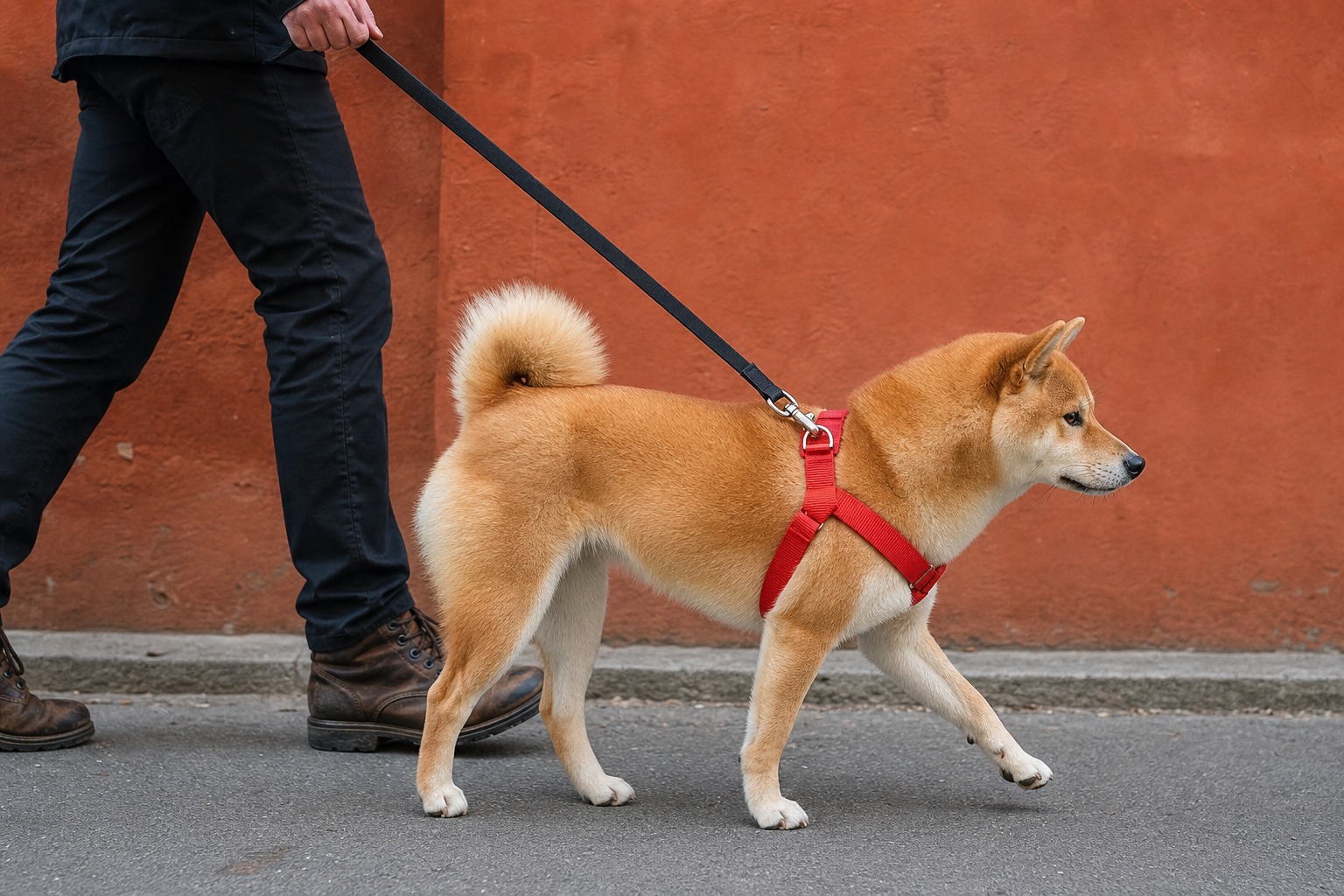
Walk down any city sidewalk and you will see it: a dog hauling its owner forward, wearing a harness marketed as “no-pull,” with the leash clipped to the ring on the dog’s back. That setup does almost nothing to stop pulling. The owner bought the right product and used it the wrong way, because nobody explained the one thing that actually matters. A harness is not a magic anti-pull device. It is a piece of leverage, and where you attach the leash decides who has it.
So this guide starts where it should: with the mechanism. Get the attachment point right and a $10 harness can transform a walk. Get it wrong and the fanciest harness on the market is just a comfortable sled rig for your dog.
The attachment point is the whole game
There are three places a harness leash can clip, and they do completely different jobs.
Back clip (between the shoulder blades). Comfortable and easy, and the right choice for a dog who already walks politely. But it gives a pulling dog perfect forward leverage, like a sled dog’s rig, so it does nothing to discourage pulling. If your dog drags you, the back clip is not your friend.
Front clip (on the chest). This is the anti-pull mechanism. When the leash clips at the chest and the dog lunges forward, the harness redirects them sideways, turning them back toward you instead of letting them power straight ahead. It removes the forward leverage and gives you a moment to reward the check-in. A “no-pull harness” earns that name only when you use the front clip.
Dual clip (both). The most versatile, and what most trainers recommend you buy: front clip for training and for heavy pullers, back clip for relaxed walks once manners improve. One harness, both jobs.
“The single most common harness mistake I see is a great no-pull harness clipped on the back, and the owner wondering why nothing changed,” says Dr. Priya Nair, a veterinarian who reviews gear for The Pet Times. “The chest clip is doing the work. It changes the physics of the pull. Clip there while you are training, and move to the back only once your dog is walking nicely.”
A note worth making, since harness design is debated: some trainers and vets prefer designs that leave the shoulder free to move naturally, on the theory that straps crossing the front of the shoulder may restrict a dog’s gait over time. The evidence is not settled, but it is a sensible reason to favor a well-fitted, shoulder-friendly harness for an active or athletic dog, and to make sure no strap digs into the armpit.
Then comes fit, which prevents both escapes and injury
The best harness in the world fails if it fits like a borrowed jacket. Two rules cover most of it.
Use the two-finger test: you should be able to slide two fingers flat under every strap that touches your dog, and no more. Looser than that and a startled dog can back straight out of it; tighter and it chafes and limits movement.
And re-check growing dogs constantly. Puppies outgrow harnesses fast, and owners often do not notice until a strap is biting in.
“I regularly meet dogs still in the harness they came home in, and it has gotten dangerously tight without anyone realizing,” says Dr. Ravi Mehta. “Snug is safe; loose is how dogs slip free and bolt into traffic. Feel under every strap, and on a young dog, feel again next month.”
One fit-related design caution: step-in harnesses are the easiest to put on, but a fearful dog that panics and reverses can shrug out of a step-in alarmingly fast. For an anxious or flighty dog, an over-the-head or vest-style harness with a snug fit is harder to escape.
Introduce the harness before you need it
Do not wait until a chaotic first walk to put a harness on a nervous dog. Spend a few days letting them sniff it, rewarding them for putting their head through, and clipping it on for treats indoors. A dog who associates the harness with good things will lift a leg into it on cue; a dog ambushed by it on a busy street learns to dread it.
The picks, organized by what your dog needs
With the mechanism and fit settled, here are tested harnesses in the order the decision actually happens: start with the dog you have (their build), then their behavior on leash, then your lifestyle, and only then looks.
By size and build
Best for flat-faced and sensitive-throat dogs: Maxbone Easy-Fit Harness. Breathable mesh and flexible straps make this a comfortable collar alternative for brachycephalic dogs and any dog with a sensitive airway.
“For flat-faced breeds and dogs with tracheal sensitivity, taking pressure off the throat is a genuine medical benefit, so for those patients the harness is simply the smarter walking setup,” says Dr. Priya Nair.
Best for large dogs: Canada Pooch Everything Harness. Padded, adjustable, and built to discourage pulling, fitting gentle giants up to 130 pounds.
Best for small dogs: Puppia Soft Harness. An over-the-head vest style (safer against escapes than a step-in) in sizes down to a 9-to-12.5-inch chest, with an adjustable chest belt, breathable mesh, and machine-washable construction.
For heavy pullers (front-clip and dual-clip)
Best overall no-pull: Rabbitgoo No-Pull Harness. A deserved favorite with well over 100,000 five-star ratings. Two metal rings, a front clip for training and pullers and a back clip for casual walks, give you the dual-clip versatility most dogs need. Soft breathable-mesh padding, easy on, highly adjustable, sizes XS to XL, and 18 colors.
“Our dog pulled constantly as a puppy. Once we started clipping the leash to the front ring of this harness, she completely stopped.” —Amazon reviewer
Best for training: 2 Hounds Design Freedom Harness. A trainer staple for good reason, with front and back attachments and a back martingale loop that gently snugs when the dog pulls, making it both anti-pull and hard to slip. Sizes up to XXL, plus a five-eighths-inch width for small dogs.
“The front clip means a pulling dog turns back toward you, which gives you the chance to reward a check-in. The dual attachment is why I use it on my own dog,” says Jordan Ellis, a trainer who contributes to The Pet Times.
Best budget no-pull: PetSafe Easy Walk Harness. Around $10 and originally designed by a veterinary behaviorist. Its front martingale loop tightens gradually as the dog pulls, applying gentle shoulder pressure that discourages hauling. Lightweight and quick to put on. Proof that the mechanism, not the price, is what matters.
For active and adventure dogs
Best for car safety: Sleepypod Clickit Sport. Safety gear outranks sport gear, so this comes first: it is the one pick that is actually about safety, not walking. Crash-tested to child-safety standards, top-rated by the Center for Pet Safety, and compatible with the seat belt. The padded vest redistributes crash forces. If your dog rides in the car, this is not optional gear.
Best reflective for night: Noxgear LightHound. Beyond reflective, it has battery-powered LEDs visible from over half a mile, up to 12 hours per charge, rain- and snow-safe (do not submerge). Eight solid colors and six multicolor modes for genuine after-dark visibility.
Best for running and biking: Non-stop Dogwear Freemotion Harness. Built for motion and used by world-class mushers, it lets the shoulders move freely and distributes pull across the upper body without restricting breathing, ideal for canicross, running, and biking.
Best durable: Atlas Pet Company Lifetime Harness. Heavy-duty nylon webbing and seams reinforced with Gore Tenara thread that resists sun, saltwater, and chemicals, plus metal hardware and a lifetime warranty with repairs. The one to buy for a destructive or hard-charging dog.
For comfort and chafe-prone dogs
Best padded: Fable Signature Harness. Breathable performance mesh, foam padding, and shock-absorbing give to smooth out a puller’s jolts, with broad adjustability.
Best against armpit chafing: an alternative-leather weatherproof harness. Smoother under the legs than webbing, which helps a dog who throws full body weight into the chest. Many come custom-embroidered and stand up to rain and rough use.
For style without sacrificing safety
Best colorways: Wild One Harness. A cult favorite that clears the safety bar with a secure under-the-arm, back-clip design and a deep bench of colors, plus matching leash and poop-bag sets.
Best personalized: Doggykingdom Personalized Harness. Fifteen colors, your dog’s name and optional phone number, reflective, adjustable at neck and chest, with a lifetime warranty.
A quick decision guide
If your dog pulls, buy a dual-clip or front-clip harness and use the front clip until manners improve. If your dog already walks well, a back clip is fine and comfortable. If your dog rides in the car, add a crash-tested harness for that specific job. If your dog is flat-faced or has a sensitive throat, choose a harness over a collar for walks. And whatever you buy, fit it to the two-finger rule and re-check it as your dog grows.
FAQs
Front clip or back clip for a dog that pulls?
Front clip, every time, while you are working on the pulling. The chest attachment redirects a lunging dog sideways and back toward you, removing the forward leverage that a back clip hands them. Move to the back clip only once your dog walks calmly. A dual-clip harness lets you do both with one purchase.
How do I stop my dog from slipping out of the harness?
Fit it snugly to the two-finger test and favor an over-the-head or vest style over a step-in, since fearful dogs can reverse out of step-ins quickly. Check the fit before every walk, especially on puppies and slim-headed breeds, and make sure straps have not loosened with wear.
Is it safe to leave a harness on all day?
No. Take it off between walks. All-day wear chafes the skin under the legs, can mat the coat, and traps moisture that leads to irritation. Treat the harness as walking equipment and use an ID-tagged collar for everyday wear.
Are harnesses bad for a dog’s shoulders?
The evidence is not conclusive, but to be safe, choose a well-fitted harness that does not dig into the armpit or cross the point of the shoulder restrictively, especially for athletic dogs. A correctly sized, shoulder-friendly harness is widely considered fine; a tight or poorly designed one is the thing worth avoiding.
References
- Center for Pet Safety, “Harness Crashworthiness Study and Certified Products.” https://www.centerforpetsafety.org/test-results/harnesses/
- American Kennel Club, “Front-Clip vs. Back-Clip Dog Harnesses.” https://www.akc.org/expert-advice/training/best-dog-harness/
- VCA Animal Hospitals, “Choosing and Fitting a Harness for Your Dog.” https://vcahospitals.com/know-your-pet/
- PetSafe, “Easy Walk Harness fitting guide.” https://www.petsafe.com/