
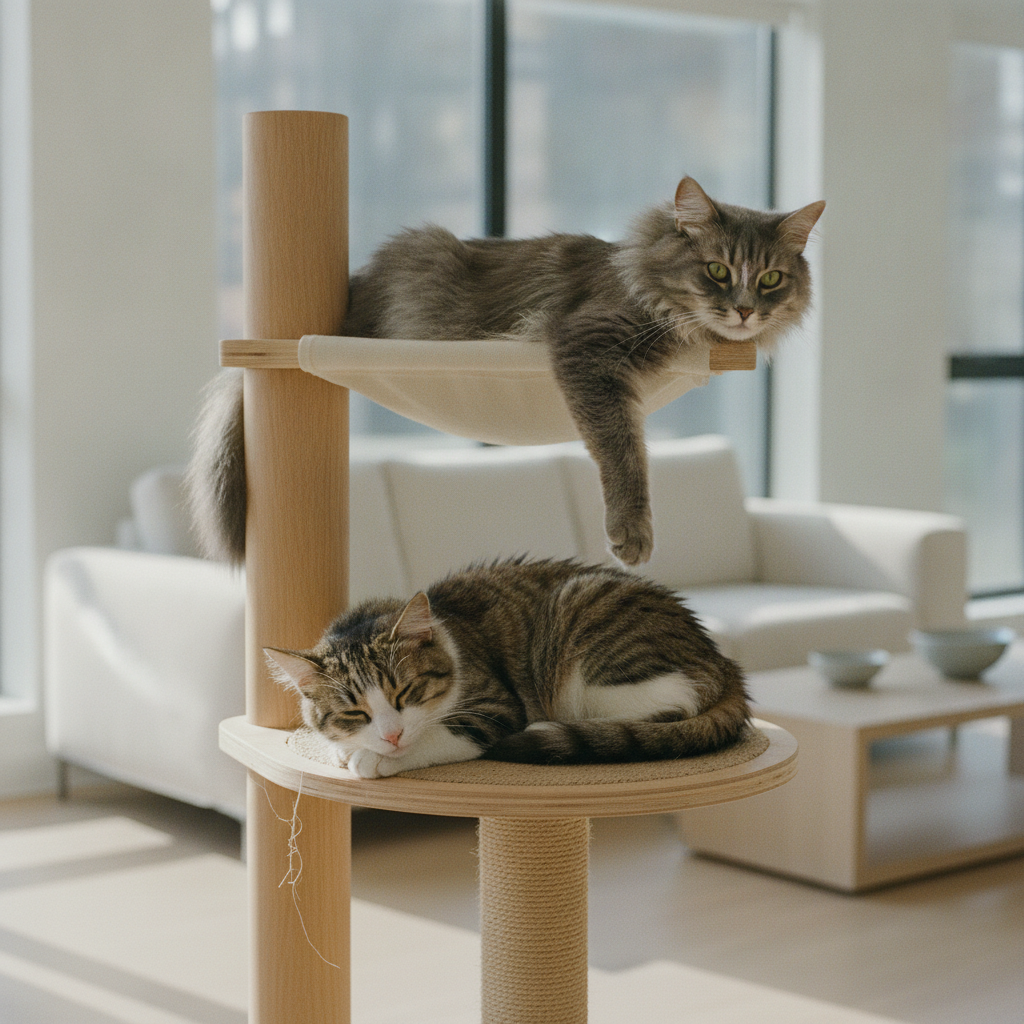
A single cat treats a tree as furniture. Two or more cats treat it as territory, and that one word changes everything about what you should buy. The tree that works beautifully for one cat can become a daily flashpoint in a multi-cat home, because now there is a top perch worth guarding, a single exit worth blocking, and a hammock worth evicting a housemate from. The wrong tower does not just fail to help. It manufactures conflict.
So before we get to the picks, here is the reframe that should drive your purchase: in a home with more than one cat, the best tree is the one that lets every cat get up, get comfortable, and get back down without having to negotiate with another cat. Capacity matters far less than you would think. Layout, redundancy, and escape routes matter far more.
Why “it holds three cats” is the wrong spec
Cat behaviorists describe territorial competition with a simple rule of thumb borrowed from resource management: provide one more of each key resource than you have cats. For litter boxes that is the well-known “n plus one.” For vertical space it works the same way. If you have two cats, you want enough independent perches that a third option always exists, so no cat is ever cornered into a confrontation over the last good spot.
That reframes the shopping question. You are not asking “can this tree physically support my cats.” You are asking three sharper questions:
How many cats can rest on it at the same time without touching — that is, how many genuinely separated perches, beds, and caves does it offer, not how many cats can technically pile on.
Does every elevated spot have at least two ways down? Single-exit cubbies and dead-end top perches are where one cat traps another. Trees with ramps, multiple posts, and offset platforms give a pinned cat an out.
Can a nervous cat see the room from a low spot and a confident cat own the top? Multi-cat households almost always include one bolder climber and one watcher. A tree that offers both a high lookout and a sheltered mid-level cave keeps the peace better than one with three identical perches.
Keep those three questions in mind and the spec sheets below start to sort themselves.
Stability is a safety issue, not a luxury
There is one number that is not negotiable in a multi-cat home: the base weight. When two cats launch off a perch at the same moment, a light tree rocks, and a tree that rocks gets abandoned. As a working rule, the tower should weigh clearly more than the combined weight of the cats likely to be on it during a play binge, and a wide or wall-anchored base beats a tall, narrow one every time. Several picks below ship with wall anchors. In a busy household, use them.
How to match the tree to your specific cats
Watch your cats for a week before you buy, because their habits narrow the field fast.
If they perch and survey, buy height and a wide top platform. If they scratch furniture, prioritize the number and orientation of sisal posts, including at least one tall vertical post a cat can stretch fully against. If they burrow and hide, you need enclosed caves, ideally more than one so they are not fought over. If you live in a small space, a corner tower or a wall-mounted shelf system will serve you better than a sprawling floor unit. And set a real budget, because a sturdier tree genuinely lasts longer, but several mid-priced models below outperform their price.
The picks at a glance
We tested and researched these across multi-cat homes, weighting separation of resting spots and base stability above raw feature counts. Prices move, so treat them as ballpark.
- Best overall for traffic flow: Frisco 76-Inch XXL Heavy-Duty Cat Tree
- Best for high-energy crews: Armarkat 73-Inch Faux Fleece Cat Tree & Condo
- Best for large breeds: Frisco 72-Inch Large Base Faux Fur Cat Tree & Condo
- Best compact corner tower: Vesper Cat Tree
- Best wall-mounted system for tiny spaces: FUKUMARU 5-Piece Wall-Mounted Cat Shelves with Hammock
- Best minimalist shelf tower: The Refined Feline Metropolitan 62-Inch Cat Tree & Condo
- Best budget tower: Yaheetech 54-Inch Multi-Level Cat Tree
- Best modern: Mau Ivy 3
- Best mixed-material: Hey-brother Wooden Cat Tree
- Best carpeted: Prestige 55-Inch Cat Tree
- Best wooden: The Refined Feline Lotus 69-Inch Cat Tree
The picks, grouped by the multi-cat problem they solve
Best overall for traffic flow — Frisco 76-Inch XXL
This is our top pick precisely because it solves the multi-cat layout problem rather than just stacking surfaces. At over six feet and more than 60 pounds, it is heavy enough that two cats can launch off it without a wobble, and its real strength is separation: four perches, two cat caves, two beds, and a hammock spread across the structure so several cats can settle without sharing airspace. That is the definition of a tree that prevents standoffs.
Where it falls short for a multi-cat home is exits. Only one post is sisal-wrapped, and a couple of the higher platforms are awkward to climb down from, which is exactly the kind of dead end that can pin a less confident cat. Place it where the top perch is reachable from a nearby shelf or windowsill and you give that cat a second way down.
Pros: very tall (23.62”L x 23.62”W x 76”H); four perches plus a hammock; two beds, one removable and washable; two caves; one long sisal post; two dangly toys; heavy, stable base.
Cons: only one scratching post is sisal; descent from the top platforms is steep for older or timid cats.
Review rating: 5/5
Best for high-energy crews — Armarkat 73-Inch
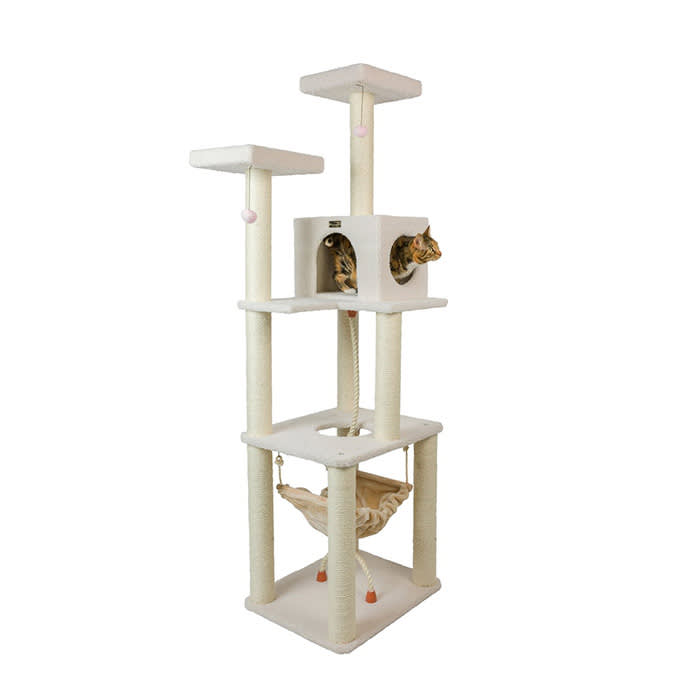
If your cats run hot, this is the outlet. Four perches, a cave, a hammock, a rope swing, and three toy attachments give a rambunctious group constant things to chase and conquer, and nine sisal posts mean simultaneous scratching without turf disputes. At 45 pounds it stays planted through chaos.
It is around $150, and the faux fleece will not suit cats who prefer carpet or sisal underfoot.
Pros: tall and sturdy (24”L x 27”W x 73”H, 45 pounds); four perches; cave; hammock; rope swing; three toys; nine sisal posts.
Cons: about $150; faux fleece not for every cat.
Review rating: 4.5/5
Best for large breeds — Frisco 72-Inch Large Base
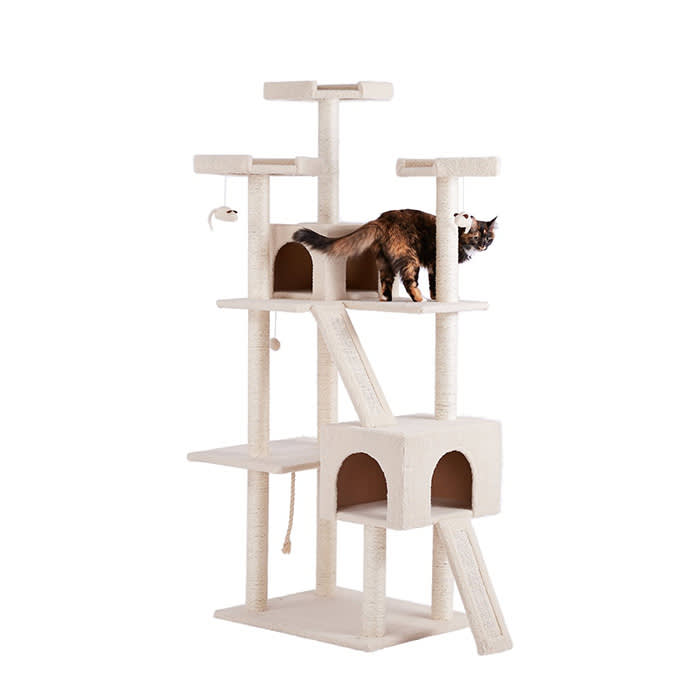
Maine Coons, Ragdolls, and other big cats break light trees, and this wide-base Frisco is built for them. The standout multi-cat feature is its two sisal-wrapped ramps between levels: big or aging cats can walk up and down instead of jumping, which removes the most common multi-cat trap, a heavy cat blocking the only descent. Add four perches, three roomy beds, two caves, and ten sisal posts, and several large cats can coexist.
At over 70 pounds it is stable and, at around $130, a genuine bargain for the size. It simply needs the floor space.
Pros: tall (44.02”L x 27.56”W x 72.01”H); 70.55-pound base; four perches; three beds; two caves; four toys; ten sisal posts; two sisal ramps; about $130.
Cons: faux fur is not every cat’s texture; large footprint.
Review rating: 4.5/5
Best compact corner tower — Vesper
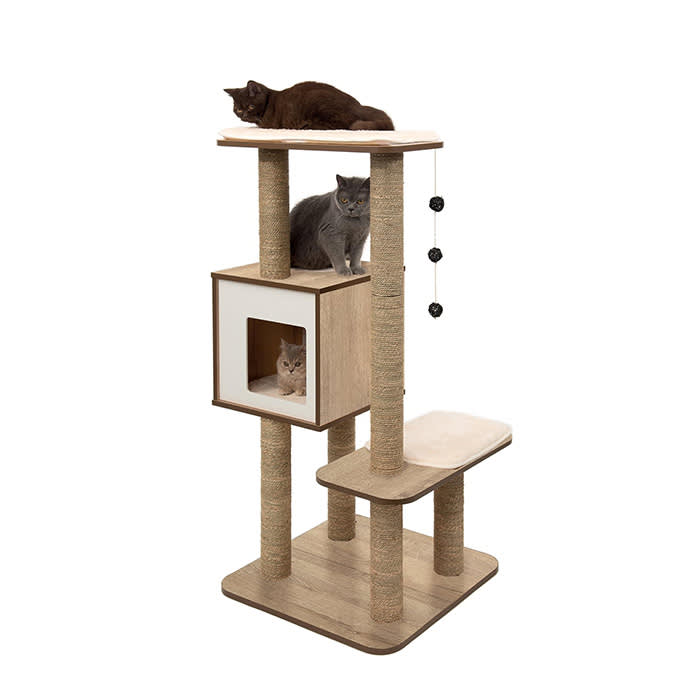
Small space, two cats, no excuses. The Vesper fits in a corner at under four feet tall and still delivers three perches, a den, six sisal posts, and a toy, which is remarkable separation for roughly eight square feet of floor. In an apartment, that footprint-to-function ratio is the whole game.
It tops out as a two-to-three-cat tree, and at over $150 it is not cheap for its size, but it buys back floor space that larger towers cannot.
Pros: corner-friendly (22.1”L x 22.1”W x 47.8”H); three perches; one den; six sisal posts; one toy.
Cons: over $150; not for more than three cats.
Review rating: 4/5
Best wall-mounted system for tiny spaces — FUKUMARU Cat Shelves
Sometimes the answer is not a tree at all. In a studio or a room with zero floor to spare, a wall-mounted shelf set gives multiple cats true vertical territory with the best possible traffic flow, because you design the route yourself. Space the shelves so every cat has an independent path up and a separate way down, and you have built the n-plus-one rule directly into your wall. Most sets include a sisal step and a small hammock.
The work is in the install: studs, brackets, and weight limits all matter, and a poorly anchored shelf is dangerous. This is the most setup-intensive pick, but for the right space it is the only one that adds zero footprint.
Pros: zero floor space; fully customizable routes and exits; sisal scratch step; usually includes a hammock; ideal for confident climbers.
Cons: requires solid wall anchoring into studs; install effort; not for cats who cannot or will not jump.
Review rating: 4/5
Best minimalist shelf tower — Refined Feline Metropolitan 62-Inch
When you want the tree to disappear into the room, this metal shelf tower is the most furniture-like option here, and its five alternating cushion-and-sisal platforms still give a multi-cat home well-spaced perches. Wall anchors are included, which is exactly right for a tall, narrow profile in an active household.
The trade-off is that minimalism means no caves and no toys, so your burrowers and your players are not served. Pair it with a floor-level cave elsewhere in the room.
Pros: tall (31”L x 13”W x 62”H); five platforms with faux-fur cushions and sisal mats; washable covers; wall anchors included.
Cons: over $300; no caves or toy attachments; tall narrow shape needs anchoring.
Review rating: 3.5/5
Best budget tower — Yaheetech 54-Inch Multi-Level
You do not have to spend $300 to give two cats separated vertical space. Around the $50 to $70 mark, this Yaheetech tower delivers multiple perches, a cave, a hammock, and several sisal posts, which is the core of what a small multi-cat home needs. It is the lightest pick here and the plush wears faster, so think of it as the right first tree or the second tree you place in another room to spread out the action, rather than a forever centerpiece.
Anchor it, keep it for two small cats, and it punches well above its price.
Pros: very affordable; multiple perches; cave; hammock; several sisal posts; good “second tree” to add redundancy.
Cons: lightweight; plush wears faster; best for two small cats.
Review rating: 3.5/5
Best modern — Mau Ivy 3
Mau’s handcrafted real-wood branch posts are genuinely sturdier than they look, and the Ivy reads as decor rather than pet gear. For multiple cats its strength is three deep, cushion-lined baskets, which give each cat a private, walled nook to curl into, the kind of separation that keeps confident and shy cats out of each other’s way.
It is a three-cat tree at most, and the over-$300 price is real. If your household is bigger than three, look elsewhere.
Pros: very sturdy for its height (30”L x 23”W x 53”H, 46 pounds); real-wood branch posts; three cushioned baskets; three sisal posts; three toys.
Cons: over $300; not for more than three cats.
Review rating: 4/5
Best mixed-material — Hey-brother Wooden Cat Tree
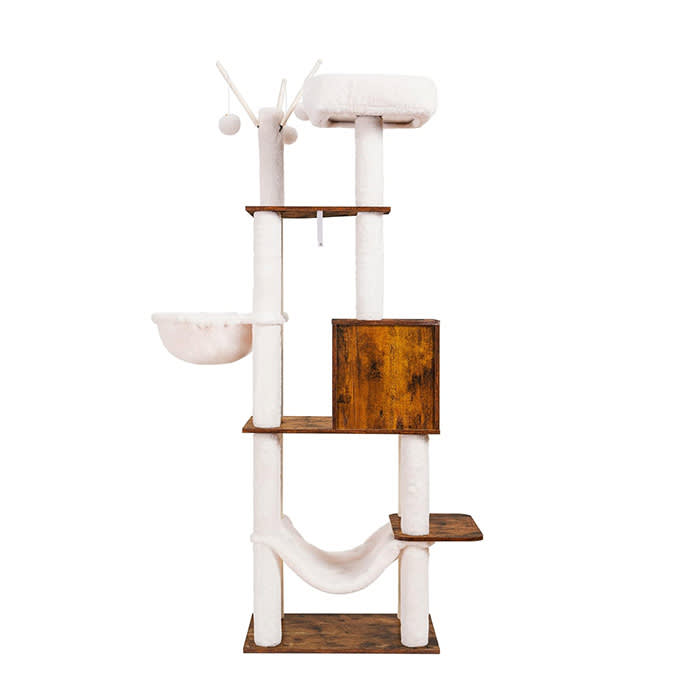
This is the value standout, and for a two-cat home it covers a lot of ground at around $100. The wooden frame carries six sisal posts, which is unusually generous and means two cats can scratch at once without queuing, plus three perches, a cave, two hammocks, and a bed for plenty of separated rest.
The honest limit is its 35-pound weight. For two small-to-medium cats it is fine, but a couple of large cats hitting it hard may find it less planted than the heavier picks. Anchor it to the wall and the concern mostly disappears.
Pros: tall (21.7”L x 19.7”W x 66.1”H); six sisal posts; two hammocks; three perches; one den; one washable fleece bed; three toys; about $100.
Cons: large footprint; lighter 35-pound build wants wall-anchoring for big cats.
Review rating: 4/5
Best carpeted — Prestige 55-Inch
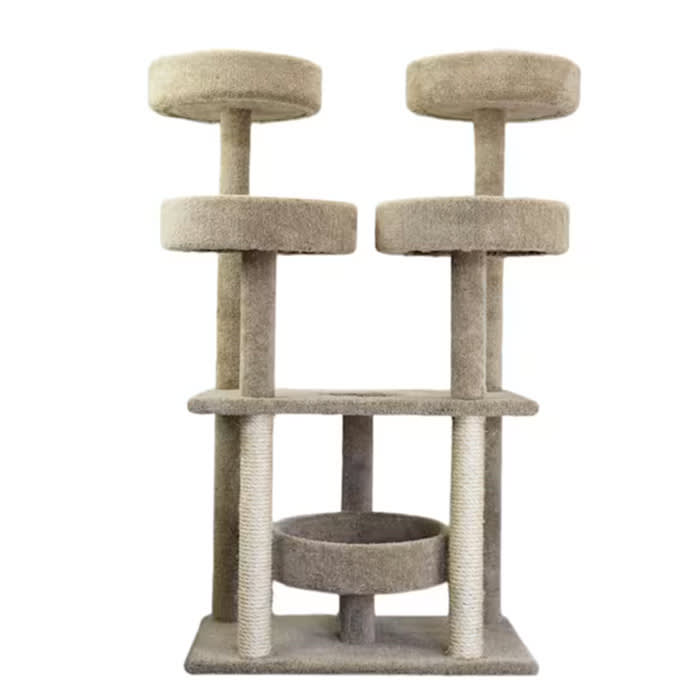
If your cats scratch carpet rather than sisal, this Prestige tower turns that instinct into a feature instead of a furniture problem. The whole structure is a scratching surface, plus two dedicated sisal posts, and the five bed levels give a multi-cat home genuinely separate landing spots. At 53 pounds it holds steady through group play, and carpet-on-wood construction tends to outlast plush-only trees.
Two honest caveats: it runs over $250, and some units arrive with a strong carpet odor that takes a few days to air out.
Pros: tall (41”L x 31”W x 55”H); five bed levels; play perch with open center; two sisal posts; sturdy 53-pound build.
Cons: over $250; can ship with a strong smell that fades.
Review rating: 4/5
Best wooden — The Refined Feline Lotus 69-Inch
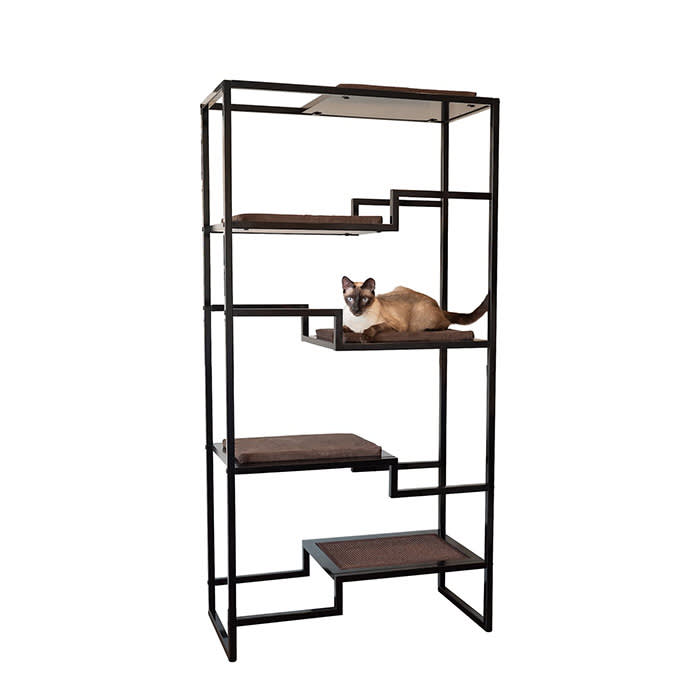
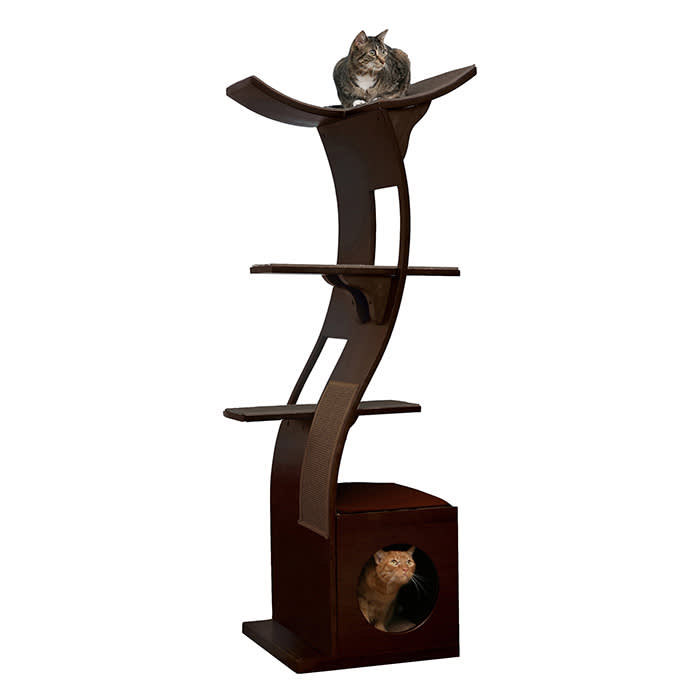
For a multi-cat household that also wants the tree to look like furniture, the Lotus earns it. The 75-pound oak frame is the most stable wooden tree here, and stability is what lets three cats use it confidently. Four berber-lined levels give well-separated resting spots, and the velcro-attached carpet pulls off for washing, which matters more than it sounds in a home where shed fur multiplies. The enclosed den gives your burrower a retreat the climbers will not bother contesting.
The catch is footprint and price. At over $300 and a real piece of furniture in size, it asks for both budget and floor space.
Pros: solid oak in four colors; very tall (20”L x 20”W x 69”H); 75-pound weight for top-tier stability; four washable berber levels; cushioned den; vertical sisal mat.
Cons: over $300; too large for tight rooms.
Review rating: 4.5/5
A note on placing two trees instead of one
Here is the strategy most lists skip. In a home with three or more cats, two modest trees in different rooms almost always keep the peace better than one large tree, because they break sightlines and give a cornered cat somewhere entirely separate to go. If your budget stretches to one premium tower or two mid-priced ones, the two-tree setup is usually the better multi-cat investment. It is the cheapest way to build redundancy into your space.
FAQs
What actually matters most when buying for multiple cats?
Separation and stability, in that order. You want enough genuinely independent perches, beds, and caves that no cat is ever forced into a standoff over the last good spot, and a base heavy or wide enough that group play does not make it wobble. Raw “how many cats fit” capacity is the least useful number on the box. Also confirm the materials are nontoxic; sisal, cut-pile carpet, and faux fur are all safe.
How do I figure out which material my cats want?
Watch what they already use. Cats that shred carpet usually want a carpeted tree plus a scratch-resistant surface; cats that stretch up against door frames want a tall vertical sisal post; cats that knead soft blankets gravitate to plush or faux fur. In a multi-cat home, it is fine, even smart, to choose a tree with more than one material so different cats each get a surface they like.
One big tree or several smaller ones?
For one or two cats, a single well-chosen tree is plenty. From three cats up, multiple trees placed in different rooms generally reduce conflict more effectively than a single large one, because they create separate territories and break the sightlines that trigger guarding behavior. Spreading toy attachments across separate trees also cuts down on squabbles.
How high should the tree be for multiple cats?
High enough that your most confident cat can claim a top lookout while a more cautious cat still has a comfortable mid-level or low perch. The goal is a range of elevations, not maximum height. A six-foot tower with well-spaced levels serves a mixed-confidence household better than a shorter tree with everything clustered at one height.
References
- American Association of Feline Practitioners and International Society of Feline Medicine, “AAFP and ISFM Feline Environmental Needs Guidelines,” Journal of Feline Medicine and Surgery. https://journals.sagepub.com/doi/10.1177/1098612X13477537
- Ellis, S. L. H. et al., “Environmental enrichment for the indoor cat,” Journal of Feline Medicine and Surgery. https://journals.sagepub.com/doi/10.1177/1098612X13477537
- The Ohio State University Indoor Pet Initiative, “Providing Vertical Space and Resources for Cats.” https://indoorpet.osu.edu/cats
- ASPCA, “Common Cat Behavior Issues: Aggression Between Cats in Your Household.” https://www.aspca.org/pet-care/cat-care/common-cat-behavior-issues