


Senior Dogs Don't Have a Pity Problem. They Have a Visibility Problem.
A quarter of senior shelter dogs get adopted, against roughly 60 percent of younger ones. A Brooklyn bag brand figured out that the fix isn't a sadder photo. It's putting old dogs in front of people who weren't looking.

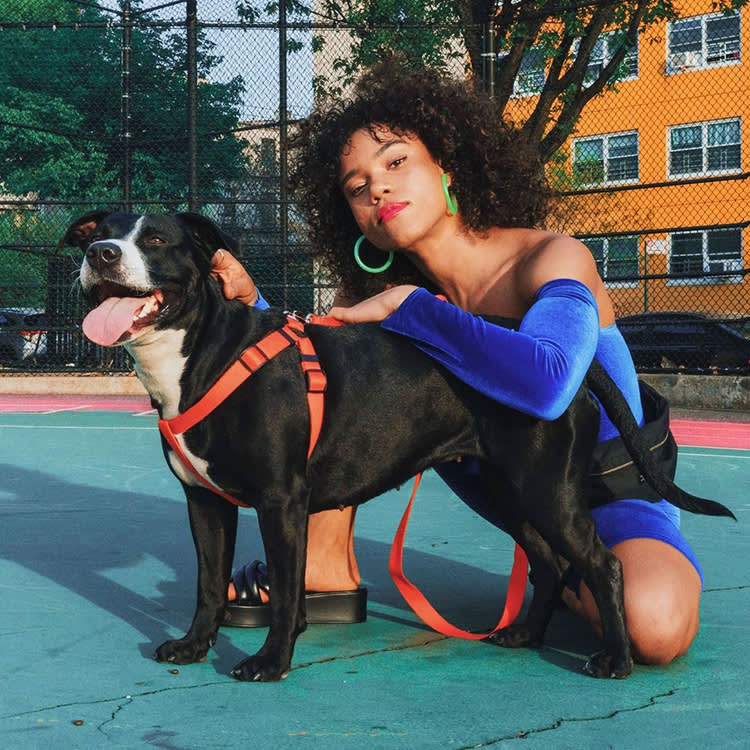
The rescue world’s standard move on senior dogs is to make you feel terrible. Grey muzzle, kennel floor, a caption about how she was surrendered at eleven and doesn’t understand why. It is all true, and it does not work very well, because guilt is a poor motivator and people scroll.
The numbers say so plainly. An analysis of shelter data found senior dogs adopted at roughly 25 percent, against about 60 percent for younger dogs. Shelter Animals Count’s 2025 national report shows the gap getting worse, not better: senior dog adoptions down again year over year, adult dogs down more, and juvenile adoptions up. The dogs who need the least work are getting the fewest looks.
So what actually shifts that? Not a sadder picture. Proximity. Old dogs need to be somewhere other than the sad picture, in the feed of somebody who wasn’t looking for a dog at all.
Which is the genuinely interesting thing about Just Fred, a Brooklyn pet accessories brand that on its surface is about handbags.
The bag is the delivery mechanism
Tennille Teague founded Just Fred out of an ordinary irritation. She took her Dachshund, Mo, everywhere: the office, dinners, events. And she hated the carrier. The traditional ones announced themselves, and the ones that looked better were not comfortable for the dog. So she made her own, and started getting stopped on the street by people asking where to buy it.
Teague came out of advertising in New York, where she produced campaigns for cause-driven brands, including work for PETA on animals used in entertainment. That background is all over the company: she understands that a brand is a distribution channel for attention, and she pointed it at old dogs.
Five percent of every sale goes to Badass Animal Rescue in Brooklyn. More importantly, she and Badass founder Krista Almqvist run a weekly Instagram feature, Best FREDS Come in All Ages: A BADASS Senior Spotlight, that puts an adoptable senior dog in front of an audience that came for the bags.
Almqvist’s framing of the problem is worth understanding: shelter stress is hard on any dog, but seniors, frequently abandoned in their later years, are carrying an additional layer of it. Teague’s is more personal. What she cannot get out of her head is what the surrender must feel like from inside the dog, that late in a life.
Their shared argument, and it is a good one, is that the older dog is not the charity case. It is the experienced hire. A senior dog has usually lived in a home, has some socialization behind it, and skips the puppy and adolescent phases entirely, which is to say it skips the housebreaking and the destructive chewing that make first-time owners quit. What you get in exchange, Teague says, is a gratitude that has no equivalent.
“People adopt a puppy and spend a year building a dog. People adopt an eight-year-old and get a finished one,” says Dr. Amara Solis. “The tradeoff is time, and it’s real. But I’d rather someone give a good dog three excellent years than give a puppy fifteen mediocre ones because they were in over their head.”
What actually makes a dog carrier safe (the part the brands skip)
Since the bag is the reason anyone finds this brand, it is worth being specific about what separates a real carrier from a purse with a dog in it. The criteria, in rough order of importance:
A rigid base. This is the one thing Just Fred gets loudest about, and it happens to be the thing that matters most. If the floor of the bag flexes, the dog’s feet push through and slide, and the dog braces constantly. A sturdy, structured bottom is what lets an animal stand or lie without gripping. Teague’s best-selling limited-edition carrier, now a permanent part of the line, is built on exactly this, plus a plush interior. The large size is the one that keeps selling out.
Sizing to the dog, not to the size chart. Your dog should be able to stand up, turn around, and lie flat. If any of the three is a squeeze, the bag is too small, regardless of the weight limit printed on it.
Ventilation on more than one side. A dog in a bag is a dog in a small warm room. Airflow is not decorative mesh.
A real weight rating, honestly read. Most soft carriers top out well below what an owner will optimistically try. A shoulder-hung bag with a 15-pound dog in it will not last, and neither will your back.
A secure interior tether. A clip that attaches to the harness, not the collar.
Washability. Old dogs have accidents. So do young dogs, in traffic.
Just Fred is a vegan brand by design, not by trend. Teague’s reasoning is that our fellow creatures should be friends, not bags, and building a dog-carrying company out of animal hides sat badly against that. Her line is vegan leather totes, pouches, leashes, and apparel, and she has found that her customers, who are not uniformly vegan, treat the vegan option as a bonus rather than a sacrifice.
The rest of the company, briefly
She is a solo founder, and bootstrapped it, which she names as the single hardest thing about the whole exercise. An angel round opened recently.
The advocacy is not limited to seniors. Just Fred has run a Black History Month collaboration with the Thurgood Marshall College Fund, sells a rainbow bandana with 100 percent of profits going to The Trevor Project, and has collaborated with Badass on apparel. Product-wise, there is a first toy in development called the U.F.O., short for Unidentified FRED Object, an activity toy designed to hold a spread like peanut butter and shaped for a dog to hold between its paws, with a look pulled from retro Japanese toys. A backpack carrier, a leash, and a sweater have followed. Her dream collaborator is GANNI, ideally a dog tote and a matching human-and-dog sweater.
And her origin as a dog person predates all of it: her first dog was Tisha, a Siberian Husky, who used to tow her on a plastic sled beside her father on his morning runs through the snow, and who would jump up and down next to the sled every morning, ready to go.
What’s new since this was written
The senior-dog gap has become one of the most studied problems in sheltering, and the research now points somewhere useful: the interventions that move senior dogs are the boring, structural ones, not the emotional appeals. A Maddie’s Fund and Grey Muzzle evaluation of strategies to increase senior adoptions found that removing or reducing the friction, including cost, does the heavy lifting.
That dovetails with a finding shelters still argue about. When Emily Weiss and Shannon Gramann compared adopters who paid an adoption fee to adopters who paid nothing, they found no meaningful difference in how attached the adopters became to their animals. Waiving the fee does not make people love the pet less. It just makes them walk through the door.
Which is the same insight the bags are running on, from the other direction. The problem was never that people don’t love old dogs. It’s that they never saw one.
References
- ASPCA. U.S. Animal Shelter Statistics. aspca.org
- Shelter Animals Count. 2025 Annual Data Report. shelteranimalscount.org
- Weiss, E. & Gramann, S. “A Comparison of Attachment Levels of Adopters of Cats: Fee-Based Adoptions Versus Free Adoptions.” Journal of Applied Animal Welfare Science, 12(4), 2009. pubmed.ncbi.nlm.nih.gov
- Maddie’s Fund / Grey Muzzle. An Evaluation of Strategies to Increase the Adoption of Senior Dogs. maddiesfund.org
- Just Fred. justfred.co
- Badass Animal Rescue. badassbrooklynanimalrescue.com
Nina Vasquez writes about life at home with pets and the relationships at the heart of it. Her work covers day-to-day living, people-and-pet stories, and the products that fit into a real household, with a warm, grounded take on everyday pet ownership.
Meet our experts ↗Keep reading
 Product Picks"A Portion of Proceeds" Means Nothing. This Rosé Says 20%.Sasha Ford · 8 min
 Product PicksTheir First Dog Backpack Fell Apart in Two Weeks. So They Built One That Doesn't.Sasha Ford · 7 min
 LivingThe Flight Is the Easy Part of Flying With Your DogDr. Ravi Mehta · 6 min
 Product PicksOnly One Piece of Dog Car Gear Actually Saves Their LifeMarcus Webb · 8 min
 Product PicksThe Right Travel Crate Depends on the Trip: 8 Picks, Sorted by How You TravelNina Vasquez · 12 min
 Product PicksLet Your Dog Carry Their Own Poop BagsSasha Ford · 4 min