


Your Cat Isn't Smart or Dumb. They're Wired for Different Things
Ranking cats by IQ misses the point. The real signs of feline intelligence are specific skills: memory, observation, problem-solving. Here's how to spot each one, and test it at home.

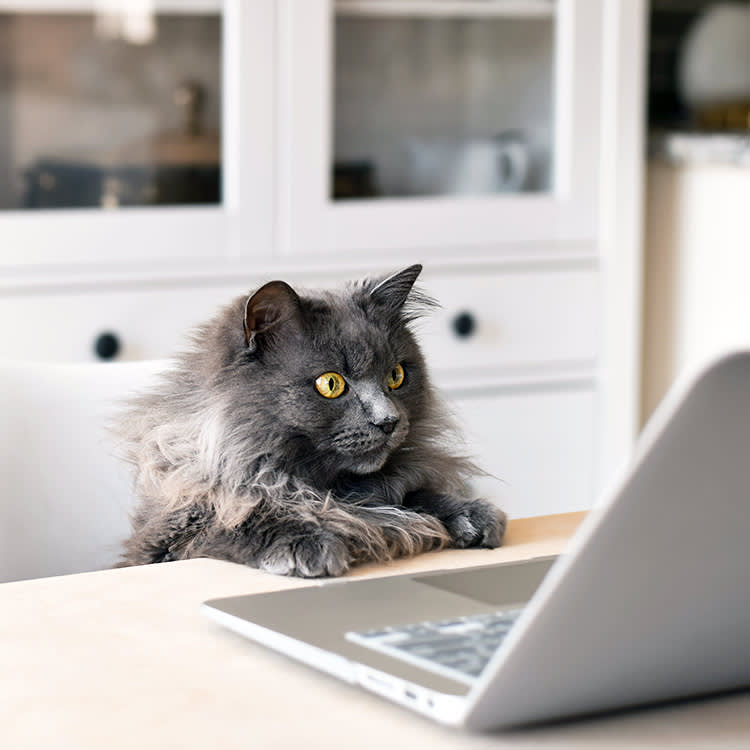
There is a long-running argument in my house about which of our three cats is the smartest. Freddy is the brave one, the only cat who trots to the door to vet our guests while her brothers cower in the next room. Wilbur has something sharp going on behind his enormous green eyes, right up until he plants his rear end in my face. And poor Winston, who headbutts hard enough to bruise and wails tragically at the food canister at non-mealtimes, gets handed the dunce cap by default.
We are being ridiculous, obviously. But the ranking instinct is worth examining, because it is built on a flawed premise. “Smart” is not a single dial that runs from dim to genius. The cats people call brilliant and the cats they call clueless are usually just good at different things, and once you stop asking “is my cat smart” and start asking “what is my cat good at,” the whole picture gets more interesting, and a lot kinder.
“We tend to treat intelligence as one number, the way we do with an IQ test,” says Dr. Lena Park, a veterinarian who works with feline behavior cases. “Cats don’t work that way. A cat can be a brilliant problem-solver and hopeless at reading your routine, or the reverse. What looks like a dumb cat is often a cat whose strengths just aren’t the ones you happen to be testing for.”
So here is a better field guide: the real signs of a clever cat, sorted by the kind of cleverness each one reveals.
Memory and pattern skills
They have your routine memorized. Of course your cat knows when it is feeding time. But a cat with strong pattern recognition also clocks when you are about to leave for work, when you usually come home, and when you tend to settle onto the couch and reach for the remote. They are not reading your mind. They are running a quietly sophisticated model of your day, built from watching you closely.
They know their name, and other names too. Glancing up when you say their name is the classic at-home intelligence test, and it is genuinely meaningful even though cats are famously bad at performing on command. Research has shown cats really do recognize their own names, and in multi-cat homes they can learn their housemates’ names as well. So whether or not your cat bothers to react, a sharp one knows perfectly well when they are the subject of conversation.
Observation and learning skills
They figure out how things work. Can your cat nudge open a door or paw at the faucet for a drink? There is a good chance they learned it by watching you. Observational learning, picking up a behavior by seeing someone else do it, is a marker of higher cognitive ability, and the cats who do it are paying close, deliberate attention to the humans they live with.
They are skilled hunters, even indoors. Watching an indoor cat stalk, freeze, and pounce on a feather wand, you can practically see the math happening. Hunting demands planning, timing, spatial awareness, and impulse control, all genuine cognitive horsepower, and it does not matter in the slightest that the “prey” is a hair tie. A cat who hunts a toy with real strategy is a cat with a real brain working.
The mischief signal (and why it gets misread)
They get into trouble on purpose. A clever cat can be a menace, and this is the sign owners most often mistake for stupidity or spite. When a cat sweeps things off a table or wriggles into a cabinet, they are rarely being “bad.” They are bored, curious, and intelligent enough to go looking for stimulation, sometimes specifically to get a reaction out of you.
The tell is the look-back. A cat who knocks a pen off the mantel and then peers around the corner to check your face is not confused, they are running an experiment, and you are the variable. That is a smart cat who is desperately under-stimulated. The fix is almost never discipline; it is a more interesting environment, which we will get to.
How to actually test your cat at home
Most “is my cat smart” quizzes online are nonsense, but a few low-stakes experiments will tell you something real about how your cat is wired. Try these over a week:
- The cup game (object permanence). Let your cat watch you hide a treat under one of three cups, shuffle them slowly, and see whether they go to the right one. Cats with strong spatial memory track it well.
- The novel-problem test. Put a treat inside a closed paper bag or a loosely lidded container and watch their approach. A methodical cat tries one tactic, then another. This is problem-solving, not magic.
- The recall test. Use a consistent word or sound right before something good for two weeks, then try it cold. If they come, they have linked the cue to the outcome, a learning win.
- The routine test. Note whether your cat starts gathering near the door before you normally leave, with no obvious trigger. That is pattern prediction in action.
The point of these is not to assign a grade. It is to notice which skills your particular cat leans on, so you can play to them.
Breed gives hints, not verdicts
Breed does not determine intelligence, but generations of selective breeding have nudged certain skills along, which is why some breeds show recognizable tendencies:
- Bengals are athletic, with exceptional balance and body awareness.
- Abyssinians are precise, efficient hunters.
- Oriental Shorthairs are problem-solvers who test systems rather than ask for help.
- Siamese are people-oriented and unusually attuned to human behavior.
- Ragdolls often show a striking sensitivity to human mood.
- Norwegian Forest Cats navigate complex spaces and remember routes well.
- Maine Coons tend to manage multi-cat social dynamics without picking fights.
- Russian Blues are cautious and observant, prioritizing safety over novelty.
- Persians excel at passive influence, getting their needs met by eliciting care rather than demanding it.
All of which comes with an enormous asterisk. There is huge variation within every one of these categories (anyone who has met a grumpy, antisocial Maine Coon knows this), and environment, early socialization, and mental stimulation can matter as much as genetics. Some of the sharpest cats are ordinary mixed-breed cats who happen to be curious, observant, and confident.
Every cat is smart in their own way
Ranking cats by intelligence is neither useful nor especially kind, and behavior professionals deliberately avoid it.
“We never say a cat is stupid,” says Dr. Lena Park. “We say they have trouble making certain associations. It sounds like a euphemism, but it is actually the more accurate description. Cats almost always have a reason for what they do; the job is to find the reason, not to grade the cat.”
If your cat is on the more puzzled end of things, you can meet them where they are by enriching their world: puzzle feeders, climbing posts, window perches, rotating toys, and real play sessions. Indoor cats especially need environments that mimic the variety they would get outdoors, surfaces to scratch, places to hide, hunting games, and vertical space to climb. A stimulated cat is a healthier, happier cat, and a happier cat tends to live longer, too.
Honestly, I would love to hear my own cats weigh in on which human in the house is the smartest. Then again, given that it is well past their dinnertime as I write this, maybe I would rather not know.
References
- Saito, A. et al., “Vocal recognition of owners by domestic cats,” Animal Cognition (2013)
- Saito, A. et al., “Domestic cats discriminate their names from other words,” Scientific Reports (2019)
- Takagi, S. et al., “Cats learn the names of their friend cats in their daily lives,” Scientific Reports (2022)
Nina Vasquez writes about life at home with pets and the relationships at the heart of it. Her work covers day-to-day living, people-and-pet stories, and the products that fit into a real household, with a warm, grounded take on everyday pet ownership.
Meet our experts ↗Keep reading
 TrainingBreed Barely Predicts Your Cat's Personality. Here's the ProofDr. Ravi Mehta · 6 min
 TrainingYour Cat Isn't Seeing Ghosts. They're Finishing a Hunt That Never Started.Dr. Lena Park · 6 min
 TrainingYour Cat Isn't Attacking the Wall. Read the Spot.Dr. Amara Solis · 7 min
 TrainingPaper Is the Best Cat Toy in Your House. It's Also a Trap.Dr. Ravi Mehta · 7 min
 Health & WellnessThe Cucumber Was Never the Point: 8 Everyday Things That Terrify CatsDr. Mara Chen · 6 min
 TrainingYour Cat Says 'I Love You' Constantly. You Keep Missing It.Dr. Amara Solis · 6 min