


The Cucumber Was Never the Point: 8 Everyday Things That Terrify Cats
That viral cat-versus-cucumber clip gets the fear all wrong. Here are eight ordinary household things that genuinely spook cats, and the one reason most of them do.

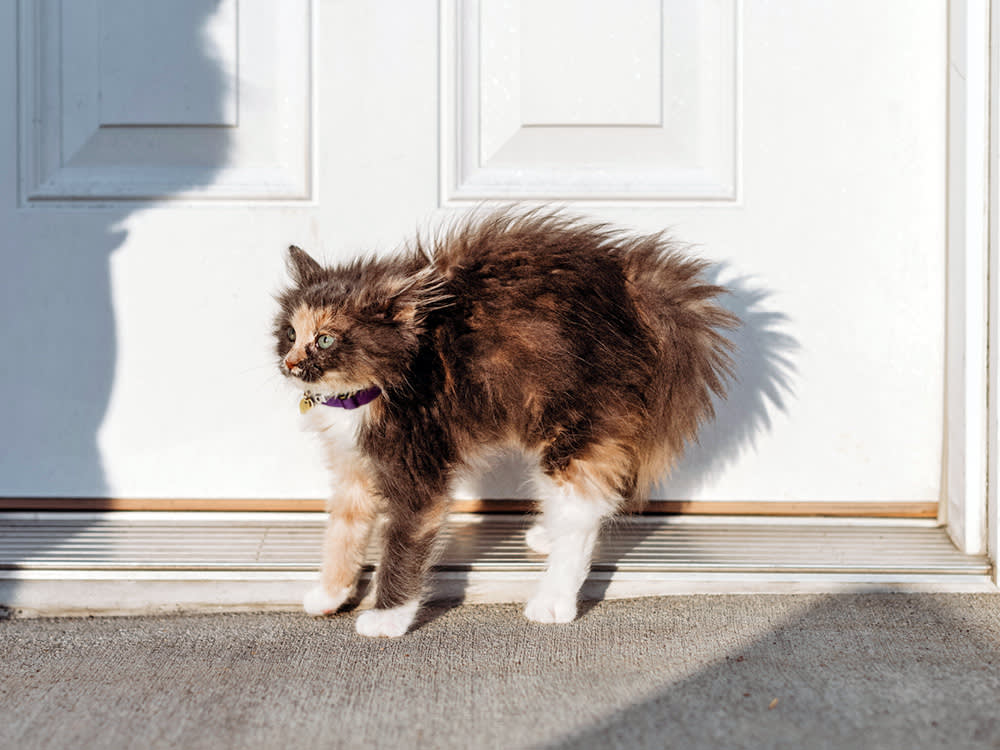
You have seen the videos. A cat is minding its business at the food bowl, someone quietly sets a cucumber behind it, and the cat launches straight up like a furry firework. It is funny once. It is less funny when you understand what is actually happening, which is that the cat believes, for a fraction of a second, that a predator has appeared out of nowhere at close range.
That is the thread running through almost everything on this list. Cats are not skittish because they are fragile. They are skittish because a small hunter that is also prey survives by treating anything sudden, silent, and unfamiliar as a threat until proven otherwise. Once you see fear that way, the “weird” things that scare cats stop looking random and start looking like a very old survival system doing its job.
People read a spooked cat as dramatic or silly, but the startle is information. A cat that bolts from a new object is telling you its threat radar fired before its thinking brain could catch up. The kind move is to lower the surprise, not to stage more of it for a laugh.
Below are eight ordinary things that set cats off, and why. You will notice a pattern: it is rarely the object itself. It is the ambush.
1. Cucumbers, bananas, and other silent surprises
Let us settle the cucumber first, because it is the marquee act. The popular theory is that the shape reads as a snake. The more likely explanation is simpler and less exotic: a cat glances up from eating, and an object that was not there a moment ago is now inches from its body. Bananas trigger the same jump. So does, for at least one very online cat, a single strawberry. The common ingredient is not produce. It is a thing appearing suddenly in a spot the cat had already checked and declared safe.
This is also why the cucumber prank is worth retiring. You are not testing your cat’s sense of humor. You are ambushing an animal at the one place it is supposed to be able to let its guard down.
2. Masks, hats, and anything that changes your outline
To a cat, you are a familiar silhouette that smells right. Put on a Halloween mask, a big hat, sunglasses, or even a headband with fake ears, and you break the picture. The shape is wrong, and for a beat the cat is dealing with a stranger who has your scent, which is arguably more alarming than a simple stranger. Plenty of cats will flee from a costumed owner and settle the second the mask comes off and the outline snaps back to normal. Same principle as the cucumber: the thing that was safe a second ago suddenly is not.
3. Balloons and bubbles
Balloons and bubbles combine two things a cat’s nervous system hates: unpredictable movement and the threat of a sudden pop. They drift in ways nothing natural drifts, they change direction on a breeze, and they can vanish with a bang. Some cats will chase a bubble happily and then flee the instant one bursts on their nose. Others take one look at a balloon bobbing near the ceiling and vacate the room entirely. Both reactions make sense for an animal wired to distrust anything that moves on its own.
4. Ticking clocks and small electronic sounds
This one has no tidy evolutionary story, which is honestly the point. Some cats are perfectly content near a wall clock until the day they register that it is ticking and the hands are twitching every second, and then it becomes a menace. High, repetitive, mechanical sounds, the kind just at the edge of a cat’s excellent hearing, can be genuinely unsettling to an animal built to notice the faint rustle of a mouse. If your cat suddenly wants nothing to do with a spot it used to love, listen for what you have been tuning out.
5. Aluminum foil
Pull a sheet of foil off the roll and you may watch your cat evaporate. Foil is a triple threat: it is bright and reflective, it makes a sharp crinkling sound, and it has a texture most cats actively dislike underfoot. There is sometimes a fourth reason, too. Foil is a classic homemade deterrent for keeping cats off counters and furniture, so a cat that lived somewhere else before you may have learned, the hard way, that the shiny crinkly stuff means “get down.”
6. Citrus and other loud smells
Here is the added one the classic lists skip. A cat’s nose is its primary reality check, and citrus reads to many cats as a hard no. Orange, lemon, and lime oils, along with strong menthol and some cleaning products, can send a cat backing out of a room fast. It is not fragile taste; it is chemistry. Citrus is such a reliable turn-off that it gets marketed as a natural cat repellent, which tells you how strongly the average cat feels about it. Worth knowing before you mist the counters with a lemon spray and wonder why the cat has relocated.
7. Change of almost any kind
Not coins. Change. Cats build a detailed mental map of their territory, and they notice when a piece of it moves. A new chair, a rearranged bookshelf, a suitcase left open in the hall, a rug that got washed and smells wrong now, all of it can read as “something is different, and different might be dangerous.” Most cats recover within a day or two once the new thing proves harmless. The trick is to let them investigate on their own clock rather than carrying them over to sniff it.
8. The carrier and other no-exit spaces
Cats adore a good box. They will wedge themselves into a shoe, a sink, or a paper bag with obvious joy. So why the meltdown at the carrier? Because a box on the living room floor is a hideout the cat entered on its own terms and can leave anytime, while a zipped carrier is a trap. The difference is control. A tight space with a way out is a fortress; the same space with the door shut is a snare, and cats know the difference instantly.
What newer research adds
The old assumption was that a scared cat mostly needed to “toughen up.” Current behavior work points the other way: chronic startle and hiding are increasingly treated as welfare signals worth addressing, not quirks to laugh off. Vets and behaviorists now lean on gradual, low-pressure exposure, letting a cat approach a new object at its own pace with a treat waiting, rather than flooding it with the scary thing to prove there is nothing to fear. Flooding tends to backfire and cement the fear.
The other shift is practical. Environmental tools that were niche a few years ago, like calming pheromone diffusers and thoughtfully placed high perches and hideouts, are now standard first-line advice for anxious cats, because a cat with a reliable escape route panics less in the first place. If your cat seems frightened often, that is a conversation worth having with your vet rather than a personality trait to wait out.
None of this means you have to cat-proof the universe. It means the next time your cat rockets off the counter, the useful question is not “why is my cat so dramatic,” but “what just ambushed them,” and how you can make the surprise a little smaller next time.
Dr. Chen is a small-animal veterinarian who leads health and safety coverage at The Pet Times. She writes and reviews the bulk of our illness, condition, and safety content, translating clinical guidance into clear, practical advice owners can act on at home.
Meet our experts ↗Keep reading
 TrainingYour Cat Isn't Aloof, Waterproof, or Low-Maintenance: 8 Myths to RetireDr. Nina Kohl · 8 min
 Health & WellnessThe Cat Loaf Has a Dark Version. It's in the Face, Not the Paws.Dr. Mara Chen · 8 min
 Health & WellnessYes, Female Cats Spray. Spaying Doesn't Always Stop It.Dr. Lena Park · 7 min
 TrainingThat Belly Is Not an Invitation. It's a Sentence.Dr. Nina Kohl · 6 min
 TrainingYour Cat Is Not Judging You. Your Cat Cannot Judge You.Dr. Mara Chen · 9 min
 Health & WellnessThe Glow in Your Cat's Eyes Is a Free Eye Exam. Learn to Read It.Dr. Ravi Mehta · 8 min