


Your Cat Doesn't Read Emotions. Your Cat Reads You
Cats adjust their affection to your happy or angry face, but not to a stranger's. That gap is the whole story: feline emotional attunement is learned about one specific person, which changes what it means when your cat responds to your mood.

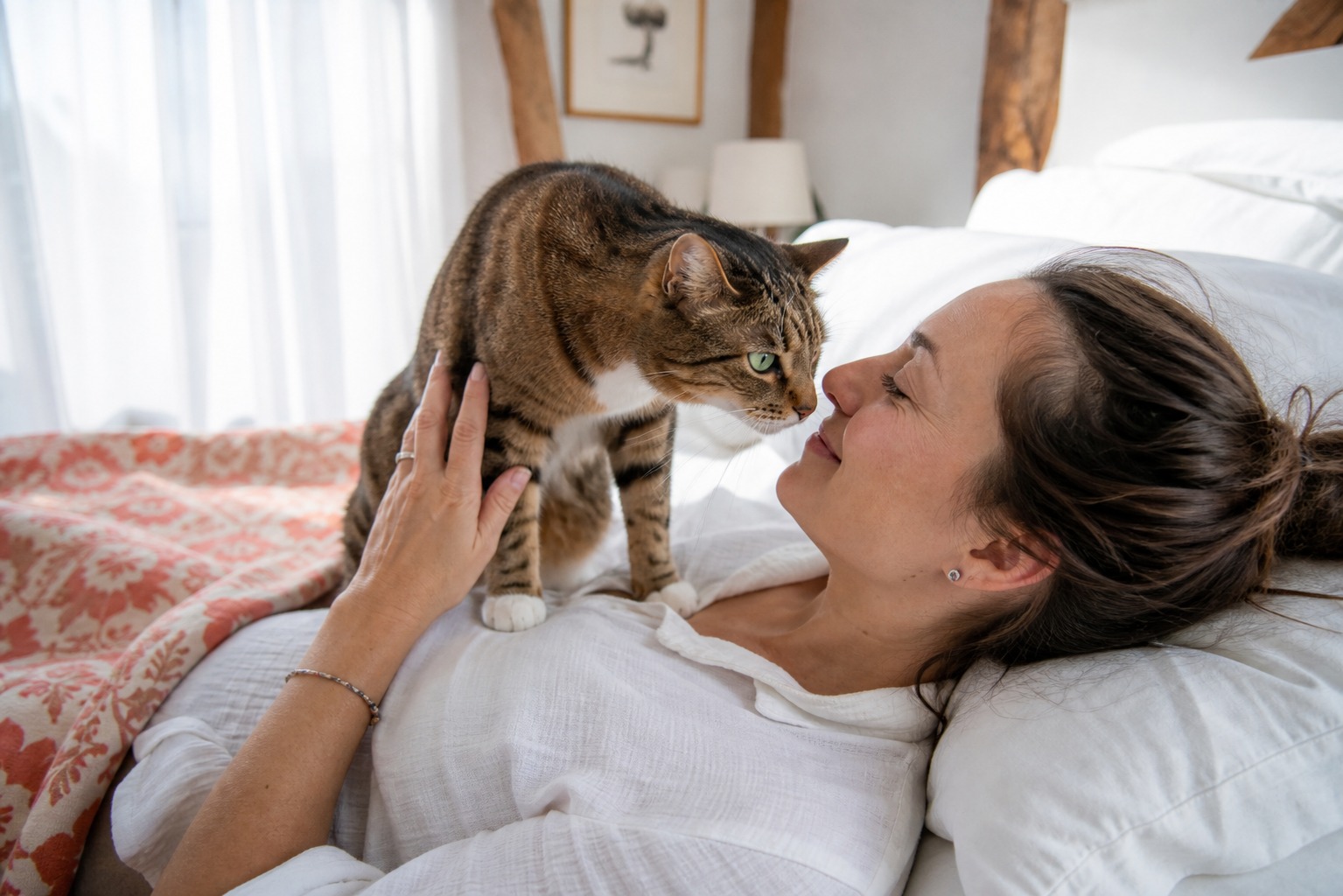
The headline you usually see is “cats can read human emotions,” and it is not quite right. The more accurate and more interesting version is that cats read one human’s emotions: yours. In the study that started this conversation, cats shifted their behavior based on their own owner’s happy or angry expression, but showed no such response to a stranger doing the exact same thing. That single detail flips the whole meaning. What looks like innate feline empathy is actually something your cat learned, specifically about you, over time. It is not that cats understand faces. It is that your cat understands your face, because they have been studying it.
That distinction matters, because it tells you where the attunement comes from and what it takes to build it.
What the study actually found
Researchers publishing in the journal Animal Cognition had owners display either a happy expression and posture or an angry one, then watched how their cats responded. The shift was modest but real. Facing a happy owner, cats offered more purring, more rubbing, and more time in the lap. Facing an angry owner, they held back the affection.
The revealing part is what did not change. Cats approached their owner just as readily whether the person looked happy or angry. Curiosity brought them over either way. What changed was what happened after they arrived, how much warmth they were willing to invest once there.
The cats weren’t avoiding their owners when those owners looked angry, they were still curious enough to come over. What changed was how much warmth they were willing to invest once they got there. That is sensitivity to mood, not just to whether a person is around.
The stranger result is the real finding
Here is the part that gets skipped, and it is the most important. When unfamiliar people displayed the same happy or angry expressions, the cats did not adjust at all. Zero pattern. The emotional radar only worked on the cat’s own person.
That points squarely at learning rather than instinct. A cat appears to build an association over many repetitions, my person’s happy face tends to precede good things, my person’s angry face tends to precede less pleasant ones, and acts on that private knowledge. They are not decoding a universal human expression. They are decoding a familiar individual whose patterns they have mapped. It may take time and exposure for that map to form, cats may not generalize the meaning of an expression from one person to another, or they may simply extend strangers the benefit of the doubt until given a reason not to. Whatever the mechanism, the takeaway is the same: your cat’s attunement to you is earned, not automatic.
It is not just faces, and it is not just one study
This finding does not stand alone, which is worth knowing before dismissing it as a single quirky experiment. It sits inside a growing body of work on how cats read their people.
The most striking companion study tested “social referencing,” the habit of checking a trusted person’s reaction to decide how to feel about something new. Researchers placed cats in a room with a genuinely odd object, an electric fan draped in fluttering green ribbons, nicknamed the “Crazy Green Monster.” About 79 percent of the cats looked back and forth between the strange object and their owner, visibly consulting the human before deciding what to do. And it changed their behavior: cats whose owners reacted negatively to the object spent more time looking toward the room’s exit than cats whose owners stayed calm and positive. The cats were using their person as an emotional reference point for an unfamiliar situation, exactly what you would expect if they read that specific person’s cues.
Other research adds that cats socially engage differently depending on an owner’s broader emotional state, interacting more with people who are agitated or, in some findings, low. None of this makes the cat a mind reader. It makes the cat a close, patient observer of one human they have decided to pay attention to.
What this changes for you
The practical implication is not that you should perform happiness for your cat, or walk on eggshells around them. It is subtler and kinder than that.
“If you’re frustrated, your cat can pick up on it, and they may keep their distance just when you’d most want their company,” Dr. Chen notes. “That isn’t a reason to fake a mood. It just means your expression is part of the conversation you’re already having with your cat, and that conversation is built over time.”
There is also a genuinely useful corollary. Because the reading is learned and relationship-specific, it strengthens with the relationship. The more consistent and positive your everyday cues, the better your cat gets at reading you, and the more that quiet mutual attention deepens the bond. A cat that consults your face when something startling happens is not being clingy. It is telling you that, out of everyone in the world, you are the one whose reaction it trusts.
So the next time your cat softens when you smile, or hangs back when you scowl, resist the flattering “they can read emotions” story. The truer one is better: your cat has spent a long time learning you in particular, and that is not something they extend to just anyone.
Frequently asked questions
Can cats really tell when I am happy or angry? Yes, but the research shows they respond to their own owner’s expressions, not to strangers displaying the same emotions. The attunement appears to be learned about a specific familiar person rather than a general ability to read human faces.
Does my cat feel my emotions the way another person would? Not exactly. What the evidence supports is that your cat has learned to associate your particular cues with good or less-good experiences and adjusts its behavior accordingly. It is close observation of you, not human-style empathy.
Do cats look to me for cues in scary situations? Often, yes. In a social-referencing study, about 79 percent of cats looked back and forth between a strange new object and their owner, and those with negative-reacting owners moved more toward the exit. Cats use a trusted person as an emotional reference point.
Should I hide my bad moods from my cat? No need to fake anything. Just know that your expression is part of your ongoing exchange with your cat, and that consistent, positive everyday cues help your cat read you better and strengthen the bond over time.
References
- Galvan, Moriah, and Jennifer Vonk. “Man’s Other Best Friend: Domestic Cats and Their Discrimination of Human Emotional Cues.” Animal Cognition, vol. 19, no. 1, 2016, pp. 193 to 205. https://doi.org/10.1007/s10071-015-0927-4
- Merola, Isabella, et al. “Social Referencing and Cat-Human Communication.” Animal Cognition, vol. 18, no. 3, 2015, pp. 639 to 648. https://link.springer.com/article/10.1007/s10071-014-0832-2
- “Emotion Recognition in Cats.” Animals, 2020. https://pmc.ncbi.nlm.nih.gov/articles/PMC7401521/
Dr. Chen is a small-animal veterinarian who leads health and safety coverage at The Pet Times. She writes and reviews the bulk of our illness, condition, and safety content, translating clinical guidance into clear, practical advice owners can act on at home.
Meet our experts ↗Keep reading
 TrainingYour Cat Is Trying to Bury Something. The Question Is What.Dr. Lena Park · 8 min
 TrainingThe Cat-Stress Study's Real Twist: Knowing Isn't the ProblemDr. Nina Kohl · 5 min
 TrainingStop Looking at Your Cat's Mouth. That's Not Where the Smile IsTom Hadley · 7 min
 TrainingYour Cat Isn't Seeing Ghosts. They're Finishing a Hunt That Never Started.Dr. Lena Park · 6 min
 Health & WellnessYour Male Cat Isn't Being Spiteful. He's Leaving You a Note.Dr. Mara Chen · 7 min
 TrainingThe Paw on Your Mouth at 4 A.M.? You Trained That.Dr. Amara Solis · 6 min