


A Food Truck for Dogs Sounds Like a Gimmick. The Argument Behind It Isn't.
Woofbowl sells grass-fed sliders and bone-broth 'beer' out of a truck. Underneath the theater is a claim the pet-food industry spent decades teaching you to reject.

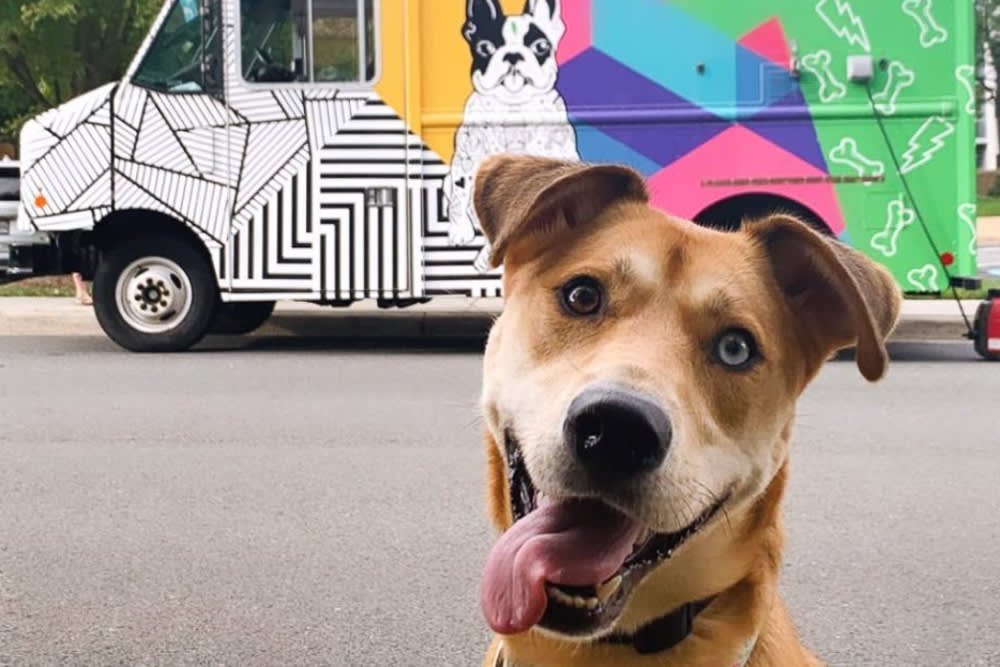
Pull up to Woofbowl and the first thing you get is the joke. A food truck, painted like a food truck, with a menu board, serving grass-fed beef sliders, chicken nuggets, grain-free pizza, ice-cream donuts, and bone-broth “beer.”
To dogs.
It’s funny, it photographs beautifully, and it is the least interesting thing about the business. Because parked underneath all that theater is a genuine argument about how dogs should eat, and it’s an argument the pet-food industry has spent an extremely long time and an extremely large marketing budget teaching people to dismiss on reflex.
The argument goes like this: “we don’t feed our dog human food” is a sentence somebody sold you.
The sentence that keeps coming up
Ron and Solo Holloway, the couple behind Woofbowl, hear it constantly. People approach the truck, look at the menu, and say some version of we don’t give our dog human food — as though fresh meat and vegetables prepared for consumption by an animal are somehow a lesser input than a high-heat-extruded pellet or a carb-based biscuit.
That’s the whole pitch, and it’s why the truck exists rather than a shelf product. It’s a lot easier to win that argument standing next to a person while their dog eats.
Their backgrounds explain some of the stubbornness. Ron came out of the US Navy, Solo out of engineering, and they pivoted into “fast food, doggie style” in 2017. It was intended as a truck from the beginning. They didn’t know other dog food trucks existed when they came up with it, and as far as they know they remain the only one serving fresh food rather than biscuits.
The dogs who started it
The proof-of-concept, as it usually is, was the founders’ own dogs: Latto and Dino, both Bulldogs, both mascots and both muses.
Bulldogs are famous for one thing in particular, and it’s not their profile. After the switch to raw, the Holloways say the gas went. So did the tear stains. Their coats got softer, they shed less, and their stools got smaller, less frequent, and considerably less pungent.
That last cluster is the detail that makes any long-time dog owner sit up, because it’s the one you can verify in your own yard within about a week of any diet change. It is not a clinical trial, and nobody should pretend it is. But it’s also not nothing, and it’s the reason people who switch a dog to fresh food tend to be evangelical about it afterward.
“Owners tell me their dog’s stool changed and I take that seriously, because it’s one of the few things they can actually observe daily,” says Dr. Lena Park. “What I’d add is that fresh and raw are not the same conversation. Fresh, cooked, complete, and balanced is an easy yes from me. Raw brings a real pathogen question into a house that may also contain a toddler or an immunocompromised adult, and that deserves a straight conversation with your vet rather than a vibe.”
What’s actually on the menu
Everything is made from scratch, in small batches, on original recipes, with the food-truck theme carried all the way through. Grass-fed beef sliders. Chicken nuggets. Grain-free pizza. Ice-cream donuts. And the bone-broth “beer,” which is the item everyone photographs.
The stated goal behind the whimsy is human-grade and nutrient-dense: clean meat protein, organic plant matter, and a design brief aimed at gut health, immunity, energy levels, muscle, and coat.
Asked which item is the customers’ favorite, the Holloways give the only correct food-business answer: everything on the menu is a favorite, because if it isn’t a favorite, it doesn’t stay on the menu.
The part that’s easy to skip past
Woofbowl is a Black-owned and veteran-owned business in an industry that is overwhelmingly neither.
The scale of that is worth stating plainly. More than 90 percent of veterinarians in the US are white, according to survey data reported by Time, and the wider pet-care industry looks broadly similar. The Holloways describe an industry that can be cliquey, and they describe something harder than cliquey: in the early days, Ron considered keeping his face out of the branding, out of a genuine fear that people would not support the business if they knew it was Black-owned. They still describe uncomfortable experiences on the road.
Their summary of the whole experience, though, is love, and their explanation for it is the one thing everyone reading this already knows to be true: dogs are unnervingly good at collapsing the distance between strangers. It’s a large part of why they got into this in the first place.
The sustainability isn’t a bolt-on
This is the part that most food businesses fake and Woofbowl appears to have designed in from the start.
Making treats fresh, daily, in small batches means there’s very little food waste heading to landfill, because they aren’t producing inventory that has to sit. The ingredients come from local farms picked for how they farm and graze: soil health, biodiversity, and carbon capture are the selection criteria. And on the packaging, they put the figure at 95 percent recyclable, compostable, or biodegradable.
Note what that 95 percent figure is not: a claim of perfection. It’s a specific, checkable number with a five-percent gap in it, which is roughly a thousand times more credible than “eco-friendly” printed on a bag.
What’s new since this was written
The truck moved. After a cross-country run west and a stint working Southern California dog spots, Woofbowl’s center of gravity is back on the East Coast, with the Holloways splitting their time between Brooklyn and the DC area, and pop-ups through Philadelphia and New Jersey along the way. If you’re trying to find them, chase the schedule rather than an address, because there isn’t one.
The broader shift is that the argument they started the truck to have is now much closer to being won. Fresh, gently cooked, human-grade dog food has moved from a fringe idea into a mainstream category with serious money behind it and a growing pile of research comparing it to extruded kibble on digestibility and stool quality. What was a weird thing to explain to strangers in a parking lot in 2017 is now a supermarket aisle.
Which is the funny thing about a gimmick. Wait long enough, and sometimes it just turns out to have been early.
References
- Woofbowl. mywoofbowl.com
- “Why Are There So Few Black Veterinarians?” Time. time.com
- “Black-Owned Small Business Woofbowl Delivers Smiles For Dog Lovers Amid Adversity.” U.S. Chamber of Commerce Foundation. uschamberfoundation.org
- “Raw or Undercooked Animal-Source Protein in Cat and Dog Diets.” American Veterinary Medical Association policy. avma.org
Not a substitute for your vet. Our guidance is educational. For urgent symptoms, contact a vet or emergency clinic right away. Editorial standards
Nina Vasquez writes about life at home with pets and the relationships at the heart of it. Her work covers day-to-day living, people-and-pet stories, and the products that fit into a real household, with a warm, grounded take on everyday pet ownership.
Meet our experts ↗Keep reading
 FoodYour Dog's Next Treat Could Help Wipe Out an Invasive Species. That's the Whole Idea.Marcus Webb · 7 min
 Food"Sustainable" Pet Food Is a Word With No Rules. Here's What It HidesLeila Torres · 8 min
 Food5 Reasons to Cook for Your Dog. Just Don't Cook All of It.Dr. Priya Nair · 6 min
 FoodSweet Potato Is a Real Dog Superfood. One Rule Makes It Safe.Dr. Priya Nair · 5 min
 Food7 Foods the Internet Swears Are Bad for Dogs. They Aren't.Dr. Amara Solis · 6 min
 FoodYour Dog Has a Sweet Tooth. That's Exactly the Problem.Dr. Nina Kohl · 7 min