


Most Dog Stretches Are Nothing. One Is a Race to the Vet
That big morning stretch is almost always exactly what it looks like. But one stretch, the belly-easing 'prayer' pose, can signal a life-threatening emergency. Here's how to tell an ordinary stretch from a red flag.

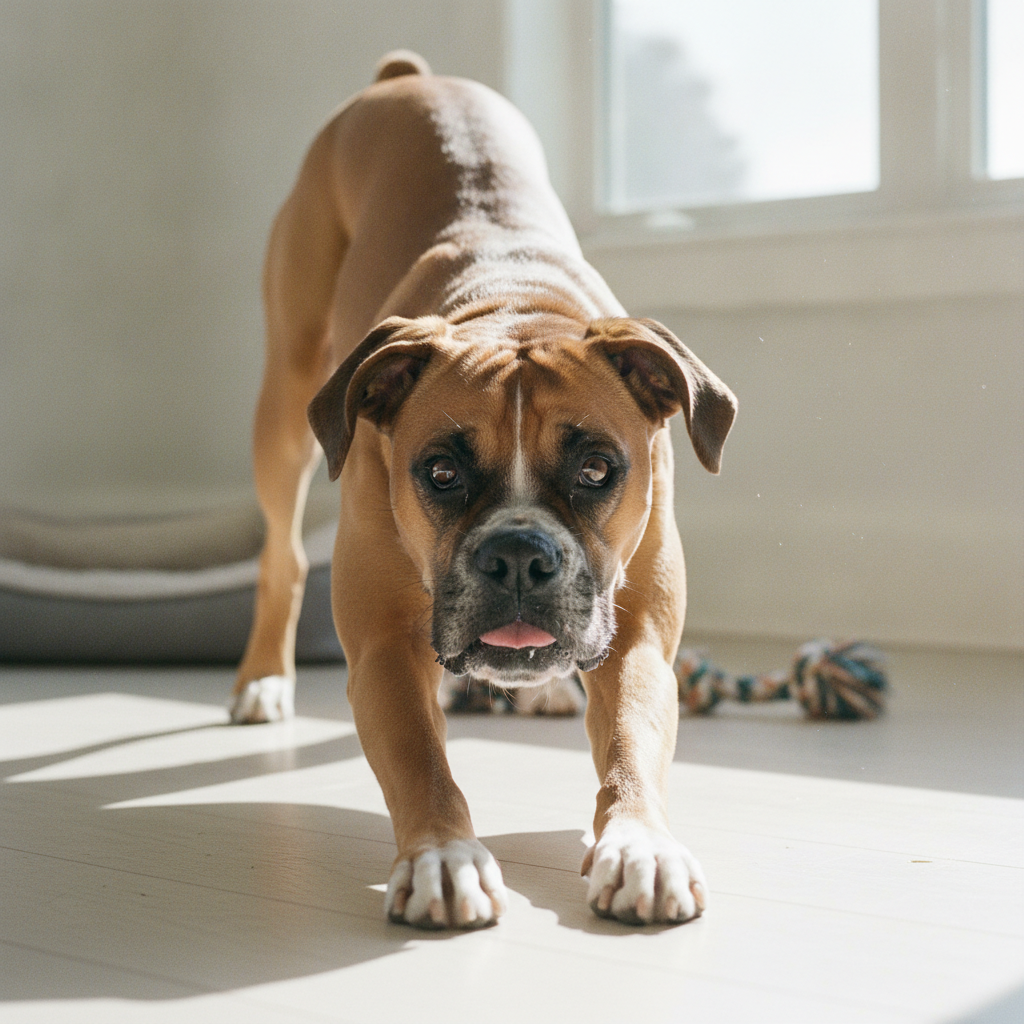
Your dog hauls itself up from a nap, front legs sliding forward, back end in the air, and lets out that satisfying groan. It’s one of the most ordinary things a dog does, and ninety-something percent of the time it means nothing more than “I was lying down and now I’m not.” Stretching is normal, instinctive, and mostly boring in the best way.
But stretching lives in a strange spot on the health radar, because one particular stretch, in the wrong context, is a genuine emergency. The skill worth having isn’t cataloging every reason dogs stretch. It’s knowing how to tell the everyday stretch from the one that means grab your keys. So let’s sort them into exactly those two piles.
The everyday stretches (the boring, good kind)
Most stretching is your dog’s body doing routine maintenance, and none of it needs anything from you but maybe a walk.
The wake-up reset. Dogs, like us, stretch and yawn when they get up, a combined move with a name: pandiculation. It’s the body resetting the muscular and nervous systems after rest, priming everything for movement. Interestingly, the stretch itself may not feel like much to the dog. The relief comes after, the same way a good stretch feels best once you release it.
The invitation to play. When a dog drops into a play bow, chest dropped and rump in the air, tail going, mouth open, it’s usually saying “let’s go.” You’ll often catch it the second you walk in the door, or when two dogs meet and size each other up. It’s a friendly, non-threatening signal, and the right response is to jump into a play session if you’ve got a minute. Expect some bouncing and a repeat bow or two as they let you know they’re delighted.
Loosening up. Dogs stretch to work tension out of tired muscles and shake off stiffness, especially after hard exercise or a long stretch of lying around. It supports flexibility and gets the blood moving, which keeps a healthy range of motion and heads off stiffness. If your dog seems to stretch and yawn a lot in a restless way, that can simply be a signal they need to burn energy, more walks, more play, more to do.
Boredom. Now and then a stretch is nothing more than a stretch, or a bored dog casting about for something to do. A dog short on exercise and mental stimulation can get anxious, and stretching may show up alongside yawning, which is itself a subtle early stress sign. The fix is enrichment: puzzle feeders, a stuffed chew, a long-lasting toy, and more activity in general.
If your dog goes long stretches between walks, it helps to build some interest into the day at home, a food puzzle parked at the top of a staircase, a secure way out to the yard, a food-stuffed toy, even dog-friendly TV. A stimulated dog stretches out of contentment, not restlessness.
The warning stretches (the kind to act on)
Here’s where attention pays off. The same basic motion, in a different context and with different company, can point at something that needs a vet, sometimes urgently.
Joint pain. Stretching more than usual, especially alongside stiffness or a reluctance to get going, can point to sore joints. Arthritis and joint pain grow common with age and appear earlier in dogs carrying extra weight or living with orthopedic problems. Look for the supporting cast: lower energy, difficulty with stairs, reluctance to jump onto furniture or into the car, more panting, and limping. A vet can palpate for soreness and swelling, gauge how freely the dog moves, and use X-rays to confirm arthritis, and there are plenty of ways to manage it, from prescribed medication and joint injections to supplements like fish oil or glucosamine. At home, shorter and more frequent walks, some time in the sun for vitamin D, and gentle stretch-massage can keep muscles supple and circulation up.
Bloat, the true emergency. This is the one to burn into memory. A dog folding into the “prayer” pose, chest to the floor and hindquarters raised, and holding it longer than a normal play bow, may be trying to ease belly pain, and one cause of that pain is gastric dilatation-volvulus (GDV), commonly called bloat or a twisted stomach. It is a life-threatening condition that occurs mainly in large, deep-chested breeds, and it can kill quickly. The warning signs clustered with that stretch: gagging and retching that brings nothing up, a visibly distended, hard, tender belly, drooling, restlessness that won’t settle, difficulty breathing, and signs of shock. If you see this combination, do not wait it out. Call your vet or an emergency clinic immediately, because with bloat the clock is measured in hours, not days.
Pancreatitis. Dogs vomit for all kinds of harmless reasons, but a dog that’s stretching repeatedly while also throwing up, turning down meals, and looking clearly miserable could have pancreatitis, and that needs quick veterinary care. The pancreas sits on the dog’s right side, inside the abdomen, and produces the enzymes that digest food along with hormones like insulin that regulate blood sugar. Pancreatitis is inflammation of that organ. It’s common, it strikes regardless of age, sex, or breed, it comes in both acute and chronic forms, and it’s frequently (though not always) triggered by a dog eating a large load of fatty food at once, which is exactly why the pan of Thanksgiving drippings should never be left within reach.
The stretch on its own almost never worries me, it’s what’s traveling with it. A loose, happy stretch is just a dog being a dog. A dog that keeps dropping its front end down with a tight, swollen belly and dry heaving is a different animal entirely, and in a big deep-chested breed I want that dog seen immediately. With bloat, minutes matter, so I would always rather see a false alarm than miss the real thing.
The rule of thumb
Read the stretch in context. On its own, in a relaxed, otherwise-normal dog, it’s maintenance, nothing to fix. What turns a stretch into a reason to call the vet is the company it keeps. Frequent stretching with stiffness suggests sore joints and a non-urgent vet visit. Stretching bundled with dramatic symptoms, vomiting, diarrhea, a distended or tender abdomen, difficulty breathing, fever, or signs of shock, means call your vet right away.
Stretching is one of the most normal things your dog does. Knowing the handful of times it isn’t is what makes you the person who catches the emergency early.
References
- American College of Veterinary Surgeons. “Gastric Dilatation-Volvulus.” https://www.acvs.org/small-animal/gastric-dilatation-volvulus
- American Kennel Club. “Bloat in Dogs: Symptoms, Causes, and Treatment.” https://www.akc.org/expert-advice/health/bloat-in-dogs/
- Cornell University College of Veterinary Medicine. “Pancreatitis in Dogs.” https://www.vet.cornell.edu/departments-centers-and-institutes/riney-canine-health-center
- VCA Animal Hospitals. “Osteoarthritis in Dogs.” https://vcahospitals.com/know-your-pet/arthritis-in-dogs
Common questions
When is dog stretching a sign of a problem?
When it's paired with other symptoms. Frequent stretching with stiffness can point to joint pain. Stretching into a 'prayer' pose with a bloated belly, retching, or restlessness can signal bloat or pancreatitis, both of which need urgent veterinary care.
What is the prayer position in dogs?
It's when a dog puts its front end down and keeps its rear end up, like a play bow that won't quit. In a playful dog it's an invitation. In a dog that's uncomfortable, restless, or bloated, it can be an attempt to relieve abdominal pain and is worth taking seriously.
Should I be worried if my dog stretches after eating?
A relaxed stretch after a meal is usually nothing. But stretching after eating combined with a swollen, tender abdomen, unproductive retching, drooling, or distress is a bloat warning, especially in large, deep-chested breeds. Call your vet immediately.
Not a substitute for your vet. Our guidance is educational. For urgent symptoms, contact a vet or emergency clinic right away. Editorial standards
Dr. Park is a board-certified emergency and critical care specialist. She reviews our health and safety content for clinical accuracy and contributes guides on recognising urgent conditions. Her focus is helping owners act quickly and correctly when it matters most.
Meet our experts ↗Keep reading
 Health & WellnessParvo in Dogs: Two Levers Decide Whether Your Puppy LivesDr. Priya Nair · 7 min
 Health & WellnessYour Dog Is Limping. Here's the 48-Hour Rule.Dr. Priya Nair · 8 min
 Health & WellnessYour Dog's Red Eye: When to Treat It as an Allergy, and When to Assume the WorstDr. Amara Solis · 6 min
 Health & WellnessCooked Salmon Is a Gift. Raw Fish From a Lake Can Kill Your Dog.Dr. Priya Nair · 5 min
 Health & WellnessBlood in Your Dog's Pee: What the Color, Timing, and Stream Are Telling YouDr. Amara Solis · 9 min
 Health & WellnessTylenol Is the 'Gentle' Painkiller That Quietly Wrecks a Dog's LiverDr. Amara Solis · 8 min