


Your Dog Reads You Better Than a Chimp Can. That's Not an Accident.
Point at a hidden treat and your dog gets it instantly. Do the same for a chimpanzee, our closest relative, and it's baffled. The gap isn't about intelligence. It's the fingerprint of thousands of years spent evolving alongside us.

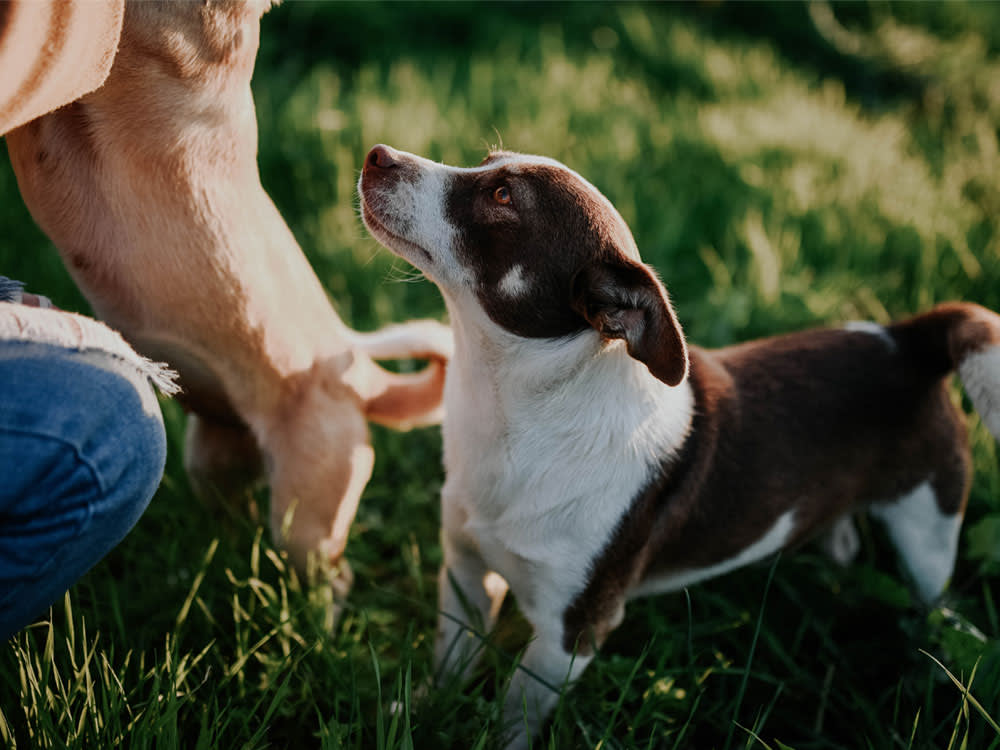
Here is a small experiment you can run at home. Hide a treat under one of two cups while your dog isn’t looking, then point at the correct cup. Your dog will trot right over to it. It feels so obvious that it barely registers as a skill.
It should. Run the same test on a chimpanzee, the species that shares the most recent common ancestor with us, and it will struggle. Our nearest evolutionary relative, with a bigger brain and famous problem-solving chops, cannot reliably read a pointed finger. Your dog does it without being taught. That contrast is one of the more surprising findings in animal cognition, and the reason behind it reframes what the bond between you and your dog actually is.
The question almost no one was asking
For a long time, the assumption ran the other way. Domesticated animals have smaller brains than their wild counterparts, and it was easy to read “smaller brain” as “duller mind.” Science was more interested in exotic and wild animals; the dog snoring on the couch seemed too ordinary to study.
The breakthrough came from a researcher who noticed the mismatch between the lab and his own backyard. Working with chimpanzees and watching them fail at simple communication tasks, he kept thinking about playing fetch as a kid, how his dog would follow a pointed finger straight to a hidden ball. The chimps couldn’t do what his childhood dog did without thinking. So he went looking for an answer, running simple tests on ordinary pet dogs.
What the tests showed
The core experiment was elegant. A person hid food in one of two containers, and the animal, a dog, a wolf, or a chimp, who had not seen where it went, got to choose. Before choosing, the animal was given a hint: the experimenter looked at, pointed to, tapped, or marked the right container. The question was simply who could read the human cue.
Dogs won, and it wasn’t close. They outperformed both chimps and wolves at using human social signals to find the food. Two details made the result more than a curiosity.
First, puppies were already good at it, regardless of age or how they had been raised. This was the finding that genuinely surprised the researchers. If dogs learned to read us purely from spending their lives around people, then experience and training would matter a lot. Instead, even young puppies with little human exposure were tuned in. The skill looked built-in, not merely absorbed.
Second, wolves, dogs’ closest wild relatives, were not nearly as skilled, even wolves raised around humans. So dogs did not inherit this talent from wolves, and they did not simply acquire it through a lifetime of human contact. Something else put it there.
Domestication, not training, did this
The pattern points to one explanation: dogs’ ability to read us was shaped during domestication itself. Over thousands of years living alongside humans, the dogs who could read our cues, follow a glance, catch a gesture, understand what we were trying to tell them, had an edge. They were more likely to be fed, kept, and bred. Their genes carried the skill forward.
This is cognitive evolution you can see in your living room. Reading human social cues wasn’t a trick we drilled into dogs. It’s a trait that got selected for, generation after generation, because the dogs who understood us thrived alongside us. When your dog follows your gaze, you’re watching the end product of that long partnership.
That is a genuinely different claim from “dogs are smart” or “dogs are well trained.” It says the sensitivity to human communication is baked into what a dog is, a species that co-evolved with us into a kind of interspecies fluency no other animal shares to the same degree.
Why it should change how you handle your dog
The most practical takeaway is almost counterintuitive: your dog may need less heavy-handed training than you think, because they are already primed to read you.
Dogs are so naturally flexible at picking up social cues that over-training can backfire, making a dog more rigid and less responsive to the subtle signals they are wired to catch. The lesson is not that training is useless, it is that a lot of communication with your dog is already happening beneath the level of formal commands. Your dog is watching where you look, how you move, what your body says. Leaning into that partnership, clear gestures, consistent signals, trusting your dog to read you, often works better than drilling.
There is a gentler implication too. If more owners understood that their dog has a mind, one shaped specifically to connect with ours, it might change how humanely dogs get treated. The dog reading your face is not a furry robot running commands. They are the result of an ancient collaboration, meeting you halfway across the species line.
None of this will shock anyone who lives with a dog. The feeling that your dog “just gets you” is not sentimental projection. It is, as it turns out, exactly what the science says is going on.
References
Dr. Kohl is a board-certified veterinary dentist with a particular interest in preventive oral care. She reviews all dental health content at The Pet Times and contributes practical guides on home dental routines, professional cleaning, and oral disease prevention.
Meet our experts ↗Keep reading
 TrainingYour Dog Doesn't Remember Your Face. They Remember How You Made Them Feel.Dr. Mara Chen · 5 min
 TrainingYour Dog Isn't Peeing on His Friend. He's Peeing on the Message Underneath Him.Dr. Amara Solis · 8 min
 TrainingYour Dog's DNA Isn't the Whole Story. The Part You Can Actually Change Is.Dr. Mara Chen · 5 min
 TrainingYour Dog Isn't Smiling. Here's What All Those Teeth Actually Mean.Dr. Nina Kohl · 6 min
 TrainingMarking Isn't a Potty Accident. Punishing It Backfires.Dr. Nina Kohl · 6 min
 TrainingYou Didn't Cause Your Dog's Leash Reactivity. Here's How to Manage ItDr. Amara Solis · 7 min