


Your Dog Doesn't Remember Your Face. They Remember How You Made Them Feel.
Canine memory doesn't work like a photo album. It works like a scent-and-feeling archive, which is why a dog can recognize you after years apart, and why first impressions stick.

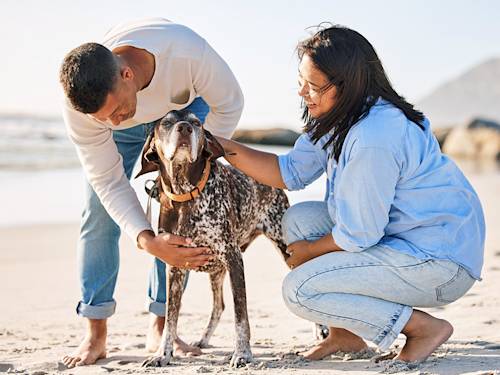
Every time my kid and I drive past a good dog, we both yell “cute dog!” and, if it’s convenient, stop for a pat. What I didn’t fully appreciate until I started looking at how canine memory works is that those thirty-second sidewalk encounters aren’t nothing to the dog. If we’re kind and interested, that dog files it away. If we’re cold or startling, they file that away too. The surprising truth about your dog’s memory is that it isn’t built from what you look like. It’s built from how you made them feel, and that changes what “being remembered by your dog” actually means.
We tend to imagine dog memory as a fuzzy version of ours: a mental scrapbook of faces and places. It’s better understood as an emotional and sensory archive. A dog’s strongest, most durable memories are tagged with a feeling, safe, exciting, uneasy, frightening, and indexed by smell and sound far more than by sight. Once you see it that way, a lot of dog behavior that seems mysterious starts to make sense.
Smell is the filing system
Put a dog’s nose next to ours and the gap runs into the tens of thousands of times over, by most estimates. The hardware explains it: roughly 100 million scent receptors in an average dog against the five or six million we’re working with, wired into a brain that hands a far bigger share of itself over to processing smell. Bloodhounds and the other tracking breeds push that receptor count toward 300 million. Smell isn’t one sense among several for a dog, it’s the primary channel through which they experience the world, capable of detecting scents from a distance and even picking up on illness and emotional states.
So when your dog recognizes you, the odds are their nose got there before their eyes did. Your personal scent is a more reliable identifier to a dog than your face, which is part of why a dog can pick their person out of a crowd or know you’re the one at the door before seeing you.
Sound and voice come next
Voice recognition does heavy lifting too. Those constantly swiveling ears aren’t just tracking distant noises; they’re reading a wide band of frequencies. When you speak, your pitch, rhythm, accent, and above all your emotional tone become part of a multisensory memory of you. The more your dog hears your particular voice, the more deeply that recognition gets wired in, and over time dogs come to recognize familiar words layered on top of the familiar voice saying them.
Sight matters least, and here’s why
Dogs can recognize faces and facial expressions, so vision isn’t irrelevant. It’s just not their strong suit. A dog’s color vision is limited to distinct blues and yellows, with reds and greens reading muddy, and images that look sharp to us can look blurry to them. What dogs win on is motion detection and night vision, which are survival tools, not portrait tools. Put simply, your face is a low-resolution detail in your dog’s picture of you. Your smell and your voice are the high-resolution parts.
Why feeling is the thing that lasts
Here’s where it comes together. Safety, delivered over and over by the same person, has a chemical signature: the dog’s brain answers with oxytocin, and oxytocin reinforces the very circuits that handle bonding and recognition. That is the machinery behind a dog imprinting on someone. Repeated positive emotional experiences don’t just get remembered, they get etched. A single warm, friendly meeting can leave a mark; a single frightening one can too. Dogs also hold onto the patterns we build over time, like when the walk happens and when the food bowl fills, a kind of episodic memory for the rhythms of shared life.
People ask me if their dog will remember them after a long time apart, and I turn the question around. The dog was never storing your face to begin with. They stored how safe you made them feel, in scent and tone. That kind of memory is sticky. It’s why a dog can fall apart with joy over someone they haven’t smelled in two years.
What newer research adds
Recent work keeps pushing back the ceiling on how much dogs actually retain. A 2024 study in the Royal Society journal Biology Letters found that “gifted word learner” dogs, the rare individuals who learn the names of objects, held onto those learned labels for at least two years without practice, real long-term memory, not a party trick. Other research has shown these dogs can even pick up new object names by overhearing their owners talk, without seeing the object, at accuracy levels that rival a young toddler’s. At the same time, studies on aging dogs have documented an episodic-like memory decline as they get older, a canine echo of what happens in human memory.
None of that changes the everyday takeaway, and if anything it sharpens it. Your dog’s memory of you is real, durable, and built mostly from feeling and scent rather than sight. Which means the way you’re remembered is squarely in your control: kindness, consistency, and calm, positive energy are what get written into the archive and kept.
Common questions
How long can a dog remember a person?
Strong emotional bonds, reinforced by scent, voice, and routine, appear to last for years and likely a lifetime. Dogs recognize and respond to people they've bonded with even after long separations.
Do dogs remember people they only met once?
Yes, especially if the interaction carried a strong feeling. A single kind, engaged meeting, or a single frightening one, can leave a lasting impression.
Do dogs remember using sight, or something else?
Smell first, then voice and emotional tone, then sight. A blind dog recognizes people about as easily as a sighted one, because vision was never a dog's primary tool for remembering us.
Dr. Chen is a small-animal veterinarian who leads health and safety coverage at The Pet Times. She writes and reviews the bulk of our illness, condition, and safety content, translating clinical guidance into clear, practical advice owners can act on at home.
Meet our experts ↗Keep reading
 TrainingTreats Teach the Trick. Meaning the 'Good Boy' Is What Makes It Stick.Dr. Ravi Mehta · 4 min
 LivingNetflix's Dog Documentary Is Great. The Title Is a Lie.Dr. Nina Kohl · 7 min
 LivingIs Your Dog Really Jealous, or Just Afraid of Missing Out? The Science Is Messier Than the Headlines.Dr. Nina Kohl · 5 min
 TrainingYour Dog Isn't Ignoring You. They Hear Things You Physically Can't.Dr. Lena Park · 8 min
 Health & WellnessPaw Chewing Is a Loop, Not a Habit. Breaking It Takes Two Moves.Dr. Amara Solis · 8 min
 TrainingYour Dog Nibbles You Like Corn on the Cob. Two Experts Disagree About What to Do.Dr. Nina Kohl · 8 min