


Your Cat Isn't Crashing Your Call. It's Crashing Your Focus
The tail across your screen has almost nothing to do with the screen. A behavior specialist explains the real trigger behind video-call interruptions and gives a timed, before-during-after protocol that actually works, with no punishment.

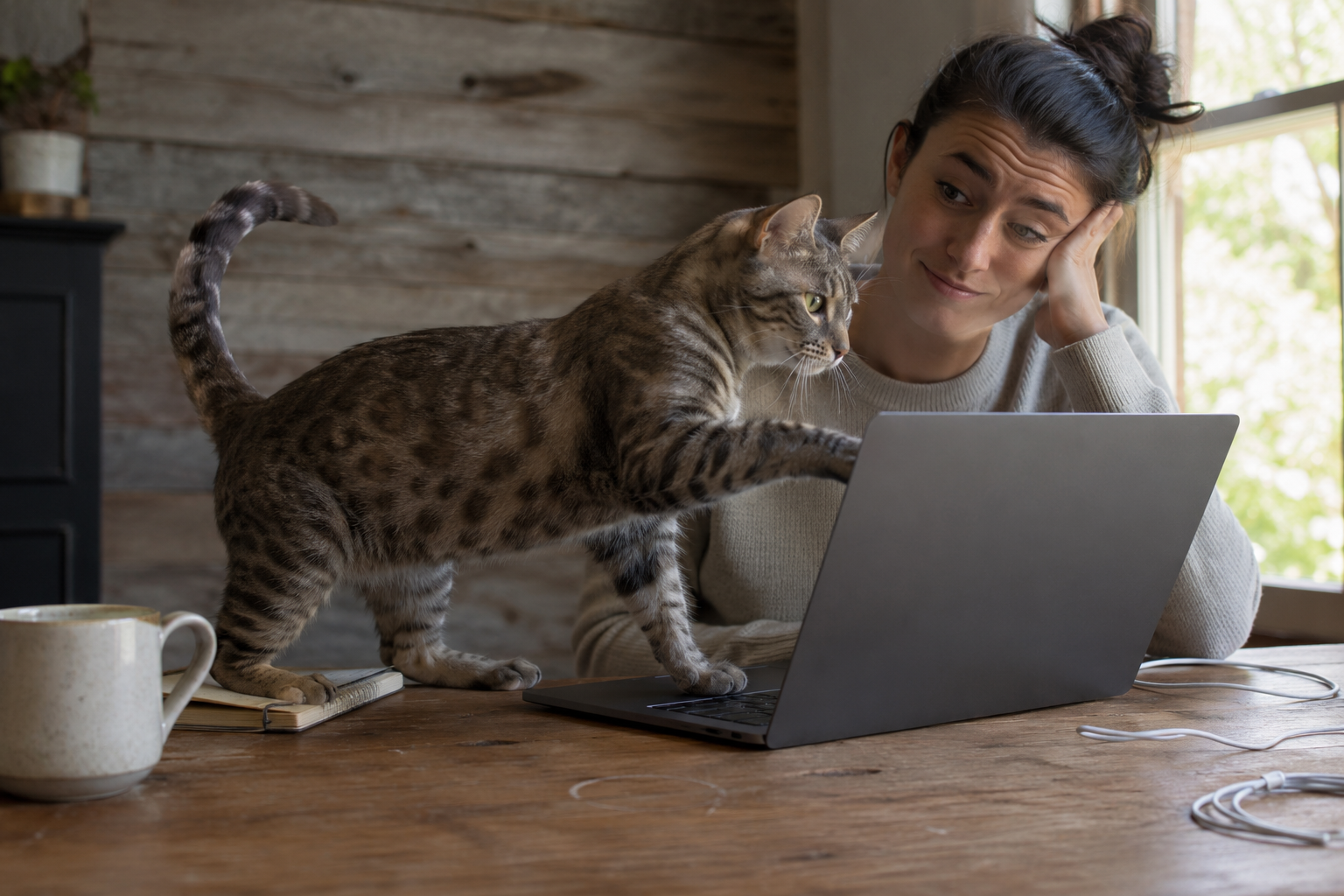
Almost every guide to this problem tells you your cat “wants attention,” which is true and also nearly useless, because your cat wants attention all day and does not walk across your keyboard all day. The interruptions cluster around one specific thing, and it is not the video call. It is your focus. The moment you become intensely engaged with something that is not your cat, while sitting still and unable to get up, you create the single most irresistible condition a cat knows: a present but preoccupied human. The screen is incidental. Solve for the focus state, not the screen, and the tail-in-the-face problem largely dissolves.
That reframe leads to a better plan than “give them attention.” Below is what is actually triggering it, a quick way to diagnose which trigger is yours, and a timed protocol built around a cat’s biology instead of against it.
What is really pulling your cat in
Strip away the screen and three overlapping triggers remain.
The first is your focus itself, read as a “giving” state.
Your cat sees you giving focused attention to something, and they want a piece of it. They do not know what a spreadsheet or a client call is. What they know is that you are in a giving mood, because you are clearly giving all this attention to the glowing thing in front of you. So they make their move.
This is why the behavior predates remote work entirely. Long before laptops, cats parked themselves on newspapers, homework, and open books, squarely on the page you were reading. The medium changed; the trigger, your absorbed attention, did not.
The second is that you look like you are talking to them. When you are animated, smiling, nodding, and speaking warmly at a screen, your cat may reasonably conclude the conversation includes them and come over to participate.
The third is that you are stuck. On a call you are vocally engaged, visually animated, and physically pinned to the chair, unable to easily disengage. To a cat, an owner who cannot get up is a captive audience.
The part nobody wants to hear: you trained this
Here is the uncomfortable mechanism underneath all three triggers.
“Most people reinforce the behavior just by reacting to it,” Vasquez says. “It does not take long for a cat to work out that walking across your desk gets them exactly what they want, which is your attention.”
The critical detail is that attention has no quality filter. Animals repeat what gets rewarded, and to a cat, being petted, laughed at, scooped up, or even scolded all register as the same jackpot: engagement. When your cat crosses the desk and you pet them, talk to them, or apologize to coworkers while lifting them away, you have paid out. That is why the behavior grows over time rather than fading.
Diagnose your trigger first
Before the protocol, spend one week noticing when the interruptions happen, because the fix shifts slightly depending on your trigger.
If they cluster at the same time every day, routine and pattern-learning are driving it; your cat has connected the clock to attention time. If they happen mostly when you get animated or laugh, your cat thinks it is being addressed. If they spike since you started working from home, your cat is adjusting to a new expectation, having previously had you only during off hours when you were fully theirs. And if they happen whenever you go quiet and still and focused, regardless of time, the focus state itself is the trigger. Most owners find it is a blend, but knowing your dominant one tells you where to push hardest.
The protocol: work with the hunt-eat-groom-sleep cycle
Cats run on a repeating loop, hunt, catch, eat, groom, sleep, and the whole loop ends in a nap. The mistake most owners make is trying to trigger this loop by petting the cat mid-call, which only rewards the interruption. The fix is to run the full loop deliberately before the call, in the right order and with the right timing, so your cat is biologically primed to sleep exactly when you log on.
Before (about 20 to 30 minutes out): run the loop. Do a genuine 10 to 15 minute interactive play session with a wand toy, chasing then a few “catches,” so it reads as a real hunt. Then feed immediately after, a meal or a substantial portion, not a token treat. The play-then-food sequence tells the cat’s brain the hunt succeeded, which flips them toward grooming and sleep. Order matters: food after the hunt, never before. This is strategy, not spoiling.
“If you know a call is coming, run the whole sequence first, hunt, then eat,” Vasquez says. “A cat that has hunted and eaten is heading for a nap, not your keyboard.”
During: give the loop somewhere to continue without you. Two tools help. First, a genuinely better resting spot right next to your desk, a cat tree or side table at screen height, warm (heated mats work well because cats seek warmth), positioned so your cat can see you and stay near you while staying out of the camera frame. Second, and this is the piece most advice misses, a food puzzle deployed at the start of the call. Puzzle feeders let a cat keep “hunting” for food on their own, and a body of veterinary work on food puzzles reports reduced anxiety and, specifically, the cessation of attention-seeking behaviors among the benefits owners observe. Load a puzzle with part of the post-play meal and set it out as you log on; your cat gets an independent activity that competes directly with pestering you.
After: reinforce the right spot. When you are off the clock, reward your cat every time they choose the new perch, with pets, gentle words, or a treat. Clicker training accelerates this: mark the moment they settle on the perch with a click, then reward. Over sessions the perch becomes the default. This works because it cooperates with how cats learn rather than fighting it.
What not to do
On one point every expert agrees: do not punish.
“Never punish them,” Vasquez says. “Your cat is not bad. They just want your attention.”
Yelling, clapping, and startling raise fear and stress, and, because any engagement counts as a reward, often backfire into a fun game where negative attention still beats none. Punishment is not just ineffective; it can deepen anxiety, erode trust, escalate the pestering, and create new problems.
If you must move your cat mid-call, do it as a non-event: no talking, no petting, no eye contact, just set them on the floor or their perch. Repeated calmly, the message lands. Closing the door is a last resort; most cats protest louder from the other side, especially a usually-open door, so pair it with real connection time off the clock.
A little perspective
Your cat interrupts you because you are a central figure in their world, often the central one. The interruption is a request, not a rebellion. Meet the underlying need on your schedule, through the timed loop, the better perch, and the puzzle, and you convert a distraction into a settled cat.
It will not vanish overnight; behavior change takes consistency. But run the protocol and you will see real improvement. Your calls may never be perfectly cat-free, and that is arguably one of the better perks of working from home, for both of you.
Frequently asked questions
Why does my cat only bother me during calls and not the rest of the day? Because a call puts you in the exact state cats find most magnetic: present, intensely focused on something that is not them, and physically unable to get up. The screen is incidental; the focus is the trigger.
Should I just give my cat attention when it interrupts? No. Attention delivered during the interruption rewards the interruption and teaches your cat to do it again. Meet the need before and around the call instead, on your terms.
What is the single most effective fix? A timed loop: a real play session about 20 to 30 minutes before the call, followed immediately by a meal, so your cat is primed to nap when you log on. Add a food puzzle during the call for an independent activity.
Is punishing my cat ever appropriate here? No. It increases fear and stress, can reinforce the behavior since even negative attention is attention, and damages trust. Remove the cat neutrally if needed and rely on positive reinforcement of a designated perch.
References
- Dantas, Leticia M. S., et al. “Food Puzzles for Cats: Feeding for Physical and Emotional Wellbeing.” Journal of Feline Medicine and Surgery, vol. 18, no. 9, 2016, pp. 723 to 732. https://pmc.ncbi.nlm.nih.gov/articles/PMC11148901/
- “Puzzle Feeders for Your Cat.” International Cat Care. https://icatcare.org/articles/puzzle-feeders-for-your-cat
- “Interactive Food Puzzles for Cats.” Preventive Vet. https://www.preventivevet.com/cats/interactive-food-puzzles-for-cats
Nina Vasquez writes about life at home with pets and the relationships at the heart of it. Her work covers day-to-day living, people-and-pet stories, and the products that fit into a real household, with a warm, grounded take on everyday pet ownership.
Meet our experts ↗Keep reading
 Health & WellnessYour Cat Pooping on the Carpet Isn't Spite. It's a Message You Rule Out in OrderDr. Amara Solis · 8 min
 TrainingThe Cat-Anxiety Mistake That Actually Gets Cats KilledDr. Amara Solis · 8 min
 TrainingCord Chewing Is a Fire Hazard First and a Bad Habit Second. Treat It in That OrderDr. Nina Kohl · 7 min
 TrainingYour Door-Opening Cat Isn't Nosy. It Needs a Harder PuzzleDr. Lena Park · 6 min
 TrainingYour Cat Doesn't Bury Their Poop? The Only Question That MattersDr. Amara Solis · 8 min
 TrainingThe Couch Isn't the Problem. It's Where You Put the Scratching Post.Dr. Nina Kohl · 7 min