


Your Door-Opening Cat Isn't Nosy. It Needs a Harder Puzzle
A cat that defeats your doors is not being bad. It is showing you an unmet need for control. Here is the wiring behind it, which of your doors are actually at risk, and how to redirect the Houdini act.

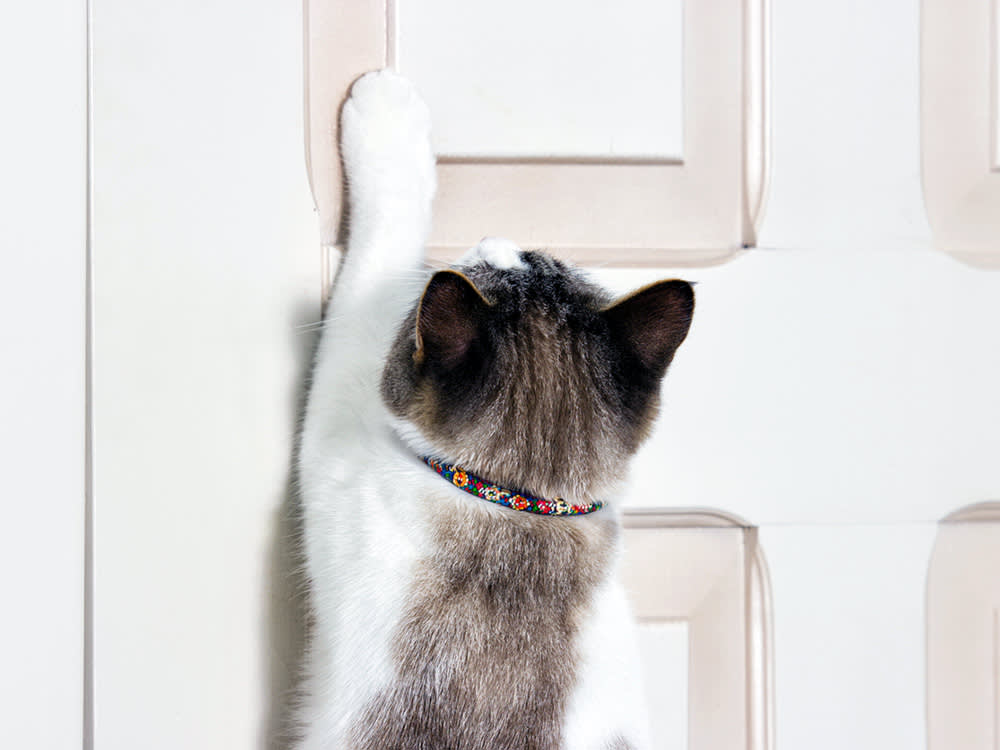
Most articles about door-opening cats treat it as a quirky party trick. It is more useful to read it as a message. A cat that spends an hour defeating your bathroom latch is not simply nosy. It is a smart animal telling you, in the only language it has, that it does not have enough control over its own environment and not enough to do. Solve for those two things and the Houdini act tends to fade on its own. Fight the cat directly and you will lose, because a bored, capable cat has more time and patience than you do.
So this piece is organized around the actual driver, not the trick. First, why the closed door bothers your cat so much. Then, which of your doors are genuinely at risk. Then, the redirect that works.
The real driver: cats hate losing the three Cs
Behaviorists talk about three things cats guard jealously: choice, control, and change. A closed door removes all three at once. It shrinks the territory the cat can choose to move through, strips its control over where it goes, and blocks the changing stream of smells and sounds that keep an indoor cat’s world interesting.
Closing a door restricts a cat’s territory, and that alone can spike anxiety. It gets worse if there is another pet in the home the cat wants the option to escape from. The ability to choose where they go is a big part of how a cat feels safe. Take it away and some cats get genuinely stressed, not just curious.
That is the part owners miss. For a confident, well-adjusted cat, the closed door is a fun problem. For an anxious cat, or one that grew up with lots of freedom and little confinement, it can read as being cornered, even when nothing on the other side is actually a threat. A cat blocked from retreating past a rambunctious dog or a frenemy cat may feel trapped. Reassurance first: it is not cruel to keep a cat out of a room for a real safety reason, and howling at the threshold will not damage them long-term. But knowing whether you are dealing with curiosity or anxiety changes how you respond.
Which of your doors are actually at risk
Not all doors are equally defensible, and cats have a clear pecking order of what they can defeat. Ranked from most to least vulnerable, so you know where to spend your childproofing budget:
Lever handles (most vulnerable). The nightmare scenario. A cat that learns to hang its body weight on one lever has effectively learned to open every lever in the house, because the skill transfers. If your interior doors have levers and you have a determined cat, assume no door is safe.
Doors left ajar. Any door not fully latched is a wedge point. Cats slip a paw into the gap and lever it wider, or hook and drag sliding and pocket doors along their track. The fix is boring but total: close doors all the way, every time.
Cabinets and drawers. Lightweight cabinet doors and even some drawers fall to persistent pawing and headbutting. This is where the danger usually lives, because cabinets are where cleaning chemicals, medications, and trash are.
Round doorknobs (most secure). The one mercy. Smooth metal knobs defeat most cats. They often understand the knob must turn, they simply cannot get traction on it. One owner described a cat who grasped the rotation concept completely yet was saved only by physics — no grip on polished metal — and admitted that lever handles would have surrendered the whole house. If you are renovating and you have a Houdini, knobs over levers is a real security decision.
How they learn it (and why folklore isn’t crazy)
The learning itself is textbook operant conditioning. A cat shoves a door with its head, the door happens to swing open, and the cat has just discovered that a specific action produces a reward. So it repeats the action, refines it, and gets faster. Over time you get the full toolkit: body-slamming, paw-wedging, handle-hooking. None of it is planned. It is trial, accident, and reinforcement, which is exactly how cats learn most things.
Personality decides who bothers. Some cats are natural “optimists” who troubleshoot a problem until they crack it; others simply lack the drive or the coordination and never try. And the old folklore that the worst escape artists are orange and tabby cats, especially ones with outdoor histories, is anecdotal but widely echoed by people who work with a lot of cats.
The punchline: there’s usually nothing back there
Here is what makes the whole thing funny and also tells you how to fix it. The forbidden room your cat wages a multi-day war to reach almost always contains a bath mat and some towels. The outcome was never the point. The problem-solving was. A closed closet is a puzzle, and for a cat wired to hunt, working a puzzle delivers the same satisfaction as working prey. Your cat is not after the room. It is after something to do.
The redirect that actually works
Two principles. Redirecting a behavior is far easier than stamping it out, and real safety risks deserve real hardware, not willpower.
- If safety is the issue, use hardware. Child locks on any door or cabinet leading somewhere dangerous or outside. Do not rely on your cat losing interest, because it won’t.
- If it is just annoying, read it as an unmet need. A cat that keeps raiding cabinets is a cat that needs a harder problem it can solve on its own terms. Food puzzles, foraging toys, and treat mazes give that drive a legal target.
- Treat the fiddling as a social bid. Door-work is often a request for engagement. When you catch your cat at it, that is your cue for a real play session, a wand, or a game of fetch, not a scolding.
- Rotate novelty on purpose. New objects and new smells compete directly with the allure of the closed door. A cardboard box, a paper bag, a fresh cat-grass pot, a toy that was put away last week and reappears. The more genuinely enriched a cat is, the less it needs to manufacture its own entertainment behind your bathroom door.
Living with a cat means living with an opportunistic little genius, and the occasional lock-picking session is part of the deal. Give that intelligence enough real puzzles, play, and novelty, and you may even come to find your cat’s inner Houdini less like a problem and more like a party trick you are quietly proud of.
References
- Vitale, Kristyn R., et al. “Attachment bonds between domestic cats and humans.” Current Biology, 2019. https://www.cell.com/current-biology/fulltext/S0960-9822(19)31086-3
- Delgado, Mikel, and Julie Hecht. “A review of the development and functions of cat play, with future research considerations.” Applied Animal Behaviour Science, 2019. https://www.sciencedirect.com/science/article/abs/pii/S0168159118303484
Dr. Park is a board-certified emergency and critical care specialist. She reviews our health and safety content for clinical accuracy and contributes guides on recognising urgent conditions. Her focus is helping owners act quickly and correctly when it matters most.
Meet our experts ↗Keep reading
 TrainingLitter Box Strikes: Why Your Cat Pees Where They Shouldn'tDr. Lena Park · 7 min
 TrainingYour Cat Screams at 3am Because You Never Let It Finish the HuntDr. Mara Chen · 8 min
 TrainingYour Cat Doesn't Bury Their Poop? The Only Question That MattersDr. Amara Solis · 8 min
 Health & WellnessYour Cat Peed on Your Clothes. The Fabric Is the Clue.Dr. Lena Park · 8 min
 TrainingYour House Is Too Cold for Your Cat. Your Laptop Isn't.Dr. Nina Kohl · 6 min
 TrainingYour Cats Don't Hate Each Other. They Just Don't Smell Like a Family Yet.Dr. Amara Solis · 9 min