


That Paw on Another Dog Is a Whole Sentence. Learn to Read It.
One dog setting a paw on another can mean 'let's play,' 'give me space,' or 'knock it off,' and the paw itself won't tell you which. Here's how to read the entire conversation and know when to step in.

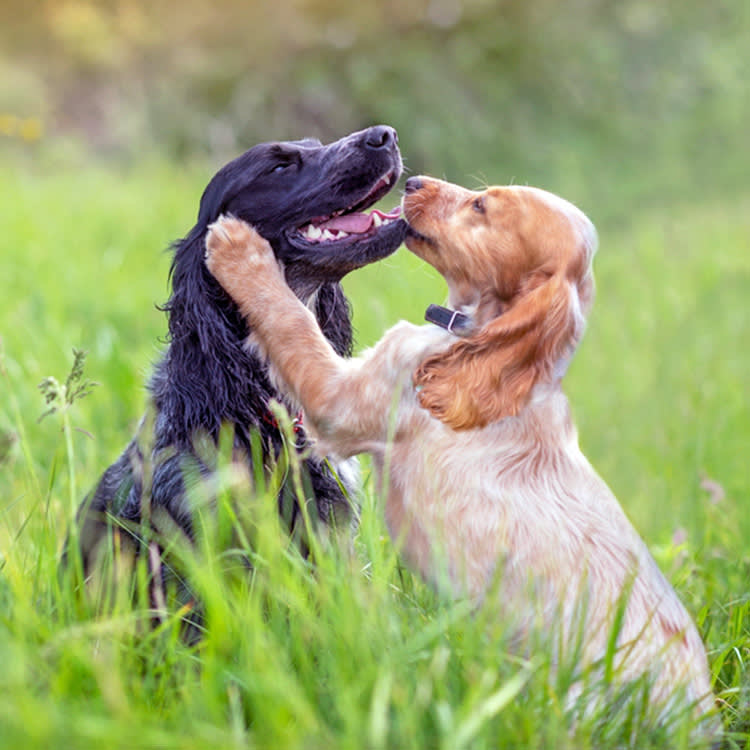
It’s one of the more charming things two dogs do: one reaches out and rests a paw on the other, and they lock eyes with that soft, expectant look. It’s easy to read it as pure sweetness. But a paw on another dog isn’t a single message. It’s a word in a longer sentence, and the same gesture can mean “let’s play,” “I like you,” or “back off.” The trick to reading it right is to stop staring at the paw and read the whole conversation instead.
Every dog interaction is a conversation
The most useful frame for any dog-to-dog exchange is to treat it like a chat between two people. It has a tone. It can be warm and easygoing, or it can be pushy and rude, and everything in between. The paw is just one gesture inside that tone, and how the other dog answers is what sets the direction. Depending on how each dog responds, a friendly overture can stay friendly or curdle into a squabble, and as with human arguments, the fault rarely sits entirely on one side.
That’s why the paw alone tells you almost nothing. What surrounds it tells you everything.
People fixate on the single cute action and miss the paragraph around it. I always tell owners to widen their gaze. Look at both dogs, look at the whole body, and watch what happens right before and right after. That’s where the real message lives.
The common reasons a dog paws another dog
The meaning shifts with the dog’s personality, the situation, and the relationship between the two dogs, but a handful of motivations come up again and again.
They want attention. A dog pawing at a buddy may just be angling for social engagement, sometimes paired with a high, hopeful little whine.
They want to play. Pawing can be an invitation to chase, wrestle, or roughhouse, often with a bouncy, loose-bodied energy. It’s friendly at heart, though it can also be an over-eager, slightly rude way to ask.
They’re feeling assertive. Dogs are constantly reading their relationships, and a paw, especially one laid on another dog’s back, can be a way of gathering information about where they stand. It isn’t necessarily hostile, but it’s worth watching for any sign the other dog is uncomfortable.
They’re setting a boundary. The flip side of assertive is self-protective. A dog might place a paw, stiffen a front leg, or give a small push to say, in effect, that’s enough. This shows up a lot when an older, steadier dog is trying to slow down a young, bouncy one who’s getting on their nerves.
They’re feeling affectionate. Some dogs simply use their front legs the way we use arms. Paws draped over one another can be a quiet moment of closeness, nothing more.
How to tell which one it is
It all comes down to body language, and you read it by watching both dogs before, during, and after the paw.
If the mood is assertive or heading toward conflict, you’ll tend to see a stiff body, a paw planted on the back, bared teeth, ears pinned back, “whale eye” (the whites showing), and possibly a growl.
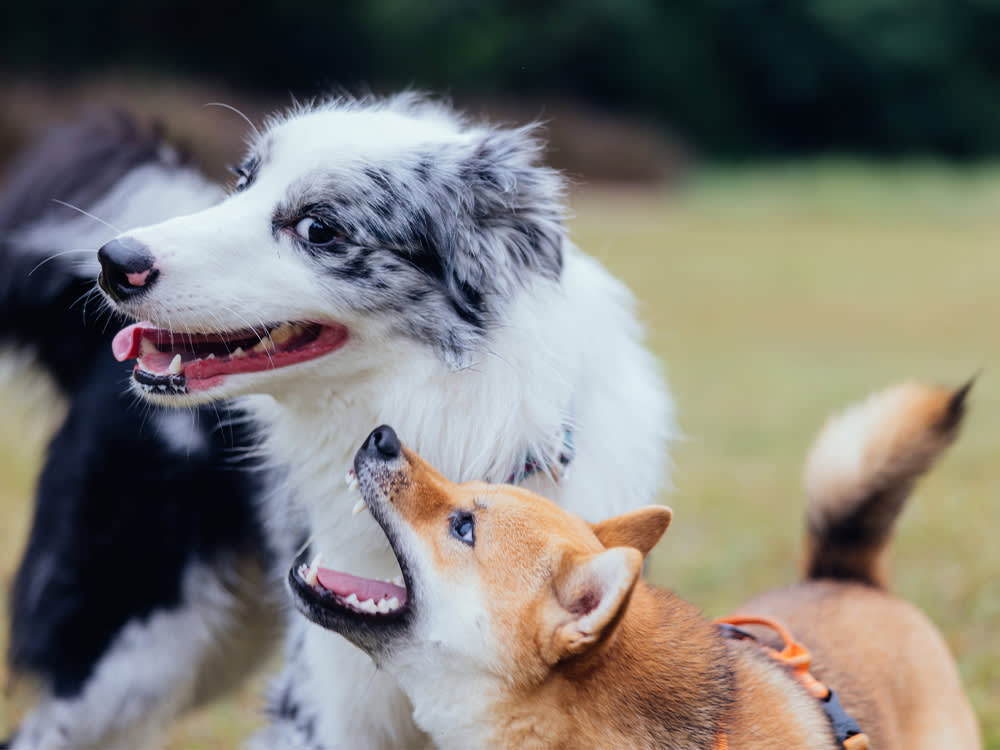
If the mood is playful or socially curious, you’ll see the opposite: a loose, wiggly body, a paw offered as an invitation, a soft and slightly open mouth, relaxed floppy ears, and soft eyes.
Same paw, entirely different sentence. The body tells you which.
When pawing becomes a problem
As sweet as it can look, this behavior does cross into trouble in a couple of situations.
When the other dog isn’t into it. Not every dog enjoys being touched by another dog’s foot. If your dog’s pawing is clearly making the other pup uncomfortable, step in, both to keep the peace and to avoid letting your dog practice being pushy. If your dog is the one being pestered, especially if they’ve been patient about it, intervene on their behalf. The goal is a dog who is neither a bully nor a target.
Good interventions are calm and neutral: call your dog’s name, ask both dogs to sit, or redirect them into another activity. Don’t scold, and give them a little separation to reset. If two dogs have a long-established, comfortable relationship, a lot of this sorts itself out, but watch closely when there are valuable things around, like favorite people, prized toys, or food.
When it’s a stress signal. If your dog constantly uses their paws to get attention, ask yourself whether it clusters around stressful moments, like before or during a thunderstorm. Does it look more intense or distressed than usual? Attention-seeking is rarely “nothing.” Sometimes it’s just a bid for connection, and sometimes it’s a dog telling you they’re not okay.
What’s new: we’re worse at this than we think
Here’s the humbling update, and it’s the best reason to slow down and read the whole picture. Recent research from the Canine Science Collaboratory at Arizona State University found that people are simply not as good at reading dogs’ body language and emotions as we assume we are. In their work, humans were less accurate than they believed at telling apart even basic positive and negative states, like a happy dog versus an upset one. Follow-up studies through 2025 have added that our own mood can skew how we interpret what a dog is feeling.
The takeaway isn’t that you can’t learn to read your dog. It’s that confidence is not the same as accuracy, and the fix is exactly what this article argues for: don’t trust a snap judgment based on one gesture. Watch both dogs, watch the whole body, and watch how the moment unfolds. When our dogs reach out a paw, they’re telling us something specific. The least we can do is read the entire sentence before we decide what it says.
References
Dr. Chen is a small-animal veterinarian who leads health and safety coverage at The Pet Times. She writes and reviews the bulk of our illness, condition, and safety content, translating clinical guidance into clear, practical advice owners can act on at home.
Meet our experts ↗Keep reading
 TrainingYou're Petting Dogs Wrong. Here's How to Ask FirstDr. Nina Kohl · 6 min
 LivingThose Viral 'Dogs Love Christmas Lights' Videos? It's Mostly You They LoveDr. Lena Park · 4 min
 TrainingYour Chihuahua Isn't 'Naturally' Anxious. Look at How You Treat Him.Dr. Mara Chen · 6 min
 TrainingThe Fake-Kidnapping Dog Trend Punishes the Dog, Not the PranksterDr. Nina Kohl · 5 min
 TrainingYou're Not Reading Your Dog. You're Reading the Room Behind Him.Dr. Ravi Mehta · 7 min
 TrainingYour Dog Isn't Throwing a Tantrum. That Word Is Hiding the Real ProblemDr. Nina Kohl · 7 min