


Those Viral 'Dogs Love Christmas Lights' Videos? It's Mostly You They Love
The internet is convinced dogs are dazzled by holiday displays. The truth about how dogs actually see those lights is more interesting, and it explains why some pups light up while others just want to leave.

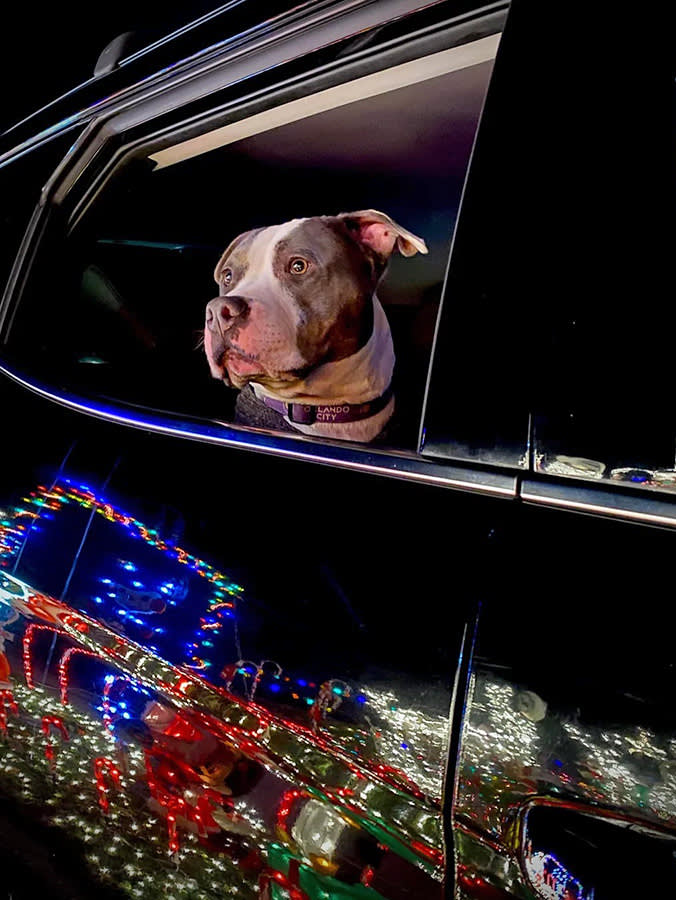
Every winter, the same clip makes the rounds: a dog with their head out a car window, ears up, eyes wide, being driven slowly past a street drenched in holiday lights, with a caption insisting they love this more than we do. It’s a lovely idea, and the comments fill with people tearing up over it. But before you plan a nightly light tour for your own dog, it’s worth asking what the dog is actually experiencing, because the honest answer changes how you’d do it.
What a dog actually sees when the lights come on
Dogs do not see color the way we do, and that matters here. Human eyes have three types of color receptors; dogs have two. Functionally, that makes them similar to a red-green colorblind person: they perceive the world mostly in blues and yellows, while reds and greens wash out into muddy, grayish tones. So the classic red-and-green display that reads as festive to you is, to your dog, a much quieter and less saturated scene. The blues and warm whites will pop for them. The reds mostly won’t.
What dogs lack in color they partly make up in motion and low-light sensitivity. Their eyes evolved to catch movement and to function in dim conditions, which is why a static string of lights may barely register while a blinking, chasing, or motion-activated display can grab their attention hard, for better or worse. That twinkle you find charming can read to a dog as sudden, unpredictable movement in the dark.
So do they enjoy it? Sometimes. It depends entirely on the dog
There is no single dog reaction to holiday lights, which is exactly why the viral videos are misleading. A confident, curious dog with good past experiences around novelty may find a lit-up street genuinely interesting, a stream of new sights and smells to investigate. A more cautious dog can find the same street stressful, especially if an inflatable lurches to life or a motion sensor trips a sudden glow.
The videos flatten a real range of responses into one cute story. I’ve seen dogs who clearly enjoy the novelty, and dogs who shut down at the first blow-up snowman. What you’re usually watching in those clips isn’t a dog moved by the lights. It’s a dog delighted to be out on an adventure with their person, and the lights happen to be there.
Watch the body, not the caption. Loose posture, an easy gait, and eager sniffing say your dog is into it. Lip-licking, a hard “whale eye” showing the whites, cowering, or trying to turn back say the opposite, and those signals are worth respecting rather than pushing through for a photo.
If you want to take your dog to see the lights, do it their way
None of this means keep your dog home. It means run the outing on the dog’s terms. Go slow, let them stop and sniff, and treat the lights as background rather than the main event. Keep a confident dog moving through the interesting parts, and give a nervous dog permission to bail early instead of forcing a full loop. Some dogs will be more interested in marking the base of a glowing lawn ornament than in admiring it, and that’s a perfectly good time by dog standards.
The reframe worth holding onto is the one the best clips accidentally capture: the joy in the video usually isn’t the lights. It’s the walk, the car ride, the undivided attention, and the company. Give a dog those four things on a dark winter evening and you don’t need a single strand of lights to make it a good night for them.
What newer research adds
The picture of canine vision has sharpened in recent years, and it lines up with what careful owners already notice. Studies of dog color perception continue to confirm the two-receptor, blue-yellow model, which is why brightly colored dog toys sold in reds and oranges can be surprisingly hard for a dog to spot against green grass, and why blue and yellow show up clearly. Research into how dogs process moving versus still images also helps explain the split reactions to displays: dogs are wired to notice motion, so animated and flickering decorations command more of their attention, and more of their wariness, than a steady glow. The consistent thread across the newer work is that a dog’s response to a light display is less about the spectacle and more about their individual temperament and how the scene moves.
Dr. Park is a board-certified emergency and critical care specialist. She reviews our health and safety content for clinical accuracy and contributes guides on recognising urgent conditions. Her focus is helping owners act quickly and correctly when it matters most.
Meet our experts ↗Keep reading
 TrainingYour Dog Isn't Wrecking the Yard. They're Doing a Job. Name It.Dr. Mara Chen · 8 min
 TrainingBaby-Talking Your Dog Isn't Silly. It's Science.Marcus Webb · 5 min
 LivingA Wolfdog Is Not a Fluffier Husky. Nobody Can Tell You What You Actually Own.Dr. Ravi Mehta · 8 min
 LivingYour Dog Isn't Pulling. You're on the Wrong Outing.Dr. Mara Chen · 7 min
 LivingWe Docked Their Tails for Looks. Other Dogs Literally Can't Read Them Anymore.Dr. Nina Kohl · 8 min
 Living'All-Day Play' Is a Red Flag, Not a Selling PointJordan Ellis · 9 min