


Your Dog Isn't Pulling. You're on the Wrong Outing.
A sniffari isn't a walk with sniffing allowed. It's a separate outing with a separate job, and the reason your dog drags you to every hydrant is that you've never told them which one this is. Here's how to run both.

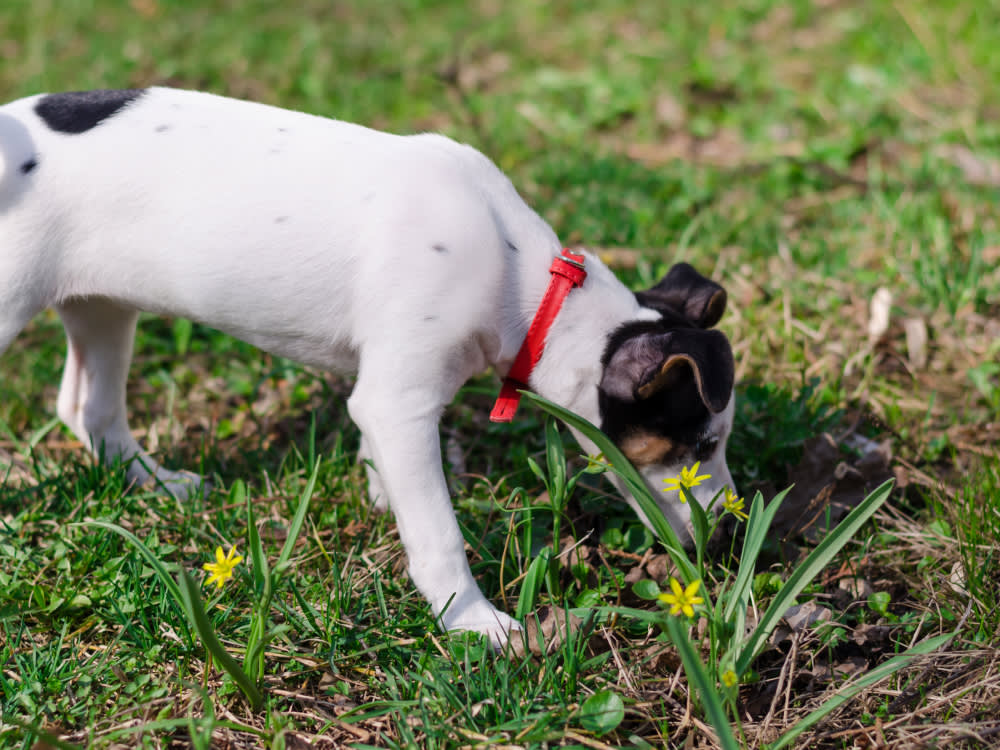
Every frustrating walk you have ever taken is really an argument about whose outing it is.
You are trying to cover a route. Your dog is trying to read one. Neither of you is wrong, and neither of you has told the other what the plan was, so you spend forty minutes negotiating at every mailbox. The dog plants. You tug. The dog gets three seconds of a very good smell and is dragged off mid-sentence. Both of you come home a little annoyed.
The fix is not better leash technique. The fix is admitting there are two entirely different outings here, giving each one a name, and telling your dog which one they are on before you leave the house.
The two outings
The walk is yours. You picked the route, you set the pace, and the dog’s job is to travel alongside you politely. It gets you both somewhere. It burns some energy. It is, from the dog’s point of view, a commute.
The sniffari is theirs. Your dog chooses the direction, sets the pace, and stops for as long as a particular patch of curb deserves. Your job is to hold the leash and be patient. You may cover one block in twenty-five minutes. That is not a failed walk. That is a completed sniffari.
Here is why the second one matters so much more than it looks. When a dog puts their nose down, they are not idly enjoying a scent. They are pulling actual information out of the environment: who was here, how long ago, what they ate, whether they were stressed, whether they are intact, which direction they went. A hydrant is a message board with a two-day archive. Whisking a dog past it at human pace is like scrolling a page of text past someone at a speed where they can only make out every fifth word.
Ban that, and you have removed the single richest thing in your dog’s day. Do it every day, on every outing, and you have a dog who has learned that the only way to get any information at all is to pull, hard, immediately, for as long as they can hold the position. Which is the exact behavior you were complaining about.
Tell them which one it is before you open the door
This is the mechanical piece, and it is embarrassingly simple: use different gear for each outing.
A flat collar and a long loose leash for the sniffari. A front-clip harness for the structured walk. Two visibly, tangibly different setups, used consistently. Dogs are exceptional at reading pre-departure cues. Within a couple of weeks, the harness coming off the hook means we are going somewhere and the collar means today you’re in charge. Your dog will start making that prediction before you have finished putting your shoes on, and the pulling problem quietly shrinks, because the dog is no longer guessing.
A few practical notes on running a real sniffari:
- Give them line. A six-foot leash is a leash for your walk. A sniffari wants ten to fifteen feet, ideally on a flat collar or a well-fitted harness. A long line lets a dog swing a wide arc, follow a scent trail across a lawn, and circle back, which is what tracking actually looks like.
- Never a retractable leash for this. The constant tension in a flexi-lead teaches a dog that pulling makes the line pay out, which is the opposite of the lesson, and the thin cord is a genuine injury risk to hands and legs.
- Follow, don’t steer. If your dog wants to spend four minutes on a single tuft of grass, they get four minutes. You do not need to understand why.
- Distance is irrelevant. Twenty minutes of dedicated sniffing will do more for a dog’s brain than an hour of brisk heeling. Stop counting steps.
- Go where the information is. Fresh grass verges, tree bases, the edges of parks, anywhere other dogs have been. A sterile stretch of concrete has almost nothing to read.
Why a slow walk tires a dog out
The obvious objection is that a sniffari sounds like doing less. Your dog barely moves. How can that be tiring?
Because scent processing is expensive. A dog’s nose is running enormous computation, and the research now backs up what trainers have been claiming for a decade. In a 2019 study in Applied Animal Behaviour Science, Charlotte Duranton and Alexandra Horowitz ran twenty pet dogs through two weeks of daily activity: half did nosework, where they were allowed to search and sniff to find hidden food, and half did heelwork, the same amount of time and handler attention but with no searching allowed.
Then both groups were given a cognitive bias test, the standard way researchers measure something like optimism in an animal. Dogs are taught that a bowl in one location always has food and a bowl in another never does, and then are shown a bowl in an ambiguous spot in between. How fast an animal walks toward the ambiguous bowl is treated as a proxy for how well they expect things to go.
The nosework dogs approached the ambiguous bowl faster after two weeks. The heelwork dogs did not. Same duration, same handler, same treats. The only difference was whether the dog got to use their nose and choose where to point it.
That is a striking result, and the researchers’ interpretation is worth taking seriously: the effect probably comes from the combination of olfaction and agency. The dog was doing something they are built for, and they were the ones deciding how.
People come in worried that a slow walk means their dog isn’t getting enough exercise. Then they try two weeks of letting the dog lead, and they call to tell me the dog is calmer in the evenings. It isn’t magic. You gave a working animal something real to do.
The version for dogs who can’t have this yet
Some dogs cannot be handed the leash and turned loose on the neighborhood. A reactive dog, a bolter, a dog who eats everything, a puppy who has not learned to walk on a leash at all. The sniffari still applies; it just moves indoors or into a fenced space first.
Scatter a handful of kibble in the grass and let them work the area. Hide treats around one room and release them into it. Use a snuffle mat. All of these deliver the same two ingredients, olfaction and choice, without asking a dog to hold it together on a public sidewalk. Build the skill in a place where the stakes are zero, then take it out.
And if your dog is a committed scavenger, a solid “leave it” is the prerequisite. A sniffari is a nose-down outing, and nose-down outings find chicken bones.
The thing to actually change tomorrow
Pick one outing a week and make it entirely theirs. Different collar, long line, no destination, no step count, no music in your ears. Get to the end of the block if you get there.
You will be bored. That is the correct feeling, and it is a good sign: it means, for once, the outing is not being run for you.
References
- Duranton, C., & Horowitz, A. “Let me sniff! Nosework induces positive judgment bias in pet dogs.” Applied Animal Behaviour Science, vol. 211, 2019, pp. 61-66. https://www.sciencedirect.com/science/article/abs/pii/S0168159118304325
- Kokocińska-Kusiak, A., et al. “Canine Olfaction: Physiology, Behavior, and Possibilities for Practical Applications.” Animals, vol. 11, no. 8, 2021. https://www.ncbi.nlm.nih.gov/pmc/articles/PMC8388720/
- American Veterinary Society of Animal Behavior. “Position Statement on Humane Dog Training.” https://avsab.org/wp-content/uploads/2021/08/AVSAB-Humane-Dog-Training-Position-Statement-2021.pdf
Dr. Chen is a small-animal veterinarian who leads health and safety coverage at The Pet Times. She writes and reviews the bulk of our illness, condition, and safety content, translating clinical guidance into clear, practical advice owners can act on at home.
Meet our experts ↗Keep reading
 TrainingA Tired Dog Isn't the Goal. A Fulfilled One Is.Dr. Mara Chen · 8 min
 TrainingYou Can't Force a Dog Friendship. But 6 Things Stack the DeckDr. Ravi Mehta · 5 min
 TrainingYour Dog Isn't Shy at Your Party. Six Signs They Want Out.Dr. Lena Park · 8 min
 TrainingMost Dog-Park Advice Is Half True. These Are the Signals That Actually MatterDr. Nina Kohl · 10 min
 LivingYour Dog Has Two Beds Because They Have Two Kinds of SleepDr. Ravi Mehta · 7 min
 TrainingTug-of-War Won't Make Your Dog Aggressive. Playing It Wrong Might.Dr. Nina Kohl · 9 min