
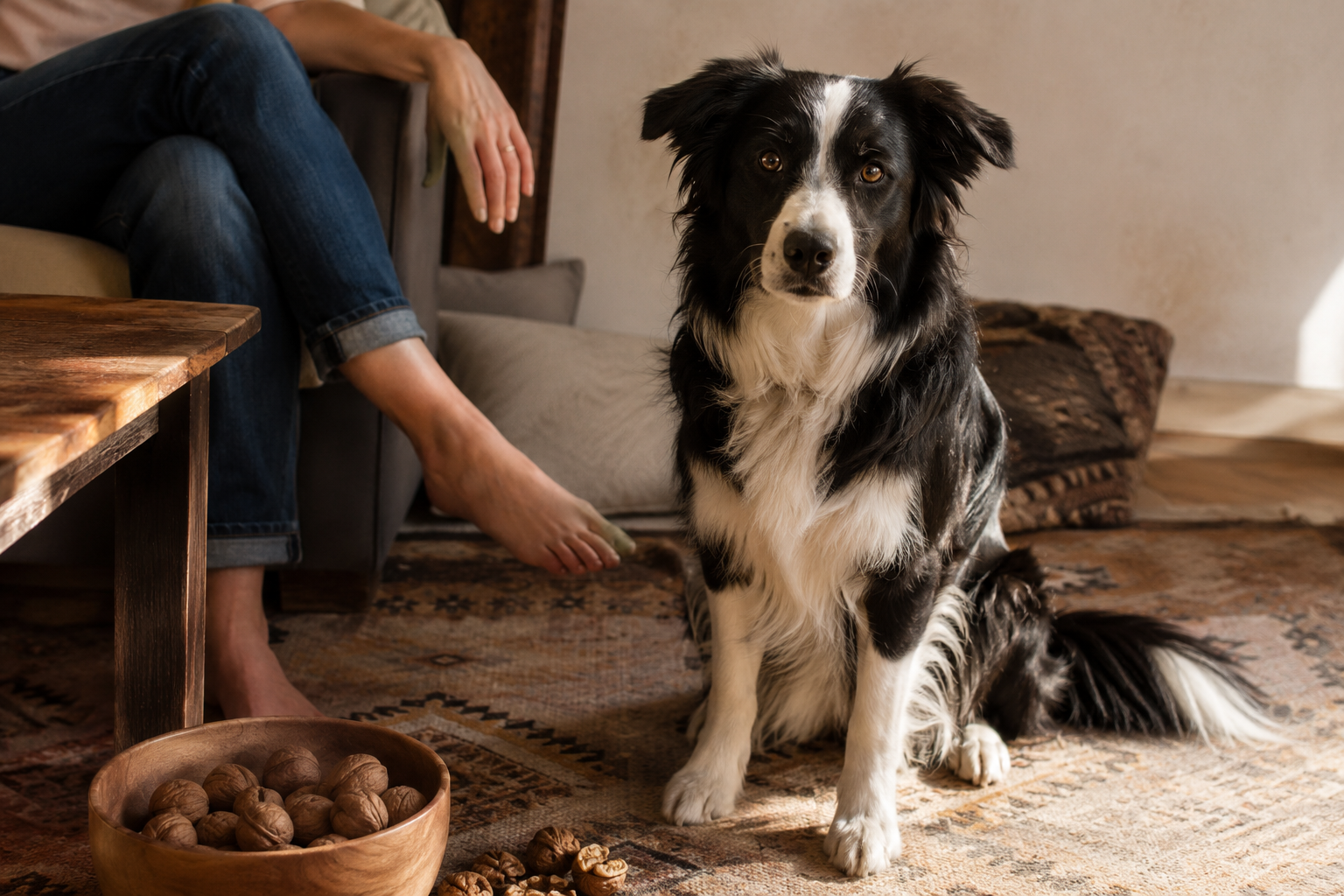
“Can dogs eat walnuts?” is the wrong question, because it treats walnuts as one thing. They are not. The gap between a plain English walnut and a black walnut is the gap between a mild stomachache and a veterinary emergency with tremors and seizures. And lurking behind both is a third, invisible hazard, mold, that can turn any walnut dangerous regardless of type. Get the distinctions right and you will know exactly how worried to be when your dog snatches one off the floor.
Here is the short version most vets land on: dogs really should not eat walnuts at all. But if one disappears down the hatch, the type is what tells you whether to relax or move fast.
Black walnuts: the hard no
A black walnut (Juglans nigra) is a genuine danger to dogs. It contains juglone, a compound that is toxic to them and can cause severe gastrointestinal distress, tremors, and seizures. On top of that, black walnuts are frequently contaminated with molds that produce their own toxins. If your dog eats a black walnut, do not wait it out. Call your vet right away.
English walnuts: not toxic, still a bad idea
The English walnut (Juglans regia), the kind in most grocery bags, does not carry juglone the way black walnuts do, so it is not toxic in the same sense. That is where the reassurance ends. English walnuts are very high in fat, enough to trigger stomach upset and, in the wrong dog, pancreatitis when eaten in any quantity. They are also prone to the same molds as black walnuts, and those molds are the real neurological threat. If you are going to let your dog near one at all, it should be fresh, unsalted, and clearly mold-free, and even then most vets would rather you did not.
“The question I want owners to ask isn’t just ‘was it a walnut,’ it’s ‘was it black, and was it moldy,’” says Dr. Mara Chen. “A single fresh English walnut is usually a shrug. A black walnut or a walnut with any fuzz on it can hit the nervous system, and those are the calls where minutes matter. When in doubt, describe the nut to your vet and let them decide.”
The three real risks, ranked
Mold and its toxins. This is the one people underestimate. Moldy walnuts can produce mycotoxins that cause tremors, seizures, and other neurological problems. Because walnuts mold easily, inspect any nut before it goes anywhere near your dog, and assume a nut found on the ground outside could be compromised.
High fat and pancreatitis. Walnuts’ fat content is hard on overweight dogs and dogs with any history of digestive trouble. Pancreatitis is a serious, painful condition marked by vomiting, abdominal pain, and diarrhea. Dogs prone to it should have no walnuts at all.
Choking and blockage. Walnuts are large. Small dogs in particular can struggle to swallow one whole, which risks choking or an intestinal obstruction. If you ever do offer a piece, it should be broken small, though the safer move is not to offer them.
If your dog ate a walnut
Act based on type and condition. For a single fresh English walnut, mild digestive upset is the likely worst case; keep an eye out and call your vet if anything develops. For a black walnut, a moldy nut, or several nuts, contact your veterinarian immediately. Either way, watch for these warning signs:
- Vomiting or diarrhea
- Lethargy
- Tremors or seizures
- Loss of coordination
- A racing heart
- Abdominal pain
Any of those, especially the neurological ones, means call your vet now. Dogs with pre-existing health conditions are the most vulnerable, and in the worst cases, a moldy or black walnut can be fatal.
Better nuts, and better snacks
If you want to share a nut, a few are safer than walnuts in small, plain, unsalted amounts: peanuts, cashews, almonds, and hazelnuts. Skip macadamias and pistachios entirely; macadamias are toxic and can cause neurological signs, and pistachios carry mold and pancreatitis risk. Honestly, though, the best “nut” for your dog is usually not a nut at all. Dog-safe fruits and vegetables like blueberries, carrots, and green beans give you a treat with real nutrition and none of the fat-and-mold baggage.
The bottom line
English walnuts are not exactly toxic, but their fat and mold risk make them a poor snack. Black walnuts should never be given, full stop. And a moldy walnut of any kind is a real hazard. When you want to reward your dog, reach for peanuts or cashews without salt, or better yet a piece of fruit, and leave the walnuts in your own bowl.
References
- Tanprasertsuk, Jirayu, et al. “Roles of Plant-Based Ingredients and Phytonutrients in Canine Nutrition and Health.” Journal of Animal Physiology and Animal Nutrition, 8 Sept. 2021, https://doi.org/10.1111/jpn.13626.
- Teuber, Suzanne S., et al. “The Atopic Dog as a Model of Peanut and Tree Nut Food Allergy.” Journal of Allergy and Clinical Immunology, vol. 110, no. 6, 2002, pp. 921-927, https://doi.org/10.1067/mai.2002.130056.
- ASPCA Animal Poison Control Center. “People Foods to Avoid Feeding Your Pets.” Accessed 2 July 2026, https://www.aspca.org/pet-care/animal-poison-control/people-foods-avoid-feeding-your-pets.
- Pet Poison Helpline. “Mycotoxins (Tremorgenic).” Accessed 2 July 2026, https://www.petpoisonhelpline.com/poison/mycotoxins-tremorgenic.