


That Dog With Its Head Out the Window Is a 50-Pound Projectile Waiting to Happen
The happiest image in car travel, an unrestrained dog in the breeze, is also one of the most dangerous. The case for buckling up your dog has almost nothing to do with the law and everything to do with physics.

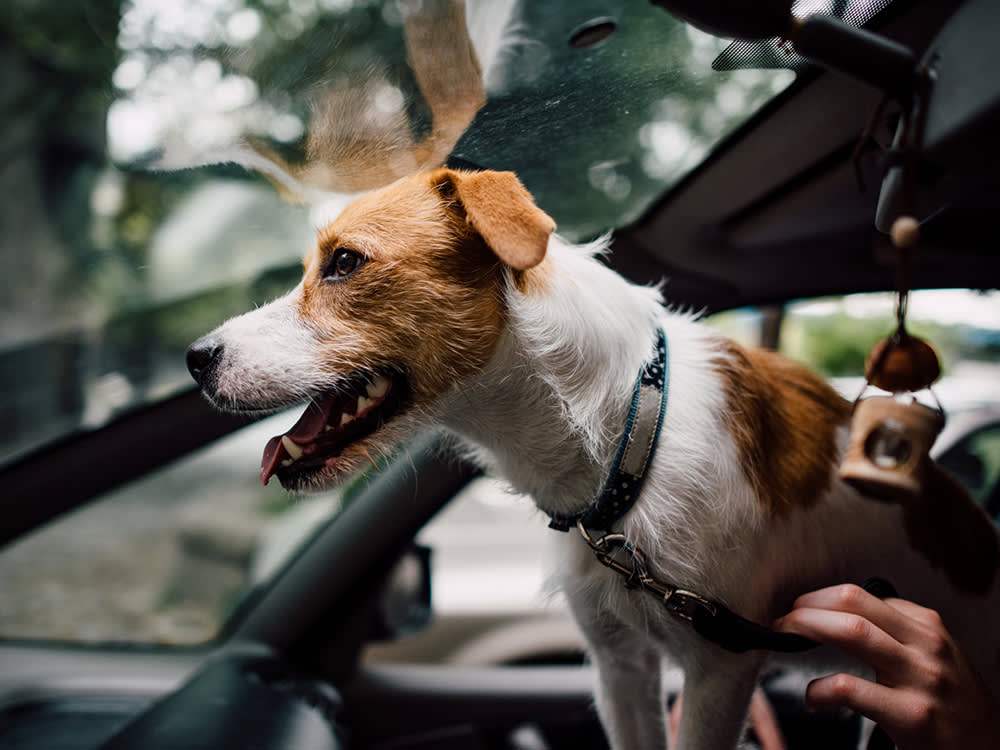
We all know the picture, and most of us love it: a dog with their head thrust out the car window, ears streaming back, tongue out, pure joy at 40 miles an hour. It’s a happy image for an obvious reason. Who wouldn’t want to feel that wind on a good day? But that same picture almost always means one thing that isn’t happy at all. The dog isn’t restrained. And an unrestrained dog in a moving car is a danger to itself, to you, and to everyone else on the road.
The instinct to let a dog roam free in the car comes from a good place. It just runs headlong into some unforgiving physics.
An unbuckled dog is a distraction before it’s ever a projectile
The first danger shows up long before any crash. A loose dog is a moving, attention-grabbing presence in a space where your attention is the only thing keeping several tons of metal on the road. The data on this is sobering. The AAA Foundation for Traffic Safety has found that glancing away from what’s ahead for even a two-second stretch doubles a driver’s crash risk. A dog climbing toward the front seat, or simply doing something interesting, buys that lapse easily.
Surveys of dog owners bear out how routinely this happens. In one AAA survey conducted with the pet-gear company Kurgo, roughly a third of respondents said their pet had pulled their attention from the wheel. One in five had taken a hand off the wheel to stop a dog from clambering up front. Owners copped to petting the dog while driving, holding the dog while braking, letting it ride in their lap, and hand-feeding it treats on the move. And the grim part: the overwhelming majority of those same owners already agreed that unrestrained dogs in moving cars are dangerous. They knew, and did it anyway, because a loose dog invites exactly this behavior.
Distracted driving of all kinds, pets included, was tied to thousands of fatal crashes in a single recent year. It doesn’t take a collision to make a loose dog a hazard. It just takes a glance.
Then comes the crash, and the physics gets ugly
Now add impact. In a sudden stop or a collision, an unrestrained dog keeps moving at whatever speed the car was traveling until something stops them, the dashboard, the windshield, the seat in front, or the driver’s body. A dog in the back seat becomes a heavy object hurled forward into whoever’s up front. A dog in the front seat is in the airbag’s path, and a deploying airbag can crush an animal that size. Safety experts describe the unrestrained dog bluntly, as a projectile, because in a crash that’s exactly what it is.
The dangers don’t end when the car stops, either. Emergency responders and safety officials describe a recurring nightmare: a dog survives the crash, panics, bolts from the wreck into live traffic, and is killed by another car, or simply vanishes and is never found. Frightened dogs have run from accident scenes and disappeared for good. Some dogs do the opposite and refuse to let paramedics near their injured person, delaying the very treatment that person needs, because to the dog, protecting their human comes first.
The through-line of every one of these scenarios is the same: get the dog out of your lap, out of the front seat, and secured in the back. As one veteran pet-safety advocate has put it, we buckle up our kids, ourselves, and even our groceries, so it’s strange that the dog is the exception.
What the law actually says, which is less than you’d think
Here’s where expectations and reality part ways. There is no federal law requiring you to restrain a pet in a vehicle, and only a small handful of states impose explicit restraint rules inside a passenger car. As of 2025, the states with clear-cut requirements are Hawaii, New Jersey, and Rhode Island, and even among those, the specifics and penalties vary:
- Hawaii bars drivers from holding an animal in their lap or letting a pet sit anywhere it could interfere with control of the vehicle. Fines run in the neighborhood of $97 for a dog in your lap and around $57 for a pet loose in a moving car.
- New Jersey has the toughest approach in the country. An unrestrained pet can be treated as an animal-cruelty violation, and drivers face fines that can range up to roughly $1,000, with jail time on the table in some cases.
- Rhode Island requires dogs to be restrained by a seat belt or crate in an open-air vehicle such as a convertible or pickup.
Beyond those, most states regulate dogs in cars only indirectly. Several, including Connecticut and Maine, fold a loose or lap-riding dog into their broader distracted-driving statutes, which prohibit any activity that impairs safe operation of the vehicle. Many more, including California, Massachusetts, New Hampshire, and Vermont, mainly restrict how you transport a dog in a truck bed or an open vehicle, requiring a crate or, in Massachusetts, tall enough sides, rather than dictating how a dog rides inside the cab. A number of localities have added their own rules on top: Troy, Michigan, for instance, banned dogs on drivers’ laps by ordinance.
The honest summary is that the law is a patchwork, and in most places it won’t be the thing that stops you. Which is exactly why the physics has to.
The real reason to buckle up
Strip away the legal question and the case is simple. A restrained dog can’t distract you into a crash, can’t become a projectile in one, and can’t bolt into traffic afterward. The goal is to make restraint a reflex, the way clicking your own belt is, so it happens every trip without a decision. Do that, and the happy version of car travel with your dog, the one where everyone arrives, stays fully intact.
Because this is safety-critical, treat it as general guidance and confirm any specific legal requirement with your own state and local rules, which change over time.
Marcus Webb writes about the gear, gadgets, and everyday choices that make life with a pet easier. His coverage runs from product picks to training and the causes worth paying attention to, always with an eye on what actually earns a place in your home.
Meet our experts ↗Keep reading
 LivingYou Buckle Up. In a Crash, an Unrestrained Dog Is a Projectile.Dr. Priya Nair · 7 min
 Health & WellnessThe Backseat Habits That Turn a Dog Road Trip DangerousDr. Ravi Mehta · 6 min
 LivingThe Trail Doesn't Care How Good Your Dog Is Off-LeashDr. Ravi Mehta · 7 min
 LivingHalf the Dogs at the Beach Are Not Having Fun. Yours Might Be One.Dr. Mara Chen · 8 min
 LivingThe Kayak Isn't What Hurts Dogs. The Water Is.Dr. Ravi Mehta · 8 min
 LivingA Woman Left Her Dog at the Airport. The Breed Ban That Set It Up Is the Real Story.Jordan Ellis · 4 min