


A Woman Left Her Dog at the Airport. The Breed Ban That Set It Up Is the Real Story.
When a traveler was told her American Bully couldn't board, she abandoned him by taxi. The cruelty made headlines. The flat-faced flight rule behind it is what more owners need to understand before they book.
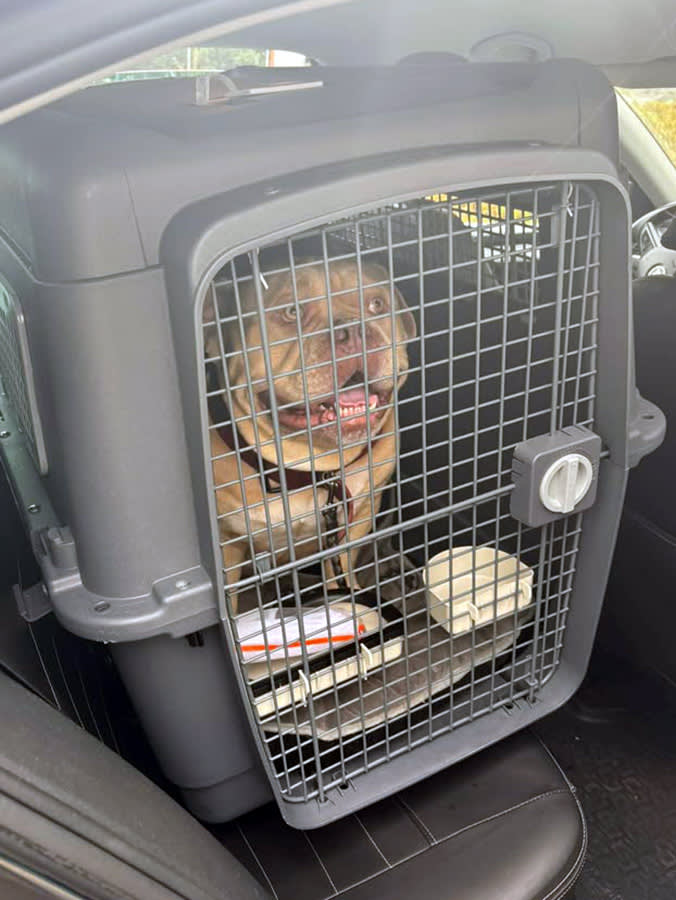
In September 2025, a woman at Brussels Airport in Belgium was told that her dog, Pako, could not fly with her. What she did next horrified animal advocates around the world: she boarded her flight alone and had Pako sent to a shelter by taxi. The headline writes itself, and the outrage is earned. But underneath the shock is a piece of travel reality that catches unprepared owners every year, and it’s worth understanding before you ever pack a crate.
What happened to Pako
Pako is an American Bully, a flat-faced, or brachycephalic, breed. Shortly after his guardian abandoned him, he arrived at SRPA Veeweyde, an animal shelter in Brussels. Staff described the situation bluntly on social media: rather than change her plans or arrange a responsible handoff, the owner flew off and sent her dog to them in a cab. The taxi driver, they noted, showed up completely unprepared with an abandoned dog on his hands.
Under Belgian law, surrendering an animal legally requires the owner to be present with identification, so a dog delivered by taxi isn’t a valid surrender at all. The story ended better than it might have. After several days, relatives of the owner contacted the shelter and arranged to take Pako in. He was not returned to his original guardian, who had permanently left the country, but placed with the family members who came back for him, and the shelter decided not to pursue legal consequences. Staff described Pako as a sociable, balanced, affectionate dog who deserved, above everything, some peace and quiet.
The rule that started it: why flat-faced dogs get grounded
The detail most coverage skimmed past is the one that actually matters for other owners. Pako wasn’t turned away because of his size or his temperament. He was turned away because of his face.
Brachycephalic breeds, the ones with pushed-in muzzles and narrow airways, are physically less able to cope with the conditions of air travel. The American Veterinary Medical Association notes that short-nosed dogs are more vulnerable than other dogs to changes in air quality, circulation, and temperature, and that their restricted airways make overheating and breathing distress far more likely under stress. That is exactly the environment a cargo hold creates.
“A flat-faced dog is already breathing through a straw on a normal day,” says Dr. Amara Solis. “Put that same dog in the heat, thin air, and stress of a cargo hold and you’ve stacked every risk factor on top of an airway that had no margin to begin with. The airlines that refuse these breeds aren’t being difficult. They’re refusing to be the last link in a chain that ends with a dog who can’t get enough air.”
That’s why the bans exist. Lufthansa stopped transporting snub-nosed breeds in the cargo hold back in 2020, and major U.S. carriers including American and Delta maintain long restricted-breed lists that cover bulldogs, pugs, Boston terriers, boxers, and bully breeds among many others. Policies differ, some allow a small snub-nosed dog to ride in the cabin as carry-on even when cargo is off-limits, and rules shift year to year, which is precisely why they blindside people at the gate.
What a responsible owner does instead
The failure in Pako’s story wasn’t just an airport rule. It was a total absence of a plan. If you own a flat-faced breed, or any dog, treat the airline’s pet policy as something to solve weeks before you travel, not something to discover at check-in.
Call the airline and confirm your specific breed is accepted, in cabin or cargo, on your exact route and aircraft. If your dog can’t fly, that is not a dead end, it’s a fork: postpone, drive, or arrange a trusted person to keep the dog while you’re away. Line that person up before you leave for the airport, not after you’ve been turned away. A boarding denial should be an inconvenience you planned for, never a decision you make with a cab and a shelter address.
Pako got a soft landing he had no reason to expect. The lesson his story leaves behind is the unglamorous one: the crate is the easy part. The plan is the whole job.
References
- American Veterinary Medical Association. “Air Travel and Short-Nosed Dogs FAQ.” avma.org
- American Airlines. “Animals: Policy and Restrictions.” aacargo.com
- Delta Cargo. “Restricted Animals.” deltacargo.com
Jordan Ellis is a certified professional dog trainer with a decade of experience working with rescue organisations and private clients. They specialise in anxiety, reactivity, and positive reinforcement methods, and review all training and behaviour content at The Pet Times.
Meet our experts ↗Keep reading
 LivingThat Dog With Its Head Out the Window Is a 50-Pound Projectile Waiting to HappenMarcus Webb · 6 min
 Health & WellnessThe Backseat Habits That Turn a Dog Road Trip DangerousDr. Ravi Mehta · 6 min
 LivingHalf the Dogs at the Beach Are Not Having Fun. Yours Might Be One.Dr. Mara Chen · 8 min
 Health & WellnessA Pool, a Lake, and the Ocean Will Kill Your Dog in Three Different WaysDr. Lena Park · 8 min
 LivingEvery Trail Closed to Dogs Was Closed Because of a Dog OwnerMarcus Webb · 8 min
 LivingCharleston Is a Dog Town on a Clock. Miss the Hours and the Trip Falls Apart.Leila Torres · 10 min