


A Pool, a Lake, and the Ocean Will Kill Your Dog in Three Different Ways
Swimming isn't one activity. Each body of water has its own failure mode, and the safety rules that work at a backyard pool are useless in surf. A venue-by-venue guide.

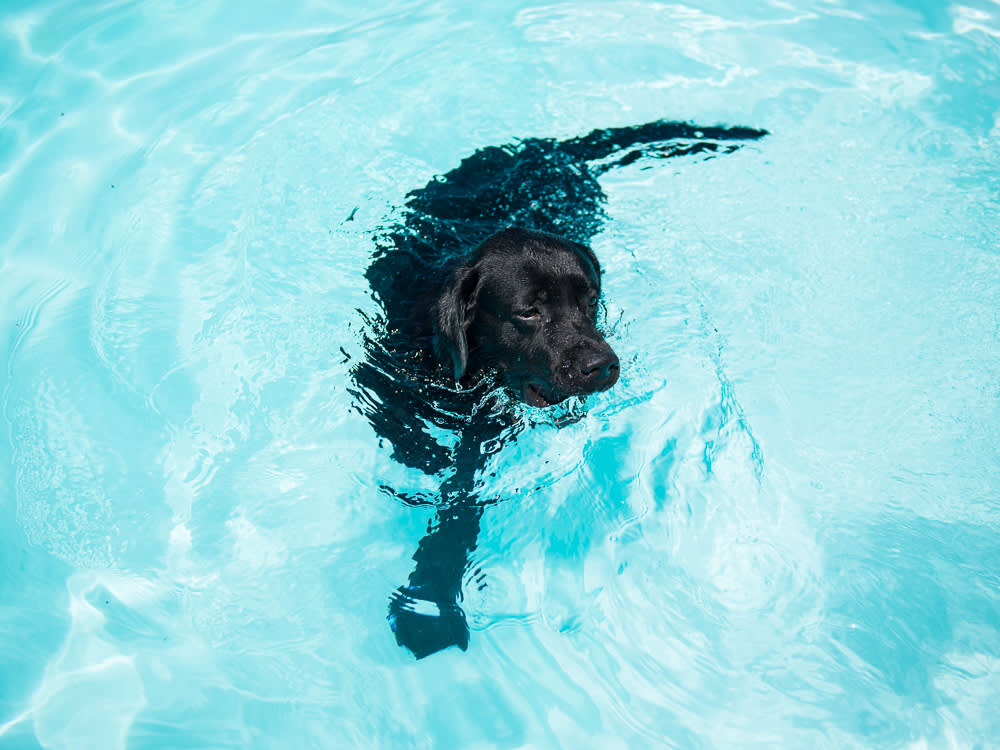
“Is my dog a good swimmer” is the wrong question, and it is the one everybody asks.
A dog who paddles happily around a backyard pool can drown in a lake. A dog who handles a lake fine can be pulled out to sea by a current they have no concept of. The skill is not the variable. The water is.
Each venue has its own distinct failure mode. The pool kills through the exit. The lake kills through what is dissolved in it. The river kills through moving water. The ocean kills through everything at once. The rules that keep a dog safe in one are close to useless in the next.
First, the assumption to throw out
There is a comfortable belief, repeated everywhere, that dogs come pre-installed with an instinct for this and that they all enjoy it.
Plenty of them dislike water intensely. And the ones who like it still have to learn the mechanics. Anatomy is doing much of the work here: a deep chest, short legs, a heavy head, or a flat face all mean a dog is spending far more effort to stay at the surface than a long-legged retriever ever does.
So build it slowly. Ease your dog toward the deep end rather than delivering them into it. A thrown toy is a useful on-ramp, provided you move the target out by inches rather than yards, and stop the instant your dog looks unsure.
And know that fear and fatigue can overwhelm a canine swimmer at any skill level, exactly as they do a human one. Which is the argument for the life jacket, and the reason to fit it on land first. A dog wearing a flotation device for the first time in an emergency is a dog fighting two problems at once.
The pool: the danger is the exit
The most counterintuitive one, and the one that kills dogs who can swim perfectly well.
A dog falls into a pool. They swim. They swim along the edge, looking for a way out. The edge is a smooth vertical wall on every side. They keep swimming. And then they stop.
The hazard in a pool is not the water. It is the absence of a findable exit.
So the rules here are structural rather than behavioral:
- Prevent access when you are not there. A gate or a sturdy pool cover is the primary defense, and it is the one that works when you are asleep or at work.
- Always supervise water activity.
- Make sure there is an easy exit, and that your dog knows how to use it. Steps or a ramp, and then practice. Walk your dog to it from every corner of the pool until finding it is automatic. This is the single most important pool-safety act available to you, and almost nobody does it.
Lakes, streams, and rivers: the danger is what is in the water, and what the water is doing
Here the water itself may be the threat.
Wear the life jacket. A properly fitted, quality canine life vest is standard here, not optional, because current and cold and distance are all unpredictable.
Do not put your dog in water you would not get into yourself. That is the whole heuristic. Watch for anything lurking below the surface: a dog moving at speed can be impaled on a branch or a post they never saw. Watch too for stretches of water that local wildlife has claimed, since nothing out there cares what your dog intended.
Do not let your dog harass waterfowl or local wildlife. This is an etiquette rule that is also a safety rule, since a swan will win.
Watch for fatigue, which arrives faster than you expect. Swimming is more tiring than running. The signals are trembling, heavy panting, swimming lower in the water, or simply slowing down. A tired dog in the middle of a lake is a serious problem in a way a tired dog in the middle of a field is not.
And then there is the thing dissolved in it. Warm, stagnant fresh water can carry blue-green algae, which is cyanobacteria and can kill a dog within minutes to hours. It also carries leptospirosis, which is vaccine-preventable and transmissible to you, and giardia, which is not vaccine-preventable at all. If the water is cloudy, still, or scummy, the answer is no.
The ocean: the danger is multiplied
Every hazard above, plus the sea’s own additions.
Do not encourage your dog to go far offshore. That means: stop throwing retriever toys and floats out into the water. Your dog will go after them, every time, without any assessment of what is between them and the shore. In the ocean, they are exposed to rough waves, riptides, and crosscurrents, and any one of those can be fatal.
Small and short-faced dogs need a life jacket regardless of intent. If your dog is a toy breed, or has short legs or a short muzzle, put a vest on them whether or not they plan to enter the water, because the water may have plans of its own.
Ocean water is bad for dogs. Large amounts of salt water can make a dog seriously ill and can prove fatal. Keep them from drinking it and offer fresh water regularly, so that thirst does not make the decision for them.
Do not let them eat what has washed up. Your dog will want to roll in the dead fish. That is a laundry problem. Eating it is a medical one, because dead fish and other marine life can contain deadly toxins.
Watch the sun. Dogs burn, and overexposure does them the same damage it does you. Get them under cover repeatedly across the day rather than at the end of it, and a canine-formulated sunblock, applied roughly half an hour before they go out in it, is worth having for light-coated, thin-coated, or hairless dogs.
The one that happens after you get home
The delayed killer that belongs to no venue in particular.
Water intoxication, sometimes called dry drowning, occurs when a dog takes water into their lungs, compromising their ability to breathe. Symptoms can take hours or even days to appear: coughing, wheezing, bluish gums and skin, and extreme lethargy.
That delay is what makes it lethal. Everyone has gone home, the towels are in the wash, the danger is assumed to have passed. If you see those signs in the day or two after a swim, it is an emergency, not a wait-and-see.
Dogs who play retrieve games in water for hours, or who bite at a hose or a sprinkler, are at higher risk, because they take in water repeatedly without meaning to.
Everybody watches the dog while the dog is in the water. The two things that hurt them most, salt-water toxicity and water intoxication, both show up after you’ve packed the car.
What’s new since this was written
The water has gotten less predictable, and the advice has tightened accordingly.
Harmful algal blooms are increasing. An ASPCA Animal Poison Control Center analysis of blue-green algae calls from 2010 through 2022 found a clear upward trend, with strong seasonal and geographic patterns, and 2025 brought some of the worst bloom outbreaks on record in parts of the country. Warmer, longer summers favor cyanobacteria. The practical consequence is that local knowledge has expired: a lake your family has swum in for twenty years is not evidence about this week.
Check the current advisory before every trip, not once a season.
Warm coastal and brackish water also carries Vibrio bacteria, which can cause severe infection through an open wound. A dog with a fresh cut, a hot spot, or a recent surgical site stays out of the water. All of it.
The rule that covers nearly all of this remains the least glamorous one available: bring more fresh water than you need, offer it constantly, and do not let your dog drink anything you did not carry there yourself.
References
- ASPCA Animal Poison Control Center. “Geographic Variability, Seasonality, and Increase in Harmful Blue-Green Algae Calls, United States and Canada, 2010–2022.” ncbi.nlm.nih.gov/pmc/articles/PMC10467101/
- CDC. “Harmful Algal Blooms and Your Pets.” cdc.gov/habs/pets.html
- American Kennel Club. “Water Safety for Dogs.” akc.org/expert-advice/health
- CDC. “Leptospirosis.” cdc.gov/leptospirosis
- Cornell Richard P. Riney Canine Health Center. “Water Safety.” vet.cornell.edu/departments-centers-and-institutes/riney-canine-health-center
Common questions
Does my dog need a life jacket?
In open water, on a boat, or in any uncontrolled situation, yes. Also consider one for toy breeds and dogs with short legs or short muzzles, regardless of whether they intend to go in.
Why is a pool dangerous if my dog can swim?
Because a dog who falls in and cannot find the steps will swim until they cannot. The hazard in a pool is not the swimming, it is the exit.
What if my dog drinks pool water or salt water?
Small amounts of salt water usually cause vomiting and diarrhea; large amounts can be fatal. Offer fresh water constantly so they are not thirsty enough to drink what they are swimming in.
Not a substitute for your vet. Our guidance is educational. For urgent symptoms, contact a vet or emergency clinic right away. Editorial standards
Dr. Park is a board-certified emergency and critical care specialist. She reviews our health and safety content for clinical accuracy and contributes guides on recognising urgent conditions. Her focus is helping owners act quickly and correctly when it matters most.
Meet our experts ↗Keep reading
 Health & WellnessThe Waves Aren't the Biggest Beach Danger to Your Dog. The Sand Is.Dr. Priya Nair · 7 min
 LivingEvery Trail Closed to Dogs Was Closed Because of a Dog OwnerMarcus Webb · 8 min
 LivingA Woman Left Her Dog at the Airport. The Breed Ban That Set It Up Is the Real Story.Jordan Ellis · 4 min
 LivingThe Trail Doesn't Care How Good Your Dog Is Off-LeashDr. Ravi Mehta · 7 min
 LivingYou Buckle Up. In a Crash, an Unrestrained Dog Is a Projectile.Dr. Priya Nair · 7 min
 Health & WellnessThe Backseat Habits That Turn a Dog Road Trip DangerousDr. Ravi Mehta · 6 min