


Your Dog Is Probably Heavier Than You Think, and That Gap Is the Real Problem
Most owners rate their overweight dog as 'ideal.' Closing that perception gap, not crash dieting, is what adds years to a dog's life. Here is how to actually see your dog's body.

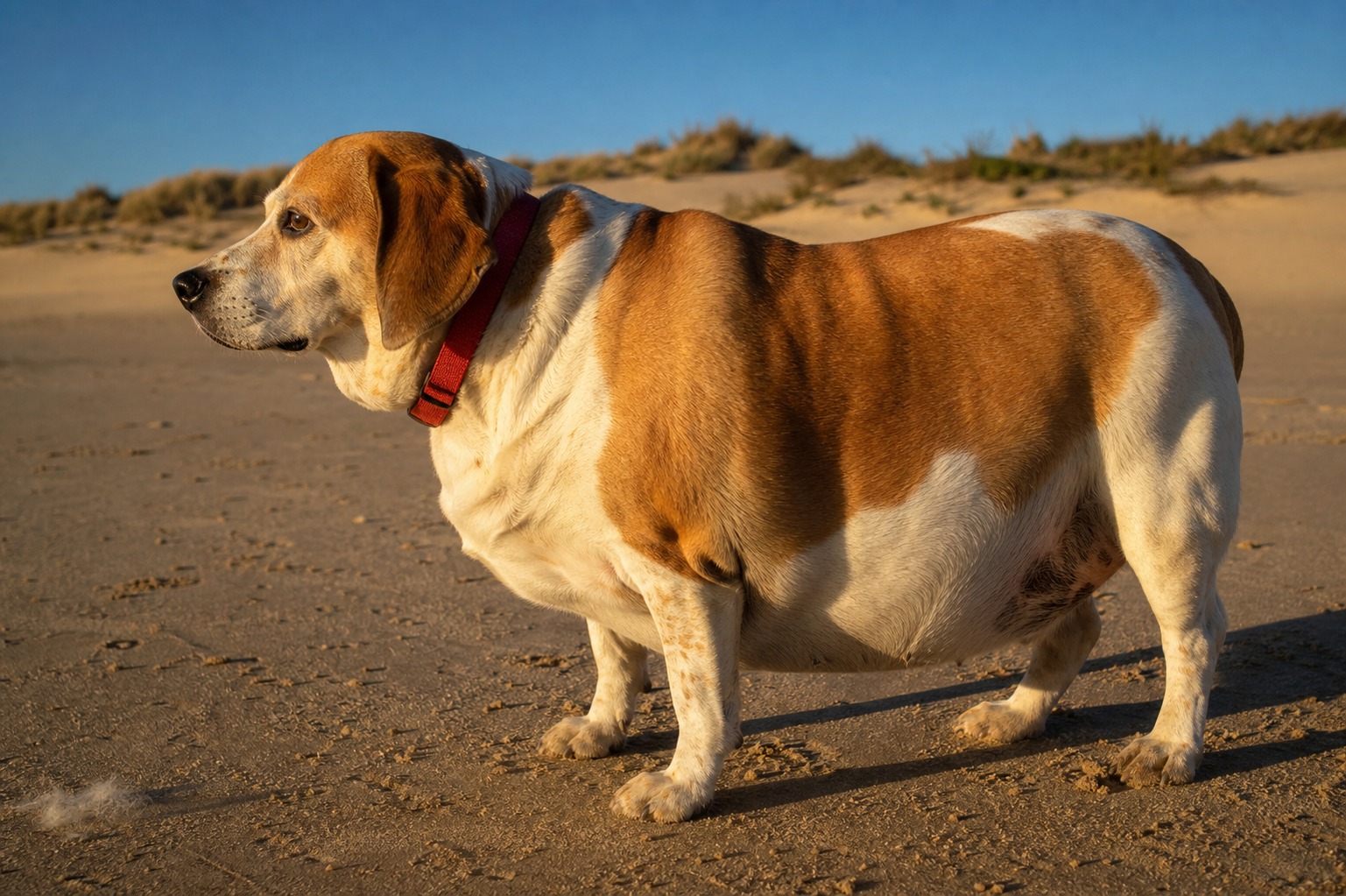
The hardest part of a dog’s weight problem is not the weight. It is that most of us cannot see it. In the 2024 Association for Pet Obesity Prevention survey, just over half of dog owners rated their dog’s body as “ideal,” while veterinary body-condition data put closer to 59 percent of dogs in the overweight-to-obese range. We are not lying. We genuinely look at a chunky dog and see a healthy one, because a soft, round dog has quietly become our mental picture of normal.
That perception gap, not a lack of love or effort, is the thing standing between a lot of dogs and two extra years of life. So before we get to calories and treats, let’s fix the eyes. Once you can actually see your dog’s body, the rest is almost easy.
The skill nobody teaches: reading your dog’s body
Vets don’t weigh a dog and call it a day, because “45 pounds” means something completely different on a Beagle than on a Border Collie. They use a Body Condition Score, a 1-to-9 scale where 4 to 5 is ideal and every point above 5 represents roughly 10 percent over ideal weight. You can run the same check at home in about thirty seconds, and it is far more honest than the bathroom scale.
Look down at your dog from above: there should be a clear waist that narrows behind the ribs. Feel along the rib cage with flat hands: the ribs should be easy to find under a thin layer, the way you can feel the bones on the back of your own hand. Look from the side: the belly should sweep up from the bottom of the ribs toward the hind legs. No waist, ribs you have to dig for, and a belly that hangs flat are the three tells of an overweight dog.
Owners ask me to settle an argument about the scale, and I tell them the number on the scale is the least useful thing in the room. I want them to put their hands on the dog. The day a client feels for the ribs and says ‘huh, that’s harder than I expected,’ that’s the day the weight actually starts to come off.
Worth knowing: in the same APOP survey, fewer than half of owners had ever heard of Body Condition Score, and under a third remembered their vet giving them one. This is a tool that exists precisely to close the perception gap, and most people have never been handed it. Now you have it.
Why a few pounds matter so much more on a dog
It is tempting to shrug off five pounds. On you, five pounds is a heavy coat. On a 40-pound dog, five pounds is more than 10 percent of body weight, the equivalent of a 150-pound person carrying an extra 18 to 20 pounds, every step, every stair, for life.
The consequences are not cosmetic. Excess weight is directly linked to diabetes, cardiovascular disease, and high blood pressure, and it raises the risk of cancer and orthopedic problems, including the painful, debilitating knee injuries (like cruciate tears) and arthritis that crop up far more often in heavy dogs. Overweight dogs also overheat faster and tire sooner, which quietly shrinks the active, joyful life you wanted for them in the first place.
And the payoff for getting it right is concrete, and bigger than most people realize. In the landmark Purina Life Span Study, 48 Labrador Retrievers were paired off as littermates and fed for life, with one of each pair getting 25 percent less food than the other. The lean-fed dogs lived a median of 1.8 years longer. Just as striking, the age at which half the dogs needed treatment for a chronic condition was 12 years in the lean group versus 9.9 years in the well-fed one. Same genetics, same household, nearly two extra years and two extra years of good health, bought with portion size alone. That is the real return on a leaner body.
Where the pounds actually come from
Once you can see the problem, the causes are usually mundane and fixable.
Too much food, measured carelessly. Most people pour by eye or trust the very generous range printed on the bag. Both overshoot. Use an actual measuring cup or, better, a kitchen scale, and treat the bag’s range as a starting estimate to adjust down if the waist disappears.
Treats, the silent driver. Roughly 90 percent of owners give treats, and a daily handful of biscuits or a few “just one” table scraps can easily be an extra 50 to 100 calories a day. That alone is a pound or two a year, which is exactly how a trim two-year-old becomes a heavy five-year-old without anyone noticing a single bad day. Keep treats under 10 percent of daily calories and count them.
The wrong macros. Diets heavy in fillers, sugar, and fat pack on weight; dogs generally stay leaner on higher-protein, appropriately portioned food. Calorie counts are often missing or confusingly listed on labels, so when in doubt, ask your vet for a target daily calorie number for your specific dog rather than guessing.
How to fix it without crash dieting
The goal is not a dramatic diet; it is a small, permanent recalibration. Pick a target weight with your vet, trim the daily portion modestly (often 10 to 20 percent), move the treats to a measured allowance carved out of that total, and add steady, joint-friendly exercise like longer walks or swimming. Reweigh or re-score every few weeks. Healthy loss is slow on purpose, generally 1 to 2 percent of body weight per week, because fast weight loss in dogs (and especially in cats) carries its own risks.
Getting ahead of weight is cheaper, kinder, and easier than treating the diabetes, arthritis, and surgeries that follow it. But none of it starts with a calorie. It starts with looking down at your dog and being willing to see what is actually there.
References
- “2024 Pet Obesity Survey Results.” Association for Pet Obesity Prevention, petobesityprevention.org/2024-survey.
- Kealy, R.D., et al. “Effects of Diet Restriction on Life Span and Age-Related Changes in Dogs.” Journal of the American Veterinary Medical Association, vol. 220, no. 9, 2002, pp. 1315-1320.
- “2021 AAHA Nutrition and Weight Management Guidelines for Dogs and Cats.” American Animal Hospital Association, aaha.org/aaha-guidelines/nutrition-and-weight-management.
- “Global Nutrition Guidelines and Body Condition Score.” World Small Animal Veterinary Association, wsava.org/global-guidelines/global-nutrition-guidelines.
Not a substitute for your vet. Our guidance is educational. For urgent symptoms, contact a vet or emergency clinic right away. Editorial standards
Dr. Nair is a veterinarian focused on diet and feeding. She covers everyday nutrition, treats, and the many "can they eat this?" questions owners ask, grounding each answer in what is actually safe and sensible for dogs and cats.
Meet our experts ↗Keep reading
 Health & WellnessThe 'Mystery Dog Illness' Wasn't a Mystery. Here Are 8 Ways to Keep Your Dog Out of It.Dr. Mara Chen · 7 min
 Health & WellnessMost Dog Coughs You Can Soothe at Home. A Few You Really Can't.Dr. Amara Solis · 9 min
 Health & WellnessYour Dog Can Take the Anti-Aging Pill Today. Read the Fine Print First.Dr. Ravi Mehta · 7 min
 Health & WellnessYou'd Expect Giant Breeds to Get the Most Cancer. A Big Study Says It's the Middle.Dr. Mara Chen · 6 min
 Health & WellnessThe Thyroid Test That Puts Healthy Dogs on Lifelong MedicationDr. Lena Park · 9 min
 Health & WellnessA Worm Can Smell Cancer. That's the Idea Behind the At-Home Dog Test.Dr. Mara Chen · 7 min