


A Worm Can Smell Cancer. That's the Idea Behind the At-Home Dog Test.
One in four dogs will face cancer, and catching it early changes everything. A urine test that recruits microscopic worms is trying to make screening as routine as a senior checkup. Here's how it works, and what it can and can't do.

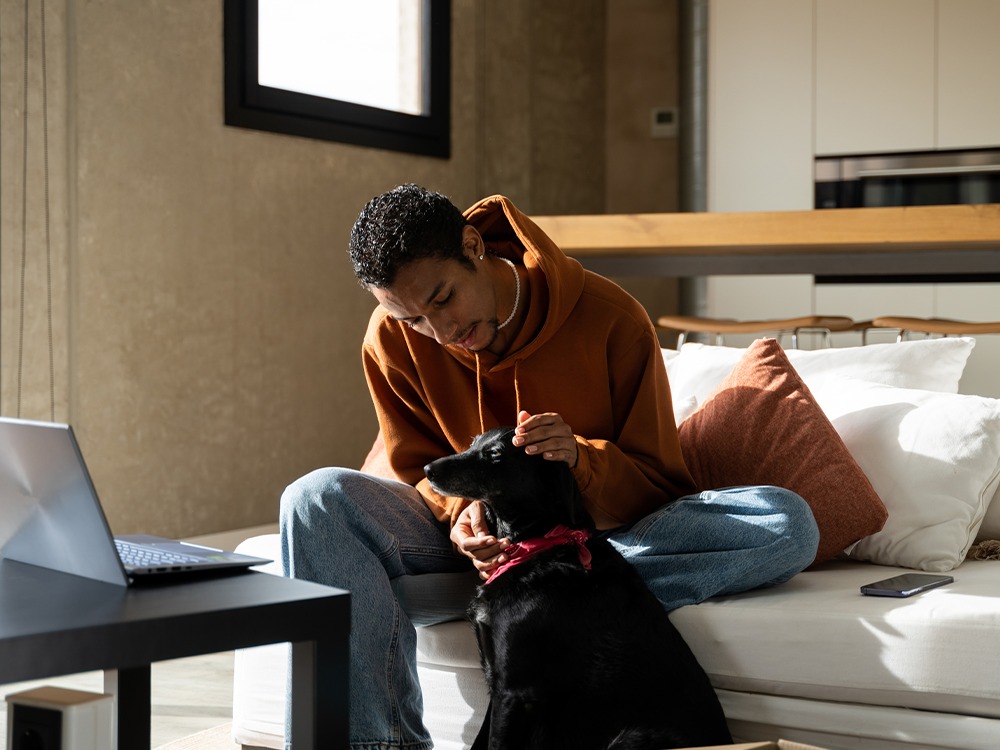
Cancer is the hardest word a dog owner can hear, and it is not rare. By the estimates the American Veterinary Medical Association works from, roughly one in four dogs will develop some form of cancer in their lifetime, and by the time a dog reaches ten, the odds are close to a coin flip. With more than 80 million dogs in American homes, that is a staggering amount of heartbreak, and for decades the tools to get ahead of it simply weren’t practical for everyday use.
The single most important variable in that fight is time. Ask a vet who treats cancer and you’ll hear the same point made a dozen ways: the earlier a cancer is caught, the more options exist and the better the odds. The problem has always been that early is exactly when cancer is silent. Which is what makes a screening test built around microscopic worms so interesting, and why it’s worth understanding what it actually does before you decide whether it belongs in your dog’s care.
The unlikely biology: worms with a nose for cancer
The test comes from Oncotect, a company that grew out of a personal story. Its founder, Chan Namgong, dove into the science of cancer detection while his mother was going through breast cancer treatment, and came across research in which Japanese scientists used a tiny roundworm to sniff out cancer in human urine. He set out to bring the same idea to pets, who at the time had no equivalent of routine cancer screening at all, and launched the company in 2019.
The worm doing the work is C. elegans, a nematode so small you need a microscope to see it, and so gifted at smell that it carries more olfactory receptors than a dog does. Here is the underlying principle, explained in plain terms: cancer cells give off distinctive chemical byproducts, and those byproducts show up in urine. You have probably heard that specially trained dogs can detect cancer in people by scent; this works on the same logic, just with a creature you can raise by the thousands in a lab. Expose the worms to a dog’s urine sample, and they move toward the cancer-associated compounds. Measure that response carefully, and you get a read on the dog’s risk.
In the company’s clinical data, drawn from hundreds of dogs, the test flagged the most common canine cancers with about 90 percent overall accuracy, roughly 83 percent sensitivity (correctly catching dogs that have cancer) and 96 percent specificity (correctly clearing those that don’t). Those figures compare favorably with more invasive blood-based options.
Why a urine test is a genuinely different proposition
The appeal is not just the clever biology; it’s the practicality. Traditional cancer diagnostics, biopsies, ultrasounds, radiographs, are expensive, invasive, and not the sort of thing anyone runs on a healthy-seeming dog just to check. Even the blood-based screening tests tend to be costly and require a hospital visit, with some running in the neighborhood of a thousand dollars retail.
A urine test changes the math on both cost and stress. There are no needles, and, in its current form, no trip required at all: you collect a small sample at home and ship it in. For an anxious dog, or an anxious owner, that lower barrier is the whole point, because a screen you’ll actually do every year beats a gold-standard test you keep putting off.
The value of a low-stress screen isn’t that it replaces a real diagnostic workup, because it doesn’t. It’s that it gets people to screen at all. The dogs I worry about aren’t the ones who get one thorough test; they’re the ones who never get tested because the process felt like too much. A no-needle, do-it-at-home option lowers that wall, and a lifted risk flag means we investigate months before symptoms would have shown up.
What it can’t do, and this part matters
A screening test and a diagnosis are not the same thing, and Oncotect’s own veterinary team is clear about the line. A positive result does not tell you which cancer a dog has or where it is; it tells you the risk is elevated and that it’s time to look further. That follow-up still involves the conventional tools, imaging and biopsy, to find and identify anything real. What the screen buys you is the prompt to start looking sooner.
The flip side is reassuring: a negative result means you may reasonably hold off on the expensive, stressful diagnostics you’d otherwise consider, at least for now. Used correctly, in other words, the test is a triage tool, not a verdict. Treat any result as the beginning of a conversation with your vet, never the end of one.
Who it’s for, and when to start
Cancer can appear at nearly any age, and a small number of very unlucky dogs develop it young, even as puppies. But the risk climbs with age, with most cancers showing up from around age five and up, and certain breeds, Golden Retrievers, Boxers, and German Shepherds among them, carrying meaningfully higher risk. The general guidance is to begin screening around age five to seven and repeat it yearly, and to start on the earlier end for high-risk breeds. Your own vet is the right person to set the timeline for your individual dog.
What’s new since this idea first made headlines
When the worm-based test was first written up, it was available only at a handful of veterinary offices in North Carolina, with a wider rollout still on the horizon. That rollout has since happened. The test is now offered as an at-home kit that ships nationwide from the company, which is based on North Carolina State University’s Centennial Campus. The process is straightforward: collect a few milliliters of your dog’s urine, mail it back, and wait roughly one to three weeks for results depending on the service tier. Current guidance suggests screening every six to twelve months for dogs seven and older, or for high-risk breeds as young as five or six.
The bigger picture is that early cancer screening for dogs, once basically unavailable, is becoming a normal part of the senior-wellness toolkit, alongside the standard blood and urine panels your vet already runs. That is real progress. Just keep the expectation honest: this is a way to catch a problem earlier and a reason to look closer, not a substitute for the exam, the diagnostics, and the veterinary judgment that turn an early flag into an actual plan.
This article is for general information and isn’t a substitute for veterinary care. If you’re worried about your dog’s health or considering a screening test, talk with your veterinarian.
References
- American Veterinary Medical Association, Cancer in Pets
- Oncotect, At-Home Cancer Screening Test for Dogs
- Today’s Veterinary Practice, Liquid Biopsy: The Future of Cancer Detection in Dogs?
- North Carolina State University Centennial Campus, Oncotect partner profile
Common questions
Is a positive result a cancer diagnosis?
No. It's a screening test that flags elevated risk. It does not tell you the type or location of a cancer, so a positive result means your vet follows up with diagnostics like imaging or a biopsy.
When should screening start?
Experts generally suggest starting around age five to seven and testing yearly, and starting earlier for high-risk breeds like Golden Retrievers, Boxers, and German Shepherds. Talk to your vet about the right timeline for your dog.
Not a substitute for your vet. Our guidance is educational. For urgent symptoms, contact a vet or emergency clinic right away. Editorial standards
Dr. Chen is a small-animal veterinarian who leads health and safety coverage at The Pet Times. She writes and reviews the bulk of our illness, condition, and safety content, translating clinical guidance into clear, practical advice owners can act on at home.
Meet our experts ↗Keep reading
 Health & WellnessOne Breed Is 31 Times More Likely to Get This Hidden Tumor. Catching It Early Changes Everything.Dr. Mara Chen · 6 min
 Health & WellnessYou Found Worms in the Poop. What You Can See Is the Least Useful Part.Dr. Priya Nair · 8 min
 Health & WellnessThere's an Actual Number for 'My Dog Drinks Too Much Water'Dr. Lena Park · 7 min
 Health & WellnessThe Color of Your Dog's Eye Goop Is a Triage MapDr. Amara Solis · 6 min
 Health & WellnessThere's a Number for 'Drinking Too Much.' Most Dog Owners Don't Know It.Dr. Lena Park · 8 min
 Health & WellnessSomething's Wriggling in the Poop. A Straight-Talk Guide to the 5 Worms Puppies Get.Dr. Lena Park · 7 min