


The Color of Your Dog's Eye Goop Is a Triage Map
Clear and watery, thick and mucusy, or yellow-green? The color of the discharge, plus the company it keeps, tells you whether to wipe it away or call the vet today.

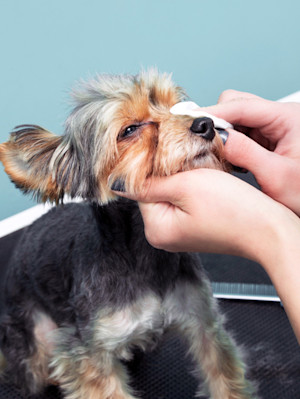
Most days, your dog’s eyes take care of themselves and ask nothing of you. Then one morning there is crust in the corner, or a wet streak down the fur, or something that was not there yesterday, and you are left guessing whether it is nothing or the start of something.
Here is a way to stop guessing. Eye discharge is not one thing, and its color is not a random detail. The color, read alongside the other symptoms it comes with, works like a triage map: it points you toward “wipe it and watch,” “book a routine visit,” or “this needs a vet soon.” Learn to read it and you can respond to your dog’s eyes with far more confidence, and far less late-night worry.
First, what discharge actually is
Eye discharge is simply any fluid coming from the eye. It can be clear and watery or thicker and colored, white, yellow, or green. Some of it is completely normal, like tears washing out a bit of dust. Some of it signals irritation, infection, or a deeper health problem. The causes are varied: allergies, bacterial or viral infection, a foreign body, a blocked tear duct, an eye injury, dry eye, or breed-related anatomy that makes some dogs prone to it. The trick is that the type and color of the discharge, plus what else is going on with the eye, narrow the field quickly.
The color map
Clear and watery is the most reassuring flavor. It usually traces to allergies, mild irritation, or something as simple as wind in the face on a car ride. A short-lived bout often clears on its own. If it becomes constant, though, it can point to an ongoing irritation or a blocked tear duct. Blocked ducts are fairly common and, without surgery, tend not to resolve, but many owners reasonably choose to leave them be, because the result is usually a cosmetic one, tears running down the face and staining the fur, rather than something that threatens the eye.
Thick and mucus-like, the kind that builds up overnight and cakes around the eye by morning, is the color to take more seriously than most people do. It is a classic sign of dry eye, where the eye is not producing enough tears. That may sound minor, but it is not: without an adequate tear film, the eye stays chronically irritated and the cornea can be damaged over time. Dry eye is not a “wait and see” condition. At a minimum it needs artificial tears several times a day, and usually more.
Yellow or green is the color that should move you toward the phone. It typically signals infection, bacterial conjunctivitis, an infected wound on or around the eye, or something deeper that needs veterinary attention. Colored, pus-like discharge is not a home-remedy situation.
Color is only half the map. Read the company it keeps.
The other half of triage is what the discharge shows up with. Mild, occasional discharge in an otherwise bright, comfortable eye is usually fine to clean and monitor. The signals that push any discharge into “get it seen” territory are: discharge that is persistent or heavy, any yellow, green, or bloody color, squinting or excessive blinking, swelling or redness around the eye, pawing at the eye from discomfort, and, most urgent, any cloudiness or visible change in the eye itself. Dogs get the same serious eye diseases people do, ulcers, glaucoma, cataracts, deep infections, and with those, early diagnosis genuinely changes the outcome. When in doubt, an eye is the wrong organ to gamble on.
The eye doesn’t give you much runway, and that’s what people underestimate. A red, squinting, cloudy eye with colored discharge can go from uncomfortable to sight-threatening faster than almost anything else I treat. I would much rather see a dog for something that turns out to be minor irritation than have an owner wait a few days on what turns out to be an ulcer or glaucoma. With eyes, early is cheap and late is expensive.
How the vet sorts it out, and how it gets treated
Because the same colored discharge can have different causes, a vet leans on a small set of quick tests: a close physical exam of the eye, a tear-production test to check for dry eye, a fluorescein stain that lights up corneal scratches or ulcers, a bacterial culture to identify an infection, and an eye-pressure test to screen for glaucoma. Those few minutes of testing are exactly what home observation cannot give you, which is why a truly concerning eye earns a visit.
Treatment follows the cause. Bacterial infections get antibiotic drops or ointment. Underlying conditions may call for oral medication. Dry eye is managed with tear-stimulating and lubricating drops. Inflammation and irritation may need anti-inflammatory medication. And some problems, blocked tear ducts, cataracts, certain breed-related issues, can be corrected surgically. For genuinely mild, uncomplicated cases, your vet may bless some home support: a clean damp cloth to gently wipe around (not in) the eye, sterile saline to flush a minor irritant, a warm compress to loosen crusty buildup, and, for allergy-driven watering, reducing exposure to the trigger plus any vet-recommended antihistamine.
What’s new since this was written
The most encouraging recent news is for the dogs with that easy-to-dismiss thick, mucusy discharge, the dry eye crowd. Dry eye, or keratoconjunctivitis sicca, is one of the more common canine eye diseases, and the mainstay treatment, topical cyclosporine (with tacrolimus as a relative), keeps proving how effective it is. These are immune-modulating drops that calm the inflammation shutting down tear production, and research shows they help a large majority of dogs, including ones whose tear tests come back severely low. In other words, the eye that goops up every single morning is very often a highly treatable eye, not a life sentence of wiping. That is a good reason not to shrug off the mucusy morning crust as merely cosmetic and to get a tear test if it keeps happening.
Bottom line
Your dog’s eye discharge is a message, and the color is the headline. Clear and watery usually means minor irritation, thick and mucusy points toward treatable dry eye, and yellow or green means infection and a call to the vet. But never read the color alone, weigh the company it keeps, because squinting, redness, swelling, cloudiness, or pawing turns even a small amount of discharge into a reason to be seen. Keep the eyes gently clean, stay alert to changes, and when the map points to the vet, go early. Eyes reward the owners who do not wait.
References
- Hwang, J., et al. “Bidirectional Corneo-Conjunctival Transposition for Large and Deep Canine Corneal Wound Healing.” Journal of Biomedical Translational Research 23, no. 3 (Sept. 2022): 67–71.
- Thomasy, S. “Canine Conjunctivitis: Causes and Treatment.” BSAVA, April 2020.
- Wolfer, J., and B. Grahn. “Diagnostic Ophthalmology: Periocular Discharge and Swelling around the Eye in a Dog.” Canadian Veterinary Journal 36, no. 10 (Oct. 1995): 661.
- Dodi, P.L. “Immune-Mediated Keratoconjunctivitis Sicca in Dogs: Current Perspectives on Diagnosis and Treatment.” Review of cyclosporine and tacrolimus therapy in canine KCS.
Common questions
What does the color of dog eye discharge mean?
Clear and watery usually points to allergies, irritation, or wind. Thick and mucus-like often signals dry eye from low tear production. Yellow or green typically means infection and needs a vet.
When should I take my dog to the vet for eye discharge?
Go in for persistent or heavy discharge, any yellow, green, or bloody discharge, squinting or excessive blinking, redness or swelling, pawing at the eye, or any cloudiness or visible change in the eye itself. Eye problems can worsen fast, so early is better.
Not a substitute for your vet. Our guidance is educational. For urgent symptoms, contact a vet or emergency clinic right away. Editorial standards
Dr. Solis is a board-certified veterinary dermatologist with over twelve years of clinical experience. She advises on skin conditions, allergies, and grooming practices that affect coat and skin health. All dermatology and allergy content at The Pet Times is reviewed by her team before publication.
Meet our experts ↗Keep reading
 Health & WellnessChronic Kidney Disease in Dogs Is a Race Against Time. How to Win GroundDr. Lena Park · 7 min
 Health & WellnessYou Cannot Tell a Lump Is Harmless by Touching ItDr. Mara Chen · 7 min
 Health & WellnessYour Dog Is Probably Heavier Than You Think, and That Gap Is the Real ProblemDr. Priya Nair · 5 min
 Health & WellnessOne Mosquito Can Put a Worm in Your Dog's Heart. Here's How to Stop It.Dr. Ravi Mehta · 8 min
 Health & WellnessYou Found a Lump on Your Dog. Here's the One Thing You Can't Do About It.Dr. Nina Kohl · 8 min
 Health & WellnessThe Worm You Can See Isn't the One That KillsDr. Amara Solis · 7 min