


A Deaf Dog Isn't Harder to Train. You Just Need a New Language
A deaf dog can live a full, joyful life. Here is how to spot hearing loss, get a diagnosis, and build a whole new language of hand signals and trust with your pup.

There is a scene in The Graduate that captures, better than almost anything, what life can feel like for a deaf dog. The main character walks into a party in full scuba gear. He can see everyone’s mouths moving and read their expressions, but inside the diving mask, all he hears is his own breathing.
A senior dog losing their hearing lives in something like that mask. They can still see you, still feel you, still read your face. They just cannot hear your voice anymore. The good news, and the whole point of this guide, is that hearing is only one channel of communication. With a little patience, you can build a richer one. Deaf dogs lead full, happy, well-trained lives, and the bond you build along the way can be deeper than ever.
Signs your dog may be losing their hearing
Hearing loss often creeps in so gradually that you do not notice until the signs get obvious. Talk to your vet if your dog shows any of these:
- Not responding to their name or familiar cues, or seeming to “ignore” you
- Confusion when following voice commands they used to know
- Not waking easily, or sleeping through sounds that used to rouse them
- A startle response when touched while asleep
- Repeated head shaking or tilting toward one side
- Prolonged barking
- Painful ears or a smelly discharge
Some of these point to hearing loss, but others, like the ear discharge or head tilting, can signal an infection or other ear condition. Either way, they are worth a vet visit.
What causes hearing loss in dogs
A dog’s ears work much like ours, and they lose hearing for many of the same reasons. Some dogs are congenitally deaf, meaning deaf from birth. Others acquire it over time from wax or debris buildup, ear mites, infections or inflammation of the ear canal, head trauma, loud noise, certain medications, or simply old age.
Coat color plays a role too, and the numbers here are more striking than most owners realize. Congenital deafness has now been documented in roughly 80 dog breeds, and the risk clusters tightly around two pigmentation genes, piebald and merle, that also produce white or light coats. In Dalmatians, the breed studied most, about 8 percent of dogs are deaf in both ears and another 22 percent are deaf in one ear, meaning close to a third of the breed has some hearing loss from birth. The merle gene tells the same story: in one large analysis, dogs carrying a single merle allele had a deafness rate around 3.5 percent, but “double merle” dogs, the ones bred from two merle parents, hit 25 percent. That is the practical case against breeding merle to merle, and it is worth knowing if you are choosing a puppy from an at-risk breed.
Acquired deafness is different. A senior dog with a chronic skin infection that spreads into the ears, for example, may lose hearing both from the infection and from aging at the same time. That kind of loss often creeps in gradually and is easy to miss until it is advanced, which is exactly why the signs above matter.
Getting a real diagnosis: the BAER test
If you suspect hearing loss, there is a definitive way to confirm it. The BAER test (Brainstem Auditory Evoked Response) measures the electrical activity in the inner ear and the hearing pathways of the brain, much like an EKG reads the heart.
The dog wears small earphones that emit a sound, while tiny electrodes on the head and shoulders detect the response. The resulting waveform shows exactly how much hearing a dog has lost, and can even reveal whether a dog is deaf in just one ear. The test is painless and gives results on the spot, though some dogs object to the earphones.
BAER testing is used routinely by breeders of at-risk breeds, by people training working dogs who must hear in both ears to locate sounds, and by owners trying to gauge hearing loss after chronic ear infections. It is offered only at specialized centers, so ask your vet for a referral.
The single most important thing I tell families with a newly deaf dog is to stop grieving the hearing and start building the new language. Dogs are remarkable at compensating. Give them a clear, consistent visual vocabulary and they adapt faster than most people expect.
Training a deaf dog
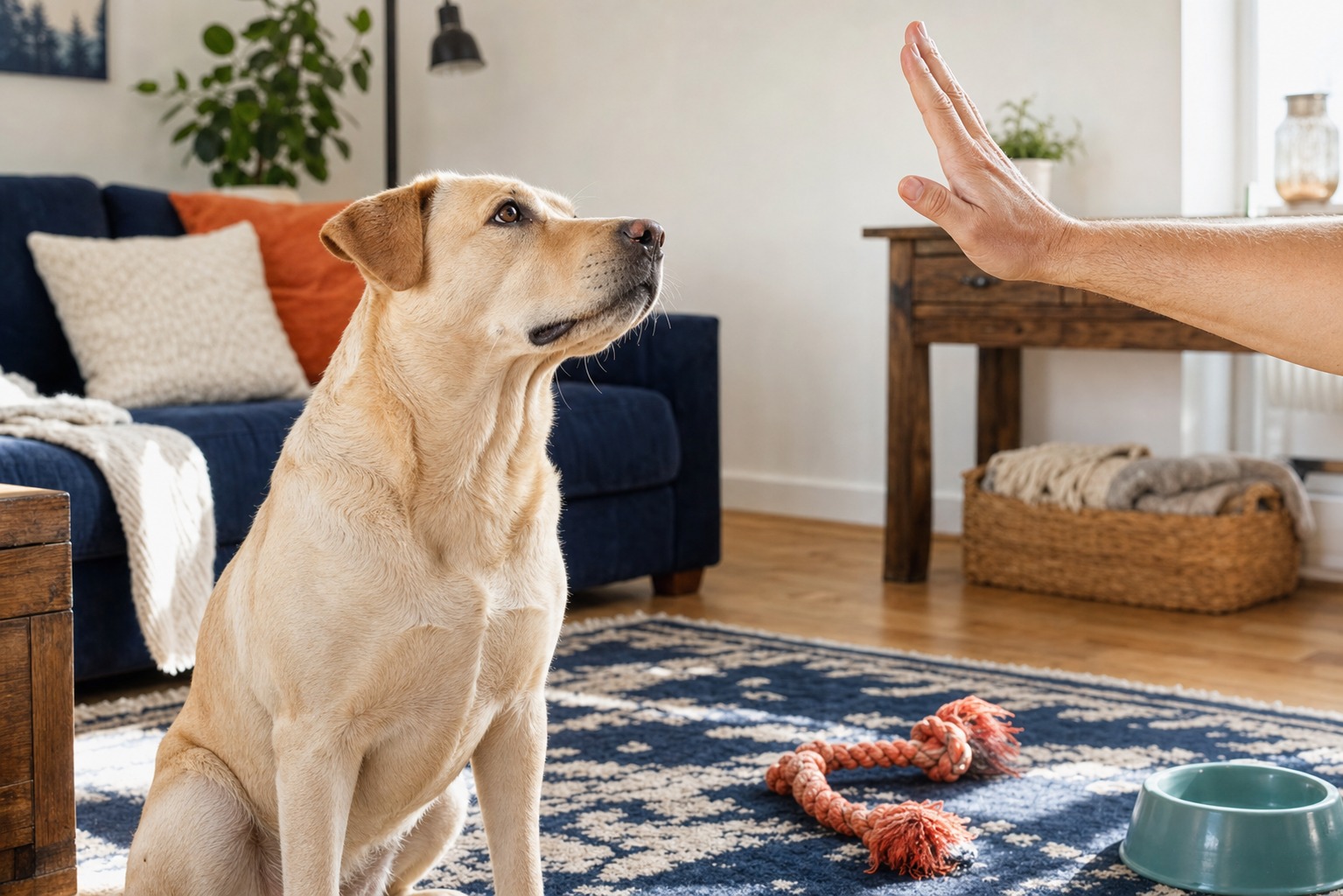
Here is the heartening truth: deaf dogs are often easier to train than hearing dogs, because they learn to watch their humans intently. The two keys are consistency and rewards. Pick a hand signal for each behavior and use it the same way every single time. It does not have to be formal sign language. Any clear, repeatable gesture works, as long as you stick with it.
A hearing dog in the house can be a real asset, too. Deaf dogs often take social cues from their hearing companions, who can effectively help with training by example.
One cue is worth teaching every dog, deaf or not: “watch,” which simply means “look at me.” It is the foundation for everything else, because you cannot signal a dog who is not looking at you. The how-to steps are in the box above. Teaching it early pays off enormously if a dog loses hearing later in life.
There is no limit to how much a deaf dog can learn. As one trainer-friendly saying goes, a dog can keep learning as long as they have a pulse and you have patience. And no, you absolutely can teach an old dog new tricks. Older dogs often have longer attention spans than puppies, which can make them easier to work with.
Living with a deaf dog
The mindset shift that matters most is to drop the pity. Treat your dog’s deafness as a non-event, because that is how your dog will treat it.
A dog isn’t sitting around mourning what it lost the way a person would. But they read us closely, so if we hover and grieve, they soak up that worry and respond by withdrawing or acting up. Handle it as an ordinary fact of daily life and your dog takes the same cue. Calm and unbothered is the real kindness here.
Here are practical tips for daily life with a deaf dog:
- Keep them leashed or in a securely fenced yard, always. They cannot hear traffic or hazards.
- Learn the essential hand signals: sit, stay, come, down, good, no, and watch. Create a signal for their name, too.
- Add a tag to their collar noting that they are deaf, alongside your contact info.
- Put a bell on their collar so you can find them around the house.
- Use a flashlight to get their attention from across a room.
- Be consistent in every signal you use.
- Let your dog know when you are leaving so you never simply “vanish” while they sleep.
- Wake them gently, with a treat near the nose or a touch away from the face. Teach kids to do the same, since some dogs may snap if startled awake.
The reward for all of this is the relationship itself. A deaf senior dog may sleep most of the day, move a little slower, and sit out some of the old antics. None of that changes the bond. Practiced hand signals, a thumbs-up for a job well done, and steady, patient attention keep the connection alive. Hearing or not, your dog is still your best friend.
References
- Strain, G.M. “Deafness in Dogs and Cats: Genetics of Deafness.” Louisiana State University School of Veterinary Medicine. https://www.lsu.edu/vetmed/deafness/genetics.php
- Strain, G.M., et al. “Prevalence of Deafness in Dogs Heterozygous or Homozygous for the Merle Allele.” Journal of Veterinary Internal Medicine, 2009. https://onlinelibrary.wiley.com/doi/10.1111/j.1939-1676.2008.0257.x
- Merck Veterinary Manual. “Deafness in Animals.” https://www.merckvetmanual.com/ear-disorders/deafness/deafness-in-animals
- Orthopedic Foundation for Animals. “Congenital Deafness (BAER Testing).” https://ofa.org/diseases/other-phenotypic-evaluations/congenital-deafness/
Common questions
How do I wake a deaf dog without scaring them?
Never startle a sleeping deaf dog by touching their face. Wake them gently by putting a treat near their nose so they smell it, or by touching them somewhere away from the head, like the shoulder or back.
How can I keep a deaf dog safe outside?
Keep them on a leash or in a securely fenced yard at all times. A deaf dog cannot hear cars, bikes, or your call, so off-leash freedom in open areas is too risky.
Dr. Chen is a small-animal veterinarian who leads health and safety coverage at The Pet Times. She writes and reviews the bulk of our illness, condition, and safety content, translating clinical guidance into clear, practical advice owners can act on at home.
Meet our experts ↗Keep reading
 First DaysEight Weeks Isn't a Feeding Milestone. It's a Behavior Deadline.Dr. Priya Nair · 9 min
 TrainingYour Dog Isn't Being Stubborn About the Snow. They're Confused.Dr. Amara Solis · 7 min
 TrainingYou Can't Bribe a Snow-Drunk Dog Inside. One Command Actually Works.Dr. Priya Nair · 7 min
 Training'Drop It' Is the One Cue That Might Save Your Dog's LifeDr. Nina Kohl · 8 min
 LivingThe Only People Who Should Own a Husky Walk 11 Miles a DayMarcus Webb · 7 min
 LivingThe Kayak Isn't What Hurts Dogs. The Water Is.Dr. Ravi Mehta · 8 min