


Eight Weeks Isn't a Feeding Milestone. It's a Behavior Deadline.
A puppy can eat solid food weeks before they should leave the litter. The reason to wait has nothing to do with the food bowl, and everything to do with what mom and littermates are still teaching.
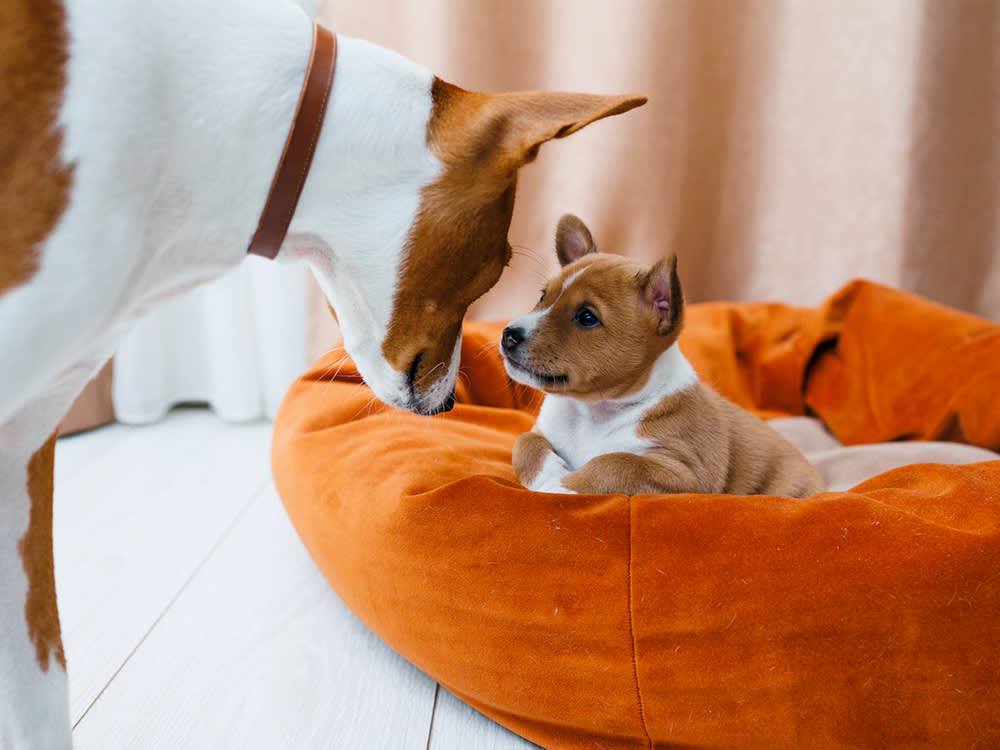
Here is the thing that trips people up: a six-week-old puppy can eat. They can crunch kibble, they can toddle to the bowl, and they will look at you like a small, complete dog. Weaning is a food milestone, and by six to eight weeks most puppies have cleared it.
Which is exactly why “he’s eating solid food, he can go home” is such a persuasive, wrong sentence.
The reason to leave a puppy with their mother and littermates until at least eight weeks, and ideally 10 to 12, has almost nothing to do with nutrition after those first weeks. It has to do with a hard-edged developmental window that is open right now, that closes on a schedule you cannot negotiate with, and that mom and siblings are the only qualified teachers for. Take the puppy out early and you do not get a hungrier dog. You get a dog who is worse at being a dog.
The window, and why it has a deadline
Newborn puppies are helpless in a way that is easy to forget. Eyes closed, ears closed, unable to walk or hold their own body temperature. The mother does everything: round-the-clock nursing, body heat, stimulating them to pee and poop, keeping them clean, physically carrying them from spot to spot.
Then, fast, they come online. And starting at about three to four weeks old, a specific window opens: the primary social and emotional development period, which runs until roughly 12 to 14 weeks. Inside it, a puppy accepts novelty easily. New surfaces, new noises, new dogs, new humans, all of it lands as “normal” with very little effort. After about 14 weeks, that same novelty starts to land as “threat,” and it takes real work to change the answer.
Almost everything that matters happens inside that window. And for the first half of it, the puppy is supposed to be in a pile of siblings with their mother nearby.
What mom is actually teaching, week by week
Nutrition and immunity (0 to 8 weeks). Puppies nurse exclusively for the first three to four weeks. Mother’s milk is complete, balanced, and carries immune factors that boost the puppy’s own defenses against infection. From about four weeks, mushy solid food enters the picture, and by six to eight weeks most puppies are fully weaned. The gradual version of this is the good version.
Body and brain (all of it). Puppies use their mother as the reference for how to be a dog: how to eat solids, how to play, how to move through the world. Littermates are the other half of the curriculum. Wrestling, climbing, and chasing each other is how a puppy discovers the limits of how hard they can go.
The social rules (three to 14 weeks). This is the piece you cannot recreate with a person and a toy. When a puppy bites too hard, mom or a sibling corrects them, immediately and proportionately, and then the game resumes. That loop is bite inhibition, and it is learned, not innate. Alongside it they are learning to read canine body language, to signal, to defer, to negotiate, and to sort the world’s sights, smells, and sounds into “fine” and “not fine” while a secure adult sits nearby to keep the whole exercise from becoming frightening.
People imagine the litter as a nursery, when it is closer to a classroom with a very strict teacher. The corrections a puppy gets from their mother and siblings are the only feedback in their life that is instant, fair, and in a language they were born understanding. There is no human substitute for that, and there is no way to schedule it later.
What early separation costs: the actual evidence
This is not vibes. It has been measured.
A study published in Veterinary Record compared 70 adult dogs who had been taken from the litter between 30 and 40 days old with 70 adults who left at about two months. The early-separation group was significantly more likely, as adults, to show destructiveness, excessive barking, fearfulness on walks, reactivity to noises, possessiveness over toys, possessiveness over food, and attention-seeking behavior.
Read that list again, because it is basically the greatest-hits album of “problems that get a dog surrendered.”
The mechanism is not mysterious. Break down what early separation removes:
Nutrition and immune support. A puppy pulled before weaning has to be bottle-fed with puppy formula, which means round-the-clock feedings, external heat support, and manual stimulation to pee and poop. Formula is a decent substitute, not a perfect one, and it does not carry the immune factors milk does. Bottle-fed puppies carry a higher risk of complications, delayed growth, and illness, particularly in the first few weeks.
The dog curriculum. Without mom and siblings, a puppy misses bite inhibition, misses body-language literacy, and misses the calibration of what is safe versus alarming. Downstream, that becomes fearfulness, biting, anxiety, and destructiveness in an adult dog.
A secure base for novelty. Between about four and 14 weeks, puppies should be meeting the world. With a litter, they meet it while attached to something safe, which is what lets an experience register as exciting instead of terrifying. Alone in a new house at five weeks, they are meeting the world with no anchor at all.
The number, and the honest exceptions
Minimum eight weeks. Target 10 to 12. That is the whole rule.
Weaning should be finished, and finished gradually. Nursing tapers from about three to four weeks as solids come in, and by roughly eight weeks the puppy is eating solid food exclusively. The longer they stay, the more likely that transition happened on the puppy’s clock instead of a breeder’s.
And sometimes none of this is possible. Puppies are orphaned when a mother is injured or killed. Shelters, which are frequently full, adopt puppies out at the eight-week minimum to get them into homes and keep them alive. There are medical reasons a mother cannot nurse. There are backyard litters that get split up early and strays found in a box.
Those puppies are not doomed. Most of them turn out completely fine. But they are starting with a real deficit, and they need the gap filled deliberately: a vet’s help immediately if you are bottle-feeding, because very young puppies are fragile and technique matters. Best case, an orphan gets fostered into another litter of similar-aged puppies, or with a nursing mom, or with a patient adult dog who will do the teaching a mother would have done. A second-best case is an owner who knows exactly what is missing and goes and gets it.
Whichever week they arrive, do these things
Age at adoption sets the starting line, not the finish.
Puppy-proof before they walk in. Toxins, cords, small swallowables, gone. If you cannot do the whole house, do one confined home-base room where the puppy can be safely left unsupervised while they settle.
Have the gear already. Crate, bowls, food, toys, leash, harness, bought thoughtfully in advance instead of grabbed in a panic on day two.
Line up a vet. For the initial check-up and vaccines. Some shelters and rescues will ask you for your vet’s name during screening, so you may need one before you can even adopt.
Enroll in a positive-reinforcement puppy class. The single highest-value thing on this list. It teaches you, it builds the bond, and it hands your puppy structured social and emotional practice inside the window that is still open.
Be boring on purpose. Same feeding times, same walk times, same rhythm. Predictability is what makes a new puppy feel safe. Give them a defined retreat of their own, a crate or a mat or a corner, that nobody bothers them in.
Keep socializing after 14 weeks anyway. The window closing does not mean the door is locked. It means the work costs more. Keep paying it, for years, and you get a dog who can handle the world.
What newer research adds
The research has moved from “is early separation bad” to “what exactly is doing the work,” and the answer keeps coming back to quality of exposure, not quantity. A 2022 systematic review of canine socialization research found that structured, positive early experiences, of the sort a good puppy class or a thoughtful breeder provides, are consistently linked to better-adjusted adult dogs, while flooding a puppy with overwhelming experiences during the same window can do harm rather than good.
The practical translation is simple, and slightly counterintuitive. Do not just haul your 10-week-old puppy to a loud farmers market and call it socialization. Ten calm, pleasant, puppy-paced encounters beat one overwhelming one, and a puppy who is frightened during the window learns fear just as efficiently as they would have learned confidence.
If your puppy came home early, that is the lever you actually have. You cannot give them back the litter. You can give them a steady, unhurried tour of the world before their brain stops taking new applications.
References
- Pierantoni, L., Albertini, M., and Pirrone, F. “Prevalence of owner-reported behaviours in dogs separated from the litter at two different ages.” Veterinary Record, 2011. https://pubmed.ncbi.nlm.nih.gov/21865608/
- Dietz, L., et al. “Canine Socialisation: A Narrative Systematic Review.” Animals, 2022. https://pmc.ncbi.nlm.nih.gov/articles/PMC9655304/
- Korbelik, J., Rand, J.S., and Morton, J.M. “Comparison of early socialization practices used for litters of small-breed dogs and their effect on adult dog behavior.” Journal of the American Veterinary Medical Association, 2011.
- Best Friends Animal Society. “Caring for Orphaned Newborn Puppies.” https://resources.bestfriends.org/article/caring-orphaned-newborn-puppies
Common questions
What is the puppy socialization window?
Roughly three to four weeks old through 12 to 14 weeks old. During this period puppies accept new sights, sounds, smells, people, and dogs unusually easily. After about 14 weeks, adapting to novelty gets measurably harder, which is why what happens inside the window sticks.
Do puppies feel sad when they leave their mom?
A sudden separation is genuinely distressing, especially before weaning is complete. Mom is not just food; she is warmth, safety, hygiene, and correction. Abrupt loss of that is a physical and emotional shock, and it can show up later as anxiety and fearfulness.
What if my puppy was orphaned or separated early?
Most of these puppies turn out fine with support. Get a vet involved immediately for bottle-feeding technique, and put real effort into structured socialization. The best case is fostering them with another litter, a nursing mom, or a patient adult dog who will teach them dog manners.
Dr. Nair is a veterinarian focused on diet and feeding. She covers everyday nutrition, treats, and the many "can they eat this?" questions owners ask, grounding each answer in what is actually safe and sensible for dogs and cats.
Meet our experts ↗Keep reading
 First DaysThe Simple Math That Ends Puppy Potty AccidentsDr. Lena Park · 6 min
 TrainingA Stranger Held His Puppy 50 Times in a Month. The Science Says He Was Right.Dr. Mara Chen · 6 min
 First DaysNighttime Crate-Training Usually Fails for One Reason: Bladder MathNina Vasquez · 8 min
 First DaysYour Puppy Isn't Regressing. They're in a Fear PeriodJordan Ellis · 8 min
 First DaysThe Only Puppy in the Litter Missed a Class. It Shows Up Years Later as a Bite.Dr. Nina Kohl · 9 min
 First DaysStop Counting Your Puppy's Sleep Hours. Watch for the Change.Dr. Amara Solis · 8 min