


Nighttime Crate-Training Usually Fails for One Reason: Bladder Math
Most crate-training struggles aren't about the crate at all. They're a mismatch between how long you're asking your puppy to hold it and what their bladder can actually do. Get that number right and the rest gets easy.

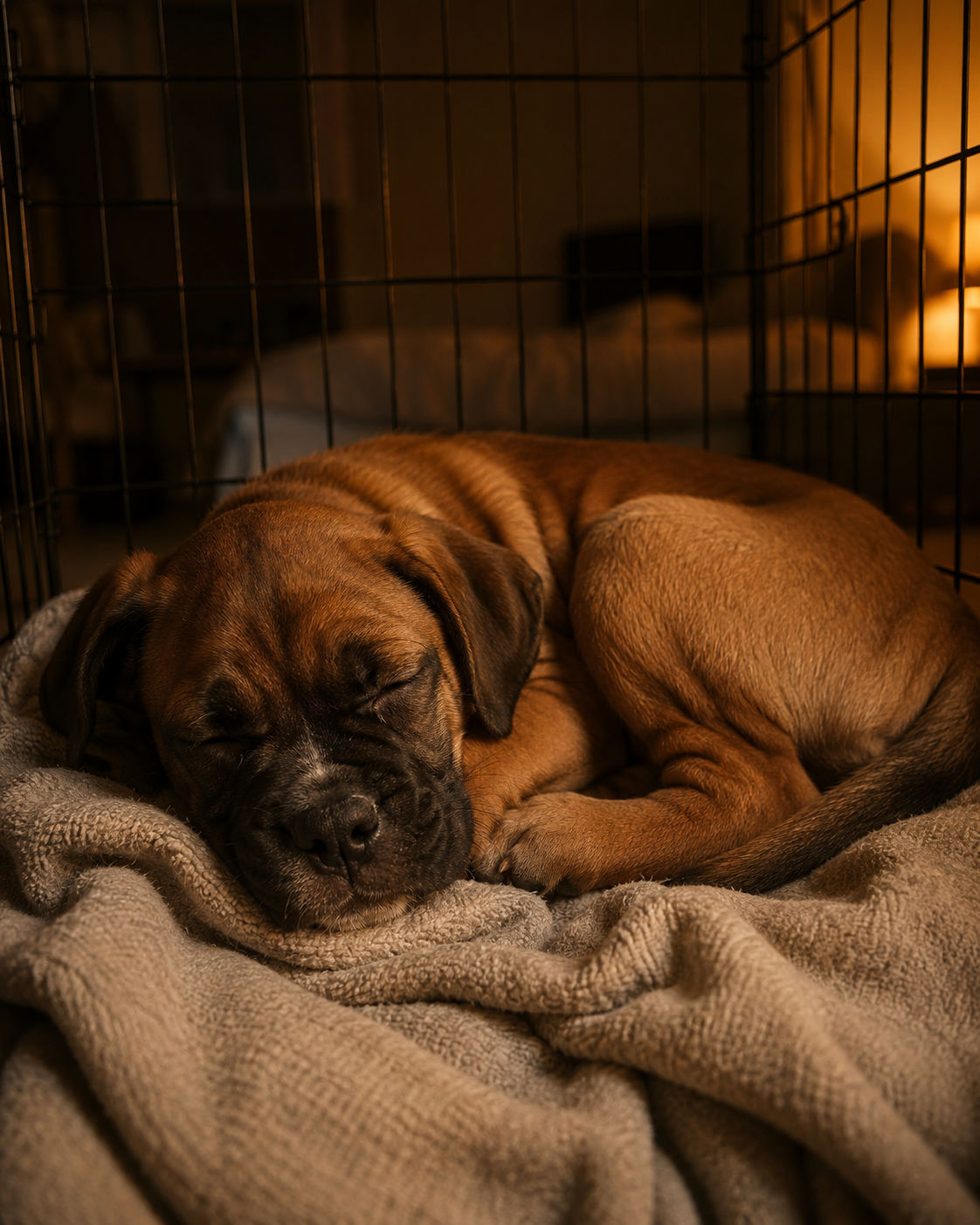
Here is the thing almost nobody tells new puppy parents up front: most nighttime crate-training that “isn’t working” isn’t a crate problem at all. It’s a math problem. People buy the right crate, make it cozy, do everything the guides say, and then quietly conclude they’ve failed because the puppy still cries at 3 a.m. and has an accident by 5. But an eight-week-old puppy physically cannot hold their bladder all night, and no amount of bedding or blanket-covering changes that. Once you build the whole plan around your puppy’s actual bladder capacity instead of your sleep schedule, crate-training stops feeling like a battle. So we start there, with the number, and only then get to the crate itself.
The bladder math that changes everything
The rule of thumb is simple: a puppy can hold their bladder for roughly one hour per month of age. A two-month-old maxes out around two hours; a three-month-old around three. But two nuances make this genuinely useful rather than just a slogan.
First, that figure is a ceiling, not a target. It describes what a puppy can do with effort and some discomfort, not what’s comfortable or healthy. Routinely pushing a puppy to the edge of their hold time invites accidents and, over time, can encourage urinary tract issues. Aim comfortably under the maximum, not at it.
Second, and this is the part that saves parents a lot of guilt: puppies don’t develop reliable bladder control until around sixteen weeks of age. Before that, the “holding it” machinery simply isn’t fully online. So if your ten-week-old wakes you at 3 a.m., that is not stubbornness, spite, or a training failure. It is a developing body doing exactly what a developing body does. Plan for it.
The practical upshot is that you set an alarm. If your puppy is eight weeks old, an overnight potty break every couple of hours isn’t coddling, it’s the schedule. As the weeks pass and their capacity grows, those wake-ups stretch out on their own. Crate-training and potty-training are the same project at night, and the bladder is the clock that runs it.
Why the crate helps in the first place
With the timing set, the crate earns its keep. When your puppy is brand-new and still learning your home, a crate keeps them out of mischief you can’t supervise, and it leans on a real instinct: dogs generally avoid soiling where they sleep, which is exactly what makes a properly sized crate a potty-training ally rather than a cage.
I never call it a cage. I call it a den, a bedroom, a rest zone. That language matters, because it reminds everyone in the house that this is a safe space, not a place you send a dog when they’ve done something wrong.
The benefits stack up: safety and security when you can’t watch them, less destruction from an anxious or bored puppy, easier nighttime potty training thanks to that clean-den instinct, and better sleep for you, knowing your puppy is contained and safe. But every one of those benefits depends on the crate feeling good to the dog, which is what the setup is for.
Setting the crate up right
A few habits make the difference between a puppy who tolerates the crate and one who chooses it:
- Line the crate with soft bedding and blankets, avoiding anything your puppy might chew up and swallow.
- Add a favorite toy to occupy them when they’re awake inside.
- Cover the crate at night for a cozy, dark, sleep-friendly cave, leaving one side open so you can check on them.
- Tire your puppy out with a walk or play session before bed.
- Give a potty break right before they head in, every single time.
- Keep the routine consistent so your puppy learns to anticipate crate time and, eventually, look forward to it.
The setup steps, in order
1. Do the bladder math (again, first)
Before anything physical, fix your overnight schedule to your puppy’s age in months as a ceiling. This one step prevents more crate “failures” than any product choice.
2. Choose a crate
Find one where your puppy can stand, turn around, and lie down comfortably, sized for the adult dog they’ll become. A hand-me-down or budget crate is fine; if you go with a wire crate, ask a trainer or vet which brands are safest for young puppies. Crucially, if the crate is oversized for now, section it off, because a puppy who can potty in the back corner and sleep up front loses the clean-den advantage entirely.
3. Make it comfortable
This is your puppy’s bedroom for a while. Fill the whole crate with comfortable bedding rather than splitting it into a sleeping half and a toilet half. You can feed meals inside, and a hook-on water bowl keeps water available without your puppy sitting in it, which matters especially in hot weather.
4. Let your puppy get used to it
Start with the crate where you and your puppy spend the most time. Being in the middle of the action helps them associate it with good things. Leave the door open so they can explore, and stock it with toys, a blanket, and treats.
Put the best things in life inside the crate. A frozen stuffed chew, a high-value treat, whatever your puppy loves most. You want them to think of that space as where the magic happens.
5. Don’t close the door until your puppy is ready
Go slowly with the door. Leave it open and toss treats in so your puppy runs in and out and doesn’t assume the door closes every time they enter. When you do start closing it, do it in small increments and build up the time. The signal they’re ready? They’re walking into the crate on their own.
6. Create a schedule
People function better on routine, and so do dogs. Use the crate for naps and bedtime at consistent times, even when you’re home. When your puppy falls asleep elsewhere, gently move them to the crate so they wake up there relaxed. Before long they’ll curl up in it on their own.
7. Never use the crate as punishment
It bears repeating: crate time is not a consequence. The crate should be a haven where your puppy rests, relaxes, and maybe dreams about the fun they have with you. A crate used as a time-out poisons the very association you’ve worked to build.
Where the crate goes at night
At least at first, put the crate near your bed. This isn’t sentimental, it’s practical: when your puppy stirs at 3 a.m., you want to hear it and get them outside before an accident, which reinforces the whole potty plan. If you’d rather not have them in your room, place the crate just outside in the hall, then move it farther away over time as their bladder matures and the wake-ups fade.
Handling the whining (without teaching bad lessons)
Nighttime crate-training may involve some crying, the puppy’s, though plenty of pet parents have shed a tear over the sound too. The trick is to respond to why, not just to the noise.
When a puppy whines, they’re telling you something, and your job is to figure out what. Boredom, a full bladder, anxiety, even illness. Listening beats ignoring every time.
Given the bladder math, treat middle-of-the-night whining as a potty signal first: take them out calmly, no play, no fuss, straight back to the crate. What you want to avoid is the trap where whining becomes the reliable way to get the door open, because a puppy learns that fast. So once you’ve ruled out a real need, reward the quiet, calm moments rather than reacting to the noise. Don’t let them “cry it out,” but don’t teach them that a meltdown is the escape hatch either. The narrow path between those is: meet genuine needs promptly, and pay attention to calm.
When you feel like giving up
Nighttime crate-training takes patience, consistency, and time, and there will be a stretch where you’re exhausted and convinced it isn’t working. Before you conclude it’s the crate, re-check the math: are the wake-ups actually matching your puppy’s age-appropriate hold time? Nine times out of ten, what looks like failure is a schedule that got ahead of the bladder. If you’ve genuinely dialed that in and your puppy still shows real distress, frantic escape attempts, drooling, or trying to injure themselves, that’s a different signal. That’s not stubbornness to push through; it’s a reason to loop in a veterinary behaviorist and consider gradual alternatives like a playpen. The current consensus still strongly favors crate-training for most puppies, but a small number do better with a modified plan, and forcing it helps no one.
Teach them to love the crate, not just tolerate it. Do that, respect the bladder clock, and most puppies settle within a few weeks into a dog who trots into their den at bedtime because, to them, it’s the safest spot in the house.
References
Common questions
How long can my puppy actually hold it overnight?
Use their age in months as a rough ceiling, so about two hours at eight weeks and three at twelve, and treat it as the maximum, not the goal. Puppies don't gain reliable bladder control until around sixteen weeks, so early-morning wake-ups are biology, not failure.
Where should my puppy's crate be at night?
At first, place it near your bed so you can hear them and take them out fast when they need to potty. You can gradually move it farther away as they mature and need fewer nighttime breaks.
What should I do if my puppy whines in the crate?
Don't let them cry it out, but don't automatically open the door either. First rule out a genuine need, a full bladder above all. If needs are met, reward calm and quiet rather than reacting to the noise.
Nina Vasquez writes about life at home with pets and the relationships at the heart of it. Her work covers day-to-day living, people-and-pet stories, and the products that fit into a real household, with a warm, grounded take on everyday pet ownership.
Meet our experts ↗Keep reading
 First DaysEight Weeks Isn't a Feeding Milestone. It's a Behavior Deadline.Dr. Priya Nair · 9 min
 TrainingYour 'Dominant' Dog Isn't the Problem. Your Puppy Has No Brakes.Dr. Lena Park · 10 min
 TrainingYou're Probably Training Your Puppy Too Hard. Here's the 6-Month Plan That Works.Sasha Ford · 6 min
 TrainingYou're Not Potty-Training the Puppy. You're Training Yourself.Dr. Priya Nair · 9 min
 First DaysYour Puppy Isn't Regressing. They're in a Fear PeriodJordan Ellis · 8 min
 First DaysStop Counting Your Puppy's Sleep Hours. Watch for the Change.Dr. Amara Solis · 8 min