


Why the Cat Eye Never Dies: 5,000 Years of Borrowing From a Feline
The winged flick has outlasted empires, silent films, and punk. The reason isn't nostalgia, it's that it borrows a specific piece of feline geometry the human eye can't stop responding to.

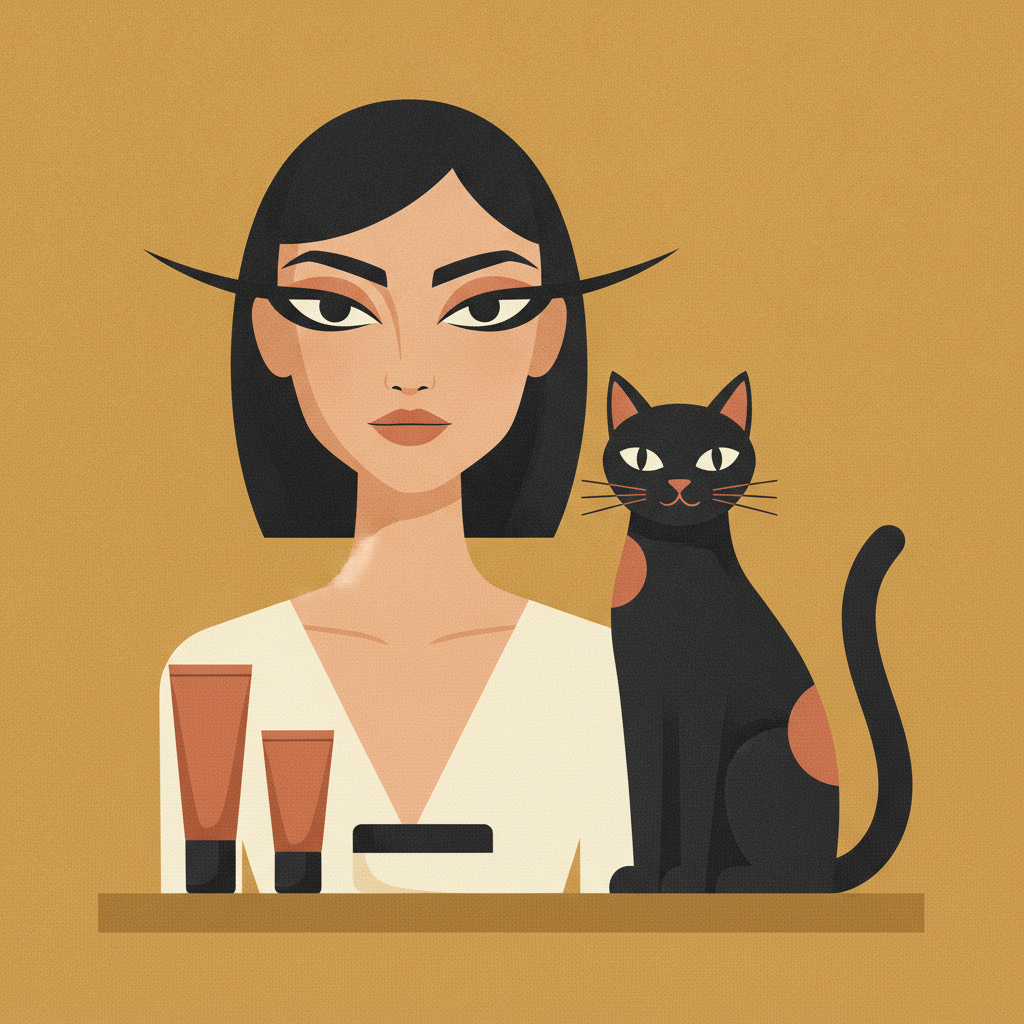
Fashion is a graveyard of dead trends. The cat eye is not in it. The same winged flick worn by Nefertiti was worn by Elizabeth Taylor, by Amy Winehouse, and by whoever posted a tutorial this morning that will rack up a few million views by tonight. Almost nothing else in beauty survives five millennia. So the real question is not who wore the cat eye, it is why this one shape refuses to die when everything around it does. And the answer, it turns out, has to do with the animal that lent it its name.
What the flick actually borrows
Start with the geometry, because that is the whole secret. A cat’s eye is horizontally elongated, upswept at the outer corner, and set off by a dark rim that makes the eye read as larger and more alert than it is. When you draw a cat eye on a human face, you are grafting that exact geometry onto a rounder, less dramatic human eye: you extend it outward, lift the outer corner, and darken the rim. The effect is not subtle flattery. It is a structural cue. Elongated, upswept eyes read across cultures as youthful, awake, and alluring, and the dark line exaggerates the contrast between the eye and the skin the way a predator’s markings do. The cat eye works because it makes a human eye briefly obey feline rules, and the human brain, wired to lock onto eyes, cannot look away.
That is the thesis. Everything that follows, every era, every icon, is just evidence that people kept rediscovering the same trick.
Ancient Egypt: the flick as armor
The extended feline line is ancient, and it did not start as pure vanity. In ancient Egypt, worn by men and women alike, including Cleopatra and Nefertiti, the darkened, elongated eye was believed to offer protection against the evil eye, and there is a kernel of function under the myth: the dark mineral rim likely cut sun glare, the way athletes still smear black under their eyes today. It was achieved with ground minerals such as malachite (green) and galena, a lead ore. That last detail is a genuine hazard the glossy histories skip: kohl made from galena was lead-based, and while some research suggests the Egyptians’ lead compounds may have had a mild antibacterial effect around the eye, lead-based cosmetics are toxic, and the tradition of lead kohl persisted dangerously for centuries. The shape survived; the chemistry, thankfully, did not.
The 1920s and 1960s: technology catches up to the shape
The look surged back in the 1920s, fueled by the 1917 screen Cleopatra starring silent-film actress Theda Bara and by the magnetic Josephine Baker, who wore a feline flick on stage. Women improvised the line with a mix of Vaseline and soot, a workaround the beauty historian Richard Corson documents in Fashions in Makeup: From Ancient to Modern Times. The point is that people wanted the shape badly enough to jury-rig it.
They got real tools in the 1950s, when liquid liner was invented, and the 1960s cat eye that followed, carried by Taylor, Sophia Loren, Maria Callas, Barbra Streisand, and a Brigitte Bardot who was rarely seen without it, was sharper and easier than any version before it. Taylor herself is the pivot point: when the makeup artist on 1963’s Cleopatra was injured, she painted her own face from his sketches and produced one of the most copied cat eyes ever filmed. A decade later, a minute-long mirror scene in her forgotten 1974 film The Driver’s Seat, in which she rings kohl around those violet eyes, became a quiet touchstone for beauty obsessives precisely because it shows the ritual, not just the result.
Punk to pop: the shape bends but does not break
After that the cat eye never left, it just kept mutating, which is exactly what a durable form does. Punk icons Soo Catwoman and Siouxsie Sioux stretched it across the entire eye socket, sometimes flooding it with acid-green shadow; Diane Lane’s character in the 1982 cult film Ladies and Gentlemen, the Fabulous Stains wore a version with red flames above the brows. Edie Sedgwick and Twiggy paired it with dramatic lashes, as did Diana Ross; it built Elvira’s whole face; it became a longtime signature of the artist Shirin Neshat; and singers from Ariana Grande to Beyoncé, Adele, and, most famously, Amy Winehouse made it central to their look. Each of them warped the flick, and none of them broke it, because the underlying geometry kept doing its job.
How to actually draw one
For all its ubiquity, the cat eye still intimidates people, which is its own kind of proof that the shape is doing something real. The fundamentals, from the makeup artists who live in it, come down to tools and steadiness. A slender, brush-tipped pen offers the most control for most people, and the core move is simple to say and hard to do:
Work the brush right down to where the lashes meet the lid, pressing it into the lash line. For shaky hands, draw your arms tight against your torso and brace your elbow on a tabletop.
If that still feels impossible, ability-inclusive tools built for unsteady hands exist, including an eyeliner-and-applicator duo from Guide Beauty, the accessibility-focused line with Selma Blair as chief creative officer, which pros routinely gift to clients who love the look but lack a steady hand. And powder users can fake a liquid liner entirely:
Wet an angled brush with a touch of water or a setting solution, sweep it across a heavily pigmented eyeshadow, and you’ve made your own liner. Keep a few cotton swabs and some micellar remover on hand to tidy the edges.
Modern variations are endless, a bright flick, a dual-toned neon, a cat eye with negative space, a reverse flick along the lower lash line that flatters hooded eyes, but every one of them is a variation on the same 5,000-year-old borrowing. That, in the end, is the cat’s quiet legacy: it handed us a piece of its own face, and we have been redrawing it ever since.
References
- Corson, Richard. Fashions in Makeup: From Ancient to Modern Times. Peter Owen Publishers.
- Tapsoba, I., et al. “Finding Out Egyptian Gods’ Secret Using Analytical Chemistry: Biomedical Properties of Egyptian Black Makeup Revealed by Amperometry at Single Cells.” Analytical Chemistry, 2010. https://pubs.acs.org/doi/10.1021/ac902348g
- Hardy, A.D., et al. “A study of the chemical composition of traditional eye cosmetics (kohls).” Journal of Cosmetic Science, 2006. https://pubmed.ncbi.nlm.nih.gov/16957810/
Nina Vasquez writes about life at home with pets and the relationships at the heart of it. Her work covers day-to-day living, people-and-pet stories, and the products that fit into a real household, with a warm, grounded take on everyday pet ownership.
Meet our experts ↗Keep reading
 LivingThe Viral Cat Essay's Real Failure Was Confusing a Feeling With a ChoiceDr. Mara Chen · 8 min
 LivingThat Head Bump Isn't a Kiss. It's a Signature.Dr. Nina Kohl · 6 min
 LivingThe 'Crazy Cat Lady' Was Queer History All AlongLeila Torres · 4 min
 LivingThe Cats in Her Art Aren't Decoration. They're the Coping Mechanism.Sasha Ford · 6 min
 LivingHow Many Cats Is Too Many? Vets Say You're Asking the Wrong Question.Nina Vasquez · 7 min
 LivingThe 'Dog Guy' Is Quietly Becoming a Cat GuyNina Vasquez · 4 min