


The 'Dog Guy' Is Quietly Becoming a Cat Guy
A 2024 UK report found men adopting adult cats at a higher rate than women, denting one of the oldest pet stereotypes going. Here's what's really behind it, and what the men trading 'I'd never get a cat' for a lap full of purring cat are actually getting.

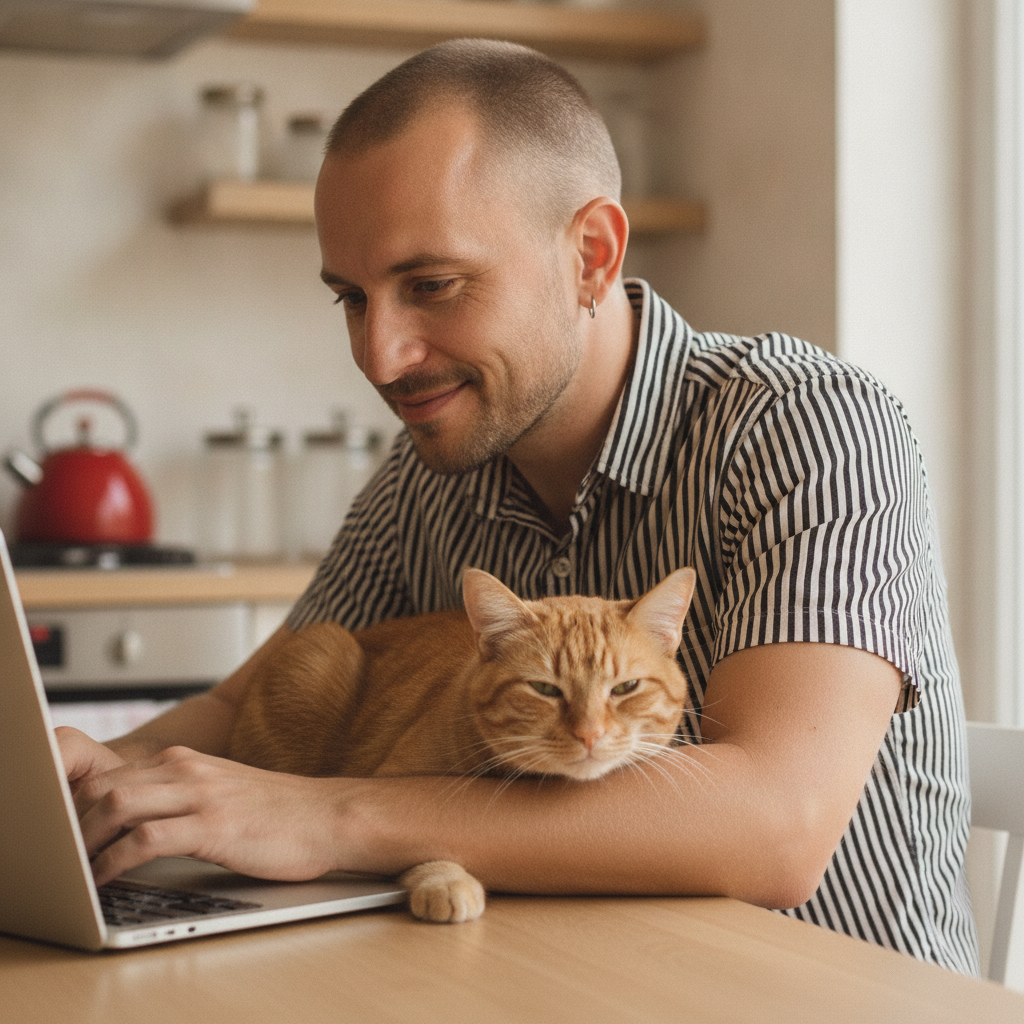
Pop culture handed us the script a long time ago: dogs are for men, cats are for everyone else. Timmy had Lassie, Charlie Brown had Snoopy, Jon Snow had Ghost, a guy and his loyal hound. The cat, meanwhile, got filed under someone else’s hobby. Plenty of men have recited some version of the line themselves, right up until the day they’re caught giving the family cat a ten-minute head massage before work.
That script is now quietly falling apart, and there’s data behind the shift. A 2024 Pet Population Report from UK Pet Food found that adult cats accounted for 27 percent of the pets men adopted across the prior four years, against 18 percent for women. In raw numbers, that’s roughly 1.5 million new male-headed households bringing home a grown cat, against about 1 million female-headed ones. The stereotype, in other words, has it backwards.
Why cats, and why grown ones
The more interesting question isn’t whether men are adopting cats. It’s what they’re actually after, and the answers are refreshingly practical.
A lot of it comes down to fit. Adult cats arrive as a known quantity: their personality is already formed, so there’s no gamble about who they’ll grow into and no kitten tearing around at 3 a.m. For men living alone or working from cluttered home setups, that predictability is a feature, not a compromise. One London-based director of photography considering his first adult cat put it simply, he has gear everywhere and no time to raise a kitten, and a settled adult suited both. The rescue math helps too: shelters are full of adult cats who get passed over for kittens, and adopting one clears an obvious guilty conscience.
Then there’s the conversion story, the self-described dog person who didn’t expect to fall for a cat and did. It tends to follow the same arc: initial wariness, a slow thaw as the cat’s quirks come into focus, and eventually a bond that feels, to hear them tell it, a little magical. Lower upkeep than a dog, cheaper to run, content to share a bed and otherwise get on with their own life, a cat asks less and still shows up.
Cats Protection, which tracks this stuff, frames the trend warmly, noting that more men are discovering the appeal of older cats, not just kittens, and often describing their cats as both good company and genuinely funny stress relief. That last part is where the wellbeing angle comes in, and it deserves an honest look.
The wellbeing case, with a caveat
The claims you’ll see attached to cat ownership range from well-supported to wishful. On the solid end: research has found that even brief, everyday interaction with an animal, on the order of ten minutes of petting a cat, is associated with lower levels of cortisol, the body’s main stress hormone. That tracks with what a lot of owners feel, a real drop in tension when the cat settles onto their chest and starts purring.
The purr itself has spawned bolder claims, that its 25-to-150-hertz frequency range can ease labored breathing, lower blood pressure, even help heal infections and bones. Those are fun to repeat, and they run well ahead of the evidence.
“I always tell people to enjoy the purr without overselling it,” says Dr. Lena Park. “The calming effect of a cat on your lap is real, and it’s a lovely reason to have one. But a purr is not medicine, and I’d hate for someone to skip a doctor’s visit because they read that it mends bones. Let the cat be good for your stress, and let your physician handle the rest.”
The gentler, better-documented benefits are enough on their own. Around a quarter of pet owners in the report admitted to enjoying time with their pet more than time with their own family, and 39 percent said their pet was good for their household’s mental health. You don’t need a bone-healing purr to justify a companion who reliably makes the day lighter.
What’s new since the report
The direction has only continued. Adult-cat adoption and the “unexpected cat guy” have kept showing up in shelter data and pet-industry surveys on both sides of the Atlantic, and rescues increasingly market grown cats to solo adopters and busy professionals precisely because the fit is so good. The broader takeaway holds up: the cat-versus-dog personality divide was always more marketing than biology.
Whatever your gender, and whatever finally tips you, the report lands on something cat people never doubted. One or two purring roommates make for a reliably good deal.
References
- UK Pet Food. “UK Pet Population Data.” https://www.ukpetfood.org/information-centre/statistics/uk-pet-population.html
- Cats Protection. “Cats and Wellbeing.” https://www.cats.org.uk/help-and-advice/wellbeing
- Pendry, Patricia, and Vandagriff, Jaymie L. “Animal Visitation Program Reduces Cortisol Levels of University Students.” AERA Open, 2019. https://journals.sagepub.com/doi/10.1177/2332858419852592
Nina Vasquez writes about life at home with pets and the relationships at the heart of it. Her work covers day-to-day living, people-and-pet stories, and the products that fit into a real household, with a warm, grounded take on everyday pet ownership.
Meet our experts ↗Keep reading
 LivingHe Fostered Six Kittens. Two Died in His Hands. He Kept Fostering.Dr. Amara Solis · 8 min
 LivingThe 'Sexy Cat Dad' Thing Isn't About Cats. It's About Consent.Leila Torres · 6 min
 LivingA Grumpy 14-Year-Old Cat Nobody Would Have Adopted Started a MovementLeila Torres · 6 min
 Living95% of Them Adopted the Cat They 'Just' FosteredNina Vasquez · 5 min
 Living95% of Them Kept the Cat: What a Loneliness Study Proved About FosteringNina Vasquez · 5 min
 LivingNobody Gives Up a Cat They Love on a Whim. Here Are the 5 Real Reasons, and the Fixes.Dr. Amara Solis · 6 min