


That Head Bump Isn't a Kiss. It's a Signature.
Bunting is how cats sign their name on you. Which is why a sudden increase in it is worth paying attention to, not just enjoying.

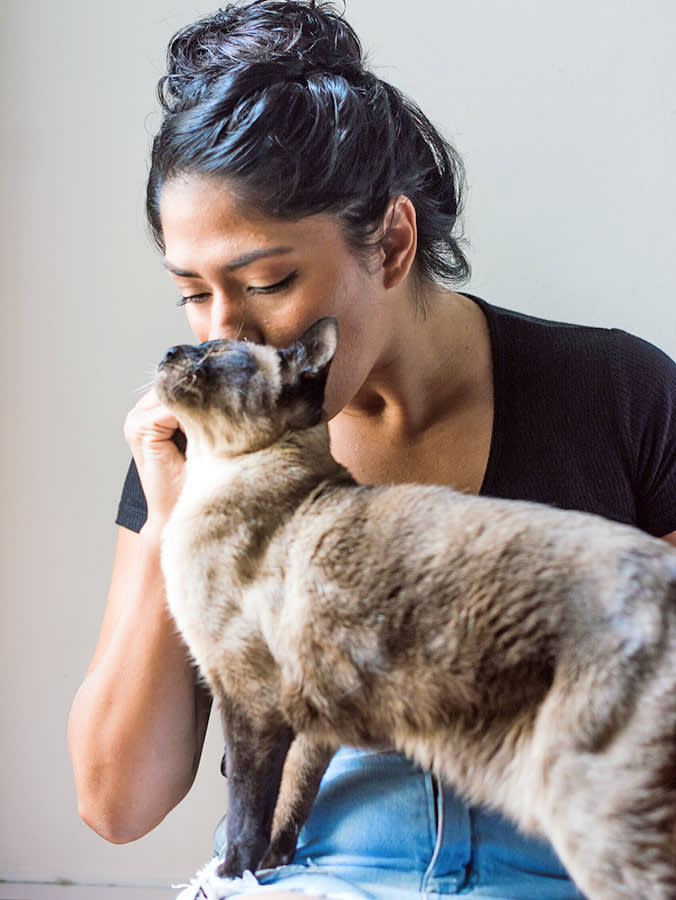
When your cat presses their forehead into your face, the received wisdom is that this is a kitty kiss. It is warmer than that and stranger than that.
What your cat is doing is depositing chemical information onto you from glands in their cheeks, chin, lips, and the patch of forehead between their ears and eyes. The behavior is called bunting. It is not a kiss. It is a signature, and the message is roughly: this one is mine, this one is family, this one smells like us.
That is a lovely thing to be told. It is also, and this is the useful part, a behavior with a normal baseline. Which means when the baseline changes, it is telling you something new.
What is actually leaving your cat’s face
Cats communicate in chemistry to a degree we barely register. Rubbing a face against something releases scent and pheromones, chemical signals that alter the behavior of whoever picks them up.
The glands are distributed all over: the cheeks, around the mouth, on the chin, on the forehead, along the flanks, and between the toes, which is why scratching and kneading are also scent-marking behaviors and not just physical ones. Urine and feces carry their own signals, which is a separate system with a much blunter message.
The information carried in a face rub can indicate territory and route, reproductive status, and social affiliation, that “you are part of my group” claim. When a cat mixes their scent with yours, they are building a shared group smell. That is genuinely what family means to a cat.
The different rubs, and what each one is for
Rubbing everything in the house. Doorframes, table legs, the corner of the hallway, the same three objects every day. Check the corners at roughly knee height and you will sometimes find a faint greasy smudge where a cat has signed the same spot over and over. This is route-marking, and cats will often add their scent on top of a spot another cat rubbed first, the way people sign a guest book.
Done at a steady, routine level, this is normal. Done frantically, on everything, all the time, especially on objects that smell of other animals or new people, it usually means the cat is territorially unsure and trying to make the place smell reliably like themselves.
Rubbing against your legs. Partly affiliation, partly a request. Cats become notably more affectionate around the time food usually appears, and they are not embarrassed about it.
Rubbing corners of furniture and walls. These sit along the routes cats travel, which is exactly where a signpost belongs.
Rubbing with the mouth slightly open, hard, insistent. Intense marking with the glands around the mouth. Often accompanied by purring. This is a cat committing.
Rubbing their face against your face. The most concentrated version, aimed at the one part of you that smells most like you.
People ask me whether their cat loves them, and I tell them to look at whether the cat is willing to put their face on your face. A cat who does not feel safe with you does not bring their eyes and nose within an inch of your teeth.
The rest of the affection vocabulary
Bunting is not the only signal, and the ones people undervalue are often the most telling.
- A tail carried straight up as they walk toward you. This is a friendly greeting in cat, and it is not ambiguous.
- Slow blinking. A cat who narrows their eyes at you and holds it is telling you they are not on guard.
- Chirps, trills, and friendly meows. Cats reserve much of their vocalizing for humans, and the pleasant end of the range is aimed at people they like.
- Kneading. Contented paw-flexing, and, with those glands between the toes, more scent-marking while they are at it.
- A turned back or an exposed belly. A cat who lies down near you without needing to keep you in view has made a real statement about how safe they feel.
When face-rubbing turns into a symptom
This is the part that earns the article, and it hinges on change rather than presence.
Face-rubbing is a daily, routine behavior. So the question is never “does my cat rub their face on things,” it is “has that gone up, gotten more intense, or gotten more focused.”
A sudden increase in rubbing the face specifically can be a cat trying to relieve something. Consider:
- Ear disease. Infection, mites, or inflammation. Look for head shaking, scratching at the ear, odor, or discharge.
- Something in the eye, or eye pain. Look for squinting, discharge, or redness.
- Dental disease or oral pain. Cats hide this extraordinarily well. Rubbing the mouth and chin against things, dropping food, or drooling are worth a look.
- Skin problems. Allergy, flea allergy, or a skin infection can make the face itch.
- Overgrooming, which can be pain-driven or stress-driven.
- Neurologic causes, which are less common but real.
A sudden increase in rubbing everything is more often about territory and stress: a new cat, a new baby, a new person, a move, a neighborhood cat visible through the window.
Either way, the rule is the same and it is a good one for cats generally. A change in a routine behavior is information. Rubbing that becomes more frequent, more prolonged, or more intense is worth a veterinary exam, because a cat who cannot tell you their ear hurts will find another way to say it.
What newer research adds
The main practical update is a note of caution about the products built on top of all this.
The synthetic feline facial pheromones sold in diffusers and sprays are modeled on the very chemistry your cat deposits when they bunt, and the marketing implies the effect is close to automatic. The evidence is thinner. A 2025 systematic review in the New Zealand Veterinary Journal, examining management strategies for a stress-linked bladder condition in cats, found encouraging evidence for changing a cat’s environment and little evidence supporting feline facial pheromone products.
That does not make bunting less meaningful. It makes it harder to bottle. The real version, a cat choosing to lay their scent on you, on their own schedule, is not something you can buy in a plug-in, and the things that reliably make a cat feel secure remain unglamorous: predictable routines, enough resources, vertical space, safe retreats, and play.
So take the head bump for what it is. Not a kiss. A cat deciding you belong to them, and writing it down.
References
- Ellis, S. L. H., et al. “AAFP and ISFM Feline Environmental Needs Guidelines.” Journal of Feline Medicine and Surgery, vol. 15, no. 3, 2013, pp. 219–230. https://doi.org/10.1177/1098612X13477537
- Vitale Shreve, K. R., and Udell, M. A. R. “The Human Side of the Human-Cat Bond.” Behavioural Processes. https://doi.org/10.1016/j.beproc.2016.09.009
- Forster, L., et al. “Understanding the Current Evidence Base for the Commonly Recommended Management Strategies for Recurrent Feline Idiopathic Cystitis: A Systematic Review.” New Zealand Veterinary Journal, 2025. https://doi.org/10.1080/00480169.2025.2477542
- Merck Veterinary Manual. “Behavioral Problems of Cats.” https://www.merckvetmanual.com/behavior/normal-social-behavior-and-behavioral-problems-of-domestic-animals/behavioral-problems-of-cats
Common questions
How do cats show affection?
Head bunting, slow blinking, friendly chirps and trills, purring near you, kneading, tail held upright as they approach, and relaxed body language with the belly exposed or their back turned to you.
How do cats mark you as theirs?
With scent. Cats have glands on the cheeks, chin, lips, forehead, flanks, and between their toes. Rubbing their face on you, sliding along your legs, and kneading all deposit their scent on you.
Should I be worried if my cat rubs on everything?
Not on its own. But a cat who suddenly starts marking everything in sight, especially along walkways and at doorways, is often a cat feeling territorially insecure. And a sudden increase in rubbing the face specifically can be a sign of pain, itch, or irritation in the ears, eyes, mouth, or skin.
Dr. Kohl is a board-certified veterinary dentist with a particular interest in preventive oral care. She reviews all dental health content at The Pet Times and contributes practical guides on home dental routines, professional cleaning, and oral disease prevention.
Meet our experts ↗Keep reading
 LivingHating Cats Doesn't Make You a Narcissist. The Rush to Diagnose Says More.Claire Sutton · 6 min
 TrainingYour Cat Isn't Running Hot and Cold. They're Running a Consent System.Dr. Amara Solis · 7 min
 TrainingYour Cat Rubbing Your Legs Isn't a Hug. It's a Deposit.Dr. Priya Nair · 7 min
 TrainingThe Cat on Your Lap Isn't the One Who Loves You MostDr. Amara Solis · 9 min
 TrainingYour Cat's 'Favorite Person' Is a Job, Not a Feeling. You Can Take It.Dr. Nina Kohl · 8 min
 LivingYour Cat Isn't Trying to Cuddle. They're Doing Math.Dr. Nina Kohl · 6 min