


'Back Up' Is the Most Useful Trick Your Dog Doesn't Know
It looks like a party trick. It's actually a safety cue. 'Leave it' tells your dog what not to do. 'Back up' tells them what to do instead, and that difference is the whole thing.

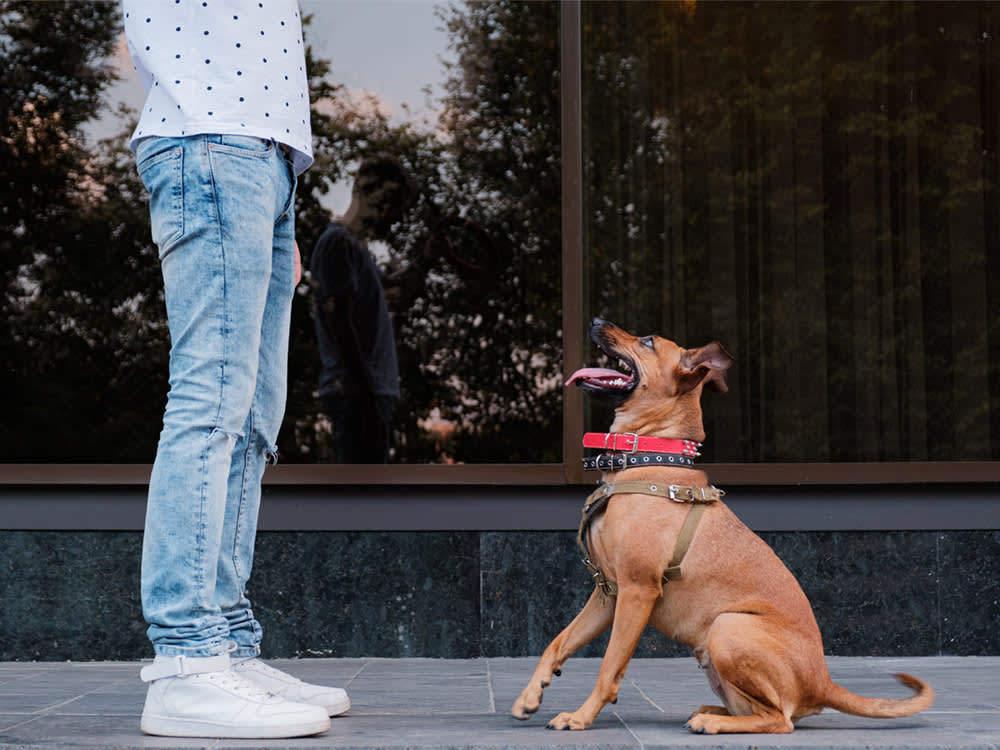
Somewhere in the hierarchy of dog tricks, “back up” sits with shake and roll over: a cute thing to show your in-laws.
That’s a mistake, and it’s costing people the single most practical cue in the repertoire.
Here’s the case, in one comparison. “Leave it” tells your dog what not to do. “Back up” tells them what to do instead. And a dog who has been given a job is dramatically better at resisting temptation than a dog who has merely been forbidden.
A dog standing eight inches from a discarded chicken bone, being told to leave it, is doing the hardest thing in dog training: staying still while every instinct fires. A dog told to back up is doing something easy. They’re walking. Away. And a dog cannot simultaneously walk backward from a chicken bone and eat it.
That’s the whole insight. The cue works because it’s physically incompatible with the thing you don’t want.
Where you’ll actually use it
Not at parties. Here:
The kitchen, when the oven is open. Every dog on earth materializes at the oven door the moment it opens. A dog underfoot at that exact moment is a burn risk for both of you. “Back up” clears the zone without you having to shove them with your knee while holding a tray.
The front door, when it’s about to open. Door-darting is a real cause of lost and hit-by-car dogs. A back-up cue creates distance from the threshold before you touch the handle, which is a far more reliable pattern than a sit that collapses the moment the door cracks.
The stairs, when you’re carrying laundry. Self-explanatory, and the reason a lot of people have fallen down stairs.
Anywhere on a walk. A discarded takeaway container. A patch of something dead. A skateboard coming fast. A puddle of antifreeze. In all of these, distance is the medicine, and “back up” is how you buy distance without dragging your dog by the neck.
The dishwasher, the trash can, the other dog’s food bowl. All the places where the dog needs to not be, and where hauling them away by the collar teaches nothing.
And in a crowded space, where a dog who can be asked to move backward out of a doorway or an elevator is a dog who is welcome in a lot more places.
Owners come to me wanting a better ‘leave it,’ and half the time what they actually need is a ‘back up.’ Asking a dog to hold still six inches from something delicious is the hardest ask in training. Asking them to walk away from it is easy. Give them the easy job.
How to teach it
The good news is it’s one of the simplest cues to build, because the behavior is one your dog already offers naturally when you step into their space. You’re not creating a movement. You’re capturing one.
1. Get face to face
Square up to your dog, close, with their attention on you. Then move toward them, calmly. This is not looming or intimidating. It’s a gentle forward pressure into their space, and most dogs will step back to restore their comfortable distance.
Some dogs need a couple of full steps. Others will back up from just a slight forward lean. Use the smallest amount of pressure that works.
2. Pay the first step, instantly
The moment one paw goes backward, mark it and pay. Click and treat, or a “yes” and a treat.
The timing here matters more than anything else in this article. If you’re late, you’ll accidentally reward whatever came next, which is usually them coming forward again for the food. Mark the backward step, not the arrival of the treat.
3. Build up the distance
Once a single backward step is reliable, keep walking gently forward until they’ve taken two steps, then three. Reward the longer version.
4. Add the word
Here’s the part everybody rushes. Do not name the behavior until the dog is doing it confidently. Once they’re clearly offering the back-up, say “back up” just before you move toward them.
Order matters. Cue, then movement, then reward. Over a few dozen reps the word starts predicting the movement, and eventually stands in for it.
5. Fade yourself out
Shrink your step forward into a lean. Shrink the lean into a hand signal, an arm extended toward them. Then drop the signal and use the word alone.
You can keep the hand signal as a permanent second channel, which is genuinely useful for a noisy environment, and invaluable later if your dog loses their hearing.
6. Proof it where it counts
A cue that only works in your living room is a party trick after all. Practice at the fridge. At the door. On the sidewalk. On the stairs. In the places you’ll actually need it, before you need it.
Picking your word
“Back up” is only a convention. “Back,” “get back,” “beep beep,” and “reverse” all work identically, because the dog doesn’t speak English, they learn a sound.
Two rules. Be consistent, so everyone in the house uses the same word. And pick something that doesn’t sound like a cue your dog already knows. “Back” and “wait” and “stay” and “stand” all start blurring together at conversational speed. “Beep beep” has the great virtue of sounding like nothing else you say.
The two things that go wrong
Your dog sits instead. Very common, and it’s your fault, in a good way: you’ve paid so heavily for sits that when your dog is unsure what you want, sitting is their default guess.
The fix is mechanical. Hold a treat a few inches above their head and move it slowly toward their back end. A dog tracking a treat backward and slightly up will step back rather than fold into a sit. Mark the step, pay, repeat. After a handful of reps you can drop the lure.
Your dog turns around and walks away forward. Also common, especially in long dogs who find reversing physically awkward.
Remove the option. Train in a narrow hallway, or between the sofa and the coffee table, or along a wall. With no room to turn, backing up becomes the only available answer, and you can reinforce it. Once it’s fluent, take it back out into open space.
What newer research adds
The reason this cue outperforms “leave it” has a name in behavior science: differential reinforcement of an incompatible behavior. Rather than suppressing a behavior you don’t want, you train and reward one that physically cannot happen at the same time.
It’s one of the best-supported ideas in the field, and it’s the same logic behind training a dog to go to a mat rather than “not jump” on guests, or to hold a toy rather than “not bark” at the door. Suppression is fragile because it depends on the dog inhibiting an impulse in real time. Substitution is durable because it gives the dog somewhere to put the impulse.
Which is worth remembering the next time you’re tempted to teach your dog not to do something. Ask instead what they could be doing instead, and teach that.
Bottom line
“Back up” takes about a week to build, it’s easier to teach than a solid stay, and it will do more for you in a kitchen, a doorway, a stairwell, and a sidewalk than any cute trick in your dog’s repertoire.
It’s not a party trick that happens to be useful. It’s a safety cue that happens to look cute.
References
- American Veterinary Society of Animal Behavior. “Position Statement on Humane Dog Training,” 2021. https://avsab.org/wp-content/uploads/2021/08/AVSAB-Humane-Dog-Training-Position-Statement-2021.pdf
- Cooper, John O., Timothy E. Heron, and William L. Heward. Applied Behavior Analysis, 3rd ed. Pearson, 2020. (On differential reinforcement of incompatible behavior.)
- “Behavioral Problems of Dogs.” MSD Veterinary Manual. https://www.msdvetmanual.com/behavior/normal-social-behavior-and-behavioral-problems-of-domestic-animals/behavioral-problems-of-dogs
- Feuerbacher, Erica N., and Clive D. L. Wynne. “Shut Up and Pet Me! Domestic Dogs Prefer Petting to Vocal Praise.” Behavioural Processes, vol. 110, 2015, pp. 47–59. https://doi.org/10.1016/j.beproc.2014.08.019
Dr. Kohl is a board-certified veterinary dentist with a particular interest in preventive oral care. She reviews all dental health content at The Pet Times and contributes practical guides on home dental routines, professional cleaning, and oral disease prevention.
Meet our experts ↗Keep reading
 Training"My Dog Only Listens When I Have a Treat." Here's the Fix You Skipped.Dr. Nina Kohl · 6 min
 TrainingAnti-Bark Devices Don't Stop Barking. They Punish a Sentence You Can't ReadSasha Ford · 7 min
 TrainingYour Dog Has a Perfect Recall. It's Just Not to the Word 'Come.'Dr. Lena Park · 7 min
 TrainingHow to Redirect Your Dog's Digging: Yard-Friendly Fixes That Actually WorkTom Hadley · 5 min
 TrainingYour Dog Doesn't Fail at Restaurants. They Fail in the First 90 Seconds.Dr. Nina Kohl · 7 min
 TrainingYour Dog Isn't Being Stubborn About the Snow. They're Confused.Dr. Amara Solis · 7 min