


Your Dog Isn't Being Bad. Your Christmas Tree Just Looks Like an Indoor Bush.
A housetrained dog who pees on the tree is confused, not defiant. Here's what the tree smells like to your dog, and the calm, no-punishment plan that keeps it dry all season.

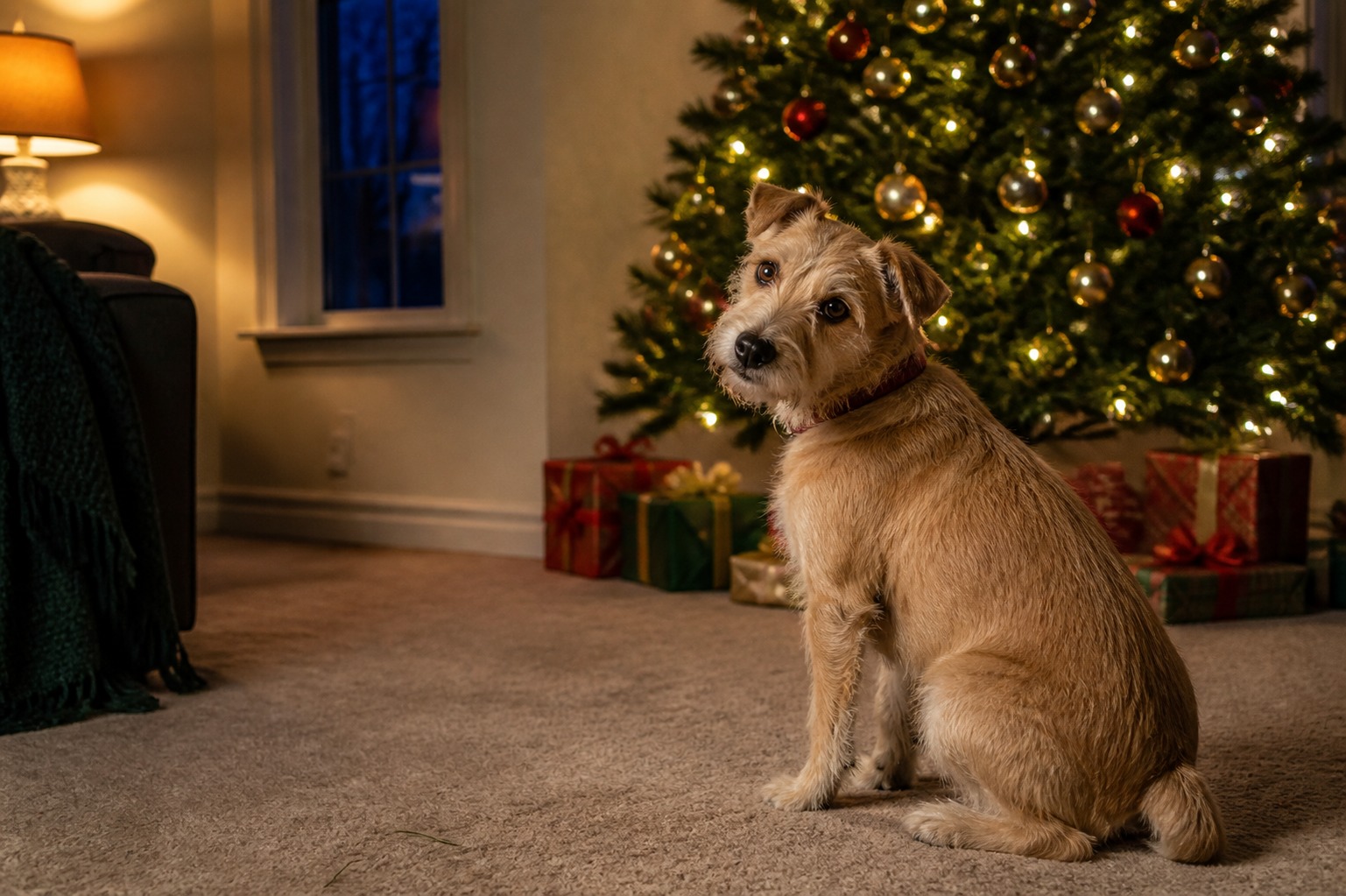
You haul the tree in, spend an hour untangling lights, step back to admire it, and your dog trots over and lifts a leg. For a lot of people it happens within the first evening. It feels like a statement. It isn’t one.
Here is the thing worth understanding before you do anything else: to your dog, a freshly cut evergreen standing on the living room floor is a genuinely strange object. It smells like the outdoors. It is roughly the size and shape of the shrubs they are used to watering on walks. Nothing about it says “decoration” or “off limits.” A dog who pees on it is reading the room exactly the way their nose tells them to. Most solidly housetrained dogs won’t do it, but plenty of good, well-trained dogs will at least think about it, and the ones who follow through aren’t acting out. They’re improvising with bad information.
So the whole job is really about two things: keeping the opportunity away from your dog while the tree is new, and quietly teaching them that this particular bush is not a bathroom. No scolding required. In fact, scolding tends to backfire, because a dog who gets in trouble for peeing in front of you often just learns to pee where you can’t see.
First, rule out the boring medical stuff
If your dog has been reliably housetrained for years and suddenly starts peeing indoors, don’t assume the tree is the whole story. A urinary tract infection, bladder stones, or other issues can make a dog urinate more often and with more urgency, and a new indoor target is sometimes the first place it shows up. A quick call to your vet, and a urine sample if they ask for one, rules this out before you spend two weeks on training that was never going to fix a physical problem.
When a house-trained adult suddenly starts having accidents, I want to see them before anyone chalks it up to the holidays. Half the time it’s behavioral and half the time the bladder is trying to tell us something, and you can’t coach your way out of the second one.
Treat the first week like a management problem
For the first several days the tree is up, your goal is simple: your dog never gets a private moment with it. Think of this as babysitting, not obedience.
Keep your dog in the room with you and actually watch them, or keep them out of the room entirely when you can’t. A baby gate, an exercise pen, or a closed door all work. If you want your dog nearby but need your hands free, clip a leash to your belt so they physically can’t wander to the tree without you noticing. Some dogs are also put off by an upright vacuum parked beside the tree, which is a low-effort deterrent if yours happens to dislike it.
At the same time, flood the schedule with legitimate options. Take your dog out more often than usual, on walks and into the yard, so a full bladder is rarely the reason they’re eyeing the tree. Every single time they go outside, pay up with a treat they actually love, right there in the moment, so the outdoor spot stays the obvious winning choice. This is the same foundation as potty-training a puppy, and it’s worth revisiting no matter how long ago your dog “graduated.”
A useful side skill here is a solid “leave it.” Practice it on all sorts of household objects your dog isn’t supposed to touch, reward the right response generously, and the tree becomes just one more thing on the list they already know to ignore.
Learn what “about to pee” looks like
By the time a leg is in the air, you’ve basically missed your window. The signals come earlier: sniffing intently at the base of the tree, circling, a sudden fixation on one spot. Those are your cues to move.
If you catch your dog mid-consideration, make a quick, surprising sound, something that interrupts them without frightening them. A clap or a bright “hey” is plenty; you want a pause, not panic. Then take them straight outside and reward the outdoor pee like it’s the best decision anyone has ever made.
If a little lands on the tree or skirt before you can react, scrub the spot down with an enzymatic cleaner. This matters more than people realize. Enzymatic cleaners break down the compounds in urine that a dog can still smell long after your nose has moved on, and to a dog, a lingering pee smell is basically a signpost that says “bathroom here.” Skip anything ammonia-based, because ammonia is a component of urine and can actually invite a repeat visit.
Make the tree the most boring spot in the house
Dogs are far less likely to pee where they relax and hang out. So flip the tree from novelty to furniture. Spend calm time near it: sit on the floor, give your dog a slow scratch, hand them a stuffed chew or a food puzzle to work on within a few feet of the branches. The more the tree becomes a place associated with lying around and being content, the less it reads as a fresh outdoor target.
You can also give your dog a job to do in that zone. Teach them a specific behavior to perform near the tree, like a “sit” or a “down,” and reward it. A dog who has a reliable, rewarding thing to do in that spot has something to fall back on that isn’t marking. Over a season, that positive history near the tree does most of the quiet work for you.
None of this takes a heavy hand. It takes a week or two of paying attention, a pocket of good treats, and the willingness to see the tree the way your dog does: not as a holiday centerpiece, but as the most confusing shrub they’ve ever met indoors.
Dr. Kohl is a board-certified veterinary dentist with a particular interest in preventive oral care. She reviews all dental health content at The Pet Times and contributes practical guides on home dental routines, professional cleaning, and oral disease prevention.
Meet our experts ↗Keep reading
 TrainingYour 'Dominant' Puppy Is Just a TeenagerDr. Nina Kohl · 5 min
 TrainingThe Viral 'Run Away From Your Dog' Trick Works. You Get to Use It Once.Dr. Mara Chen · 7 min
 TrainingNo Dog Is "Untrainable." Some People Just Quit.Dr. Nina Kohl · 8 min
 TrainingYes, You Can Potty Train a Senior Dog. Start Here.Dr. Ravi Mehta · 6 min
 TrainingYour Dog's Side Should Be the Best Seat in the HouseDr. Nina Kohl · 8 min
 TrainingHow to Redirect Your Dog's Digging: Yard-Friendly Fixes That Actually WorkTom Hadley · 5 min