


Your Dog Isn't Being Bad at the Door. They're Winning a Game You Keep Playing.
Every time you chase a door-darter or scold them once you catch them, you make the next escape harder. Here's how to stop rewarding the game and teach a dog to hold at an open door instead.

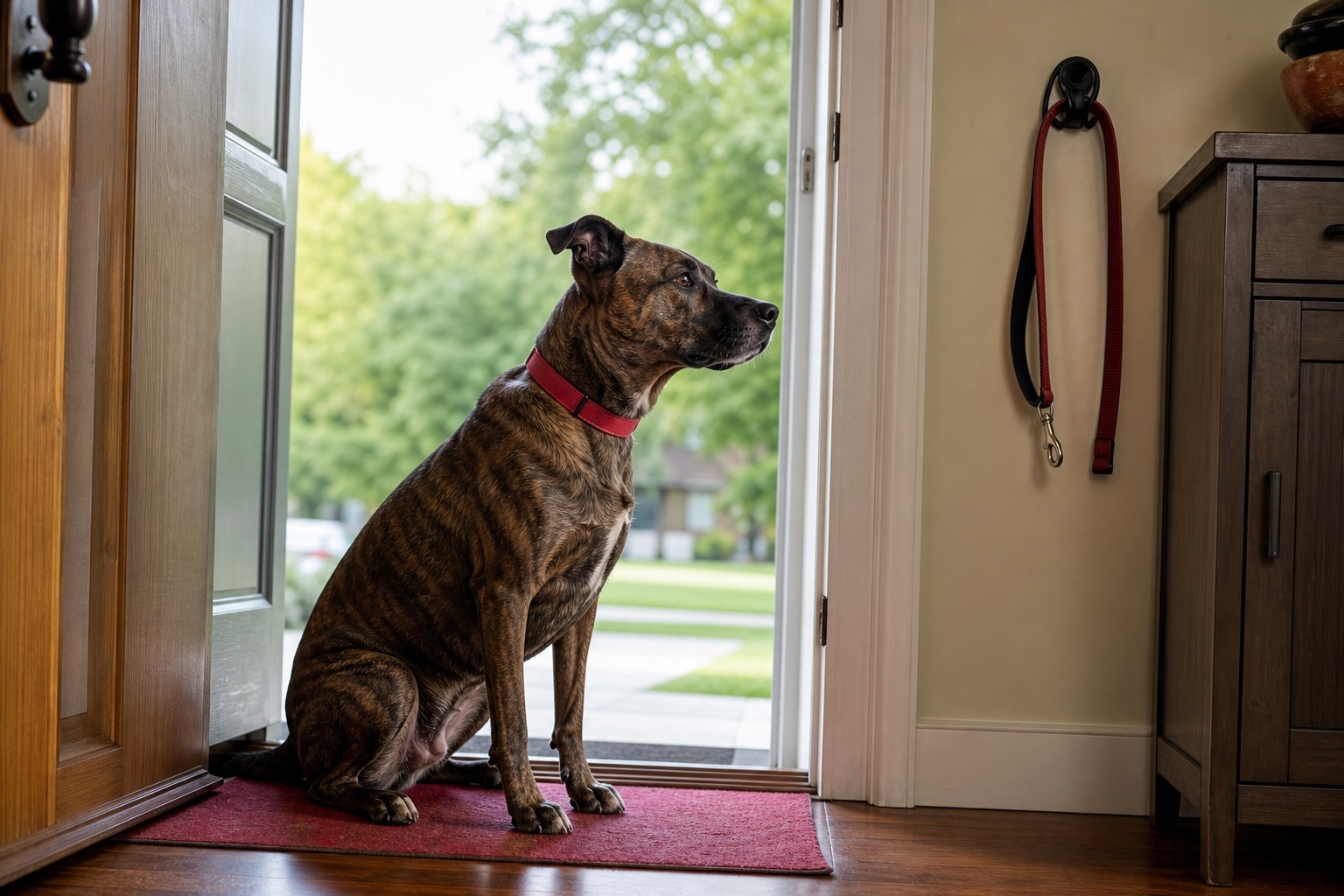
Got a four-legged escape artist who treats every open door as a starting gun? It is far less charming than it sounds, and sometimes it is downright frightening. A dog who slips out the moment a door cracks is a headache at best and, near a busy street, a genuine emergency. The good news is that door-darting isn’t a character flaw or a sign of a “bad” dog. It’s a game, and once you understand the rules your dog is playing by, you can stop handing them the win.
Why the outside is so irresistible
Your dog has food, water, toys, and your company, so why bolt? Because the world beyond the threshold is thrilling. For a dog, the outdoors is a firehose of smells, sights, and things to chase, and that payoff is enormously reinforcing. If you’ve ever watched your dog inhale every inch of a sidewalk on a walk, you already know how magnetic it is.
There’s a second reward layered on top, and it’s the one most owners accidentally supply. A practiced darter has learned that dashing out the door reliably turns their calm, seated human into a sprinting, arm-waving playmate. From the dog’s point of view, that chase is the best part. So the escape isn’t only about freedom. It’s about getting a rise out of you.
The two mistakes that make it worse
Here’s where good intentions backfire. When you finally corner your runaway and let them have it, calmly or otherwise, you’re teaching a lesson your dog will absolutely learn, just not the one you intend.
Think about it from their side. Getting caught made the fun stop and made an angry human appear. In behavior terms, you removed something good and added something bad in the same moment. The trouble is your dog won’t connect either consequence to the darting. They’ll connect it to being captured. Scold a dog when you catch them and you’ve just taught them that letting you get close is where things go wrong, which makes them far harder to retrieve the next time they slip out. Two well-meant reactions, chasing and scolding, are the exact two things that reinforce the whole cycle.
What to do when your dog is already loose
An accomplished door-darter is usually an accomplished keep-away champion, so the instinct to chase is the instinct to resist. Running at your dog just launches the game they were hoping for. Flip the script instead.
Grab something irresistible, a squeaky toy is perfect, carry it out the door, and set it squeaking. Then do the counterintuitive thing: the instant your dog looks, turn and run away from them while keeping the toy going. Most dogs can’t stand to be left out of the fun and will chase you. Let them catch an end of the toy, play a little tug, then swap it for a treat, and keep the party going as you drift toward safety, luring them through a gate, into the garage, or inside, then closing it behind them.
If your dog is more of a car fanatic than a toy fiend, use that. Jog to the car and ask the magic question in your happiest voice: want to go for a ride? When they leap in, keep your word and take them around the block. Whatever lights your particular dog up, fetch, a flying disc, a stick, the promise of a walk, that’s your recall tool in the moment.
And once you’ve got them back? This bears repeating because it’s the hardest part: do not yell, do not even calmly reprimand, and do not march them straight back inside, which reads as punishment too. Stay out and play for a bit. Make coming to you the best decision your dog made all day. Punish the reunion and you’ll pay for it at the next escape.
Owners tell me their dog ‘knows’ they did wrong because they run away when called. The dog doesn’t feel guilty, it feels unsafe coming close, usually because the last few times ended in a scolding. The fastest way to a reliable recall is to make yourself the one thing worth running toward, every single time, no exceptions.
Take the game off the table entirely
Retraining the darter is only half the job. The other half is engineering the environment so a bolt isn’t even possible.
- Build a buffer. If you can’t fence the whole yard, fence a small zone right outside the door, or install a barrier with a self-closing gate. A real, physical wall beats an electronic containment collar every time, because a determined dog will blast straight through a shock line as readily as through an open doorway.
- Use indoor barriers. Baby gates and exercise pens set back from the door keep your dog out of launch range. Make it a house rule that everyone, family and guests alike, checks that the dog is safely gated away before opening the door or greeting a visitor.
- Burn the fuel. A well-exercised dog is a less opportunistic dog. Cranking up your dog’s aerobic activity leaves them with less restless energy to funnel into escape attempts. A tired dog is far less interested in making a break for it.
Teach the skill that fixes it: waiting at the door
The long-term solution is a dog who chooses to hold at an open door until you say otherwise. You build that with short, upbeat clicker sessions, following the step-by-step in the how-to above: reward tiny bits of patience as your hand approaches the knob, then as the door cracks, then as it swings wide, always resetting cheerfully with an “oops” when your dog breaks, never with anger.
The finishing touch is consistency across your whole household. Teach everyone who handles your dog to ask for the same wait using the same cue. The more reliably every person reinforces it, the more dependable your dog becomes, and the less likely that open door is ever a problem again. A patient dog at the threshold and a human who never turns capture into punishment: that’s the combination that finally ends the darting for good.
Dr. Kohl is a board-certified veterinary dentist with a particular interest in preventive oral care. She reviews all dental health content at The Pet Times and contributes practical guides on home dental routines, professional cleaning, and oral disease prevention.
Meet our experts ↗Keep reading
 TrainingYour Dog Isn't Giving You a Hard Time. They're Having One.Dr. Nina Kohl · 7 min
 TrainingYour 'Dominant' Puppy Is Just a TeenagerDr. Nina Kohl · 5 min
 TrainingYour Dog Isn't Being Stubborn. You're Paying Them to PullDr. Mara Chen · 8 min
 TrainingYour Dog Isn't Being Stubborn About the Snow. They're Confused.Dr. Amara Solis · 7 min
 TrainingYour Dog Isn't Being Bad. Your Christmas Tree Just Looks Like an Indoor Bush.Dr. Nina Kohl · 6 min
 TrainingHow to Redirect Your Dog's Digging: Yard-Friendly Fixes That Actually WorkTom Hadley · 5 min