


Your Dog Isn't Being Stubborn. You're Paying Them to Pull
A dog pulls because pulling works — every taut step forward is a paycheck. Fix the payout, not the willpower, and the dragging stops. Here's the retrain, plus what the gear actually does.

Affiliate disclosure. This article contains affiliate links. We may earn a small commission if you buy through a link, at no extra cost to you. How we handle recommendations.
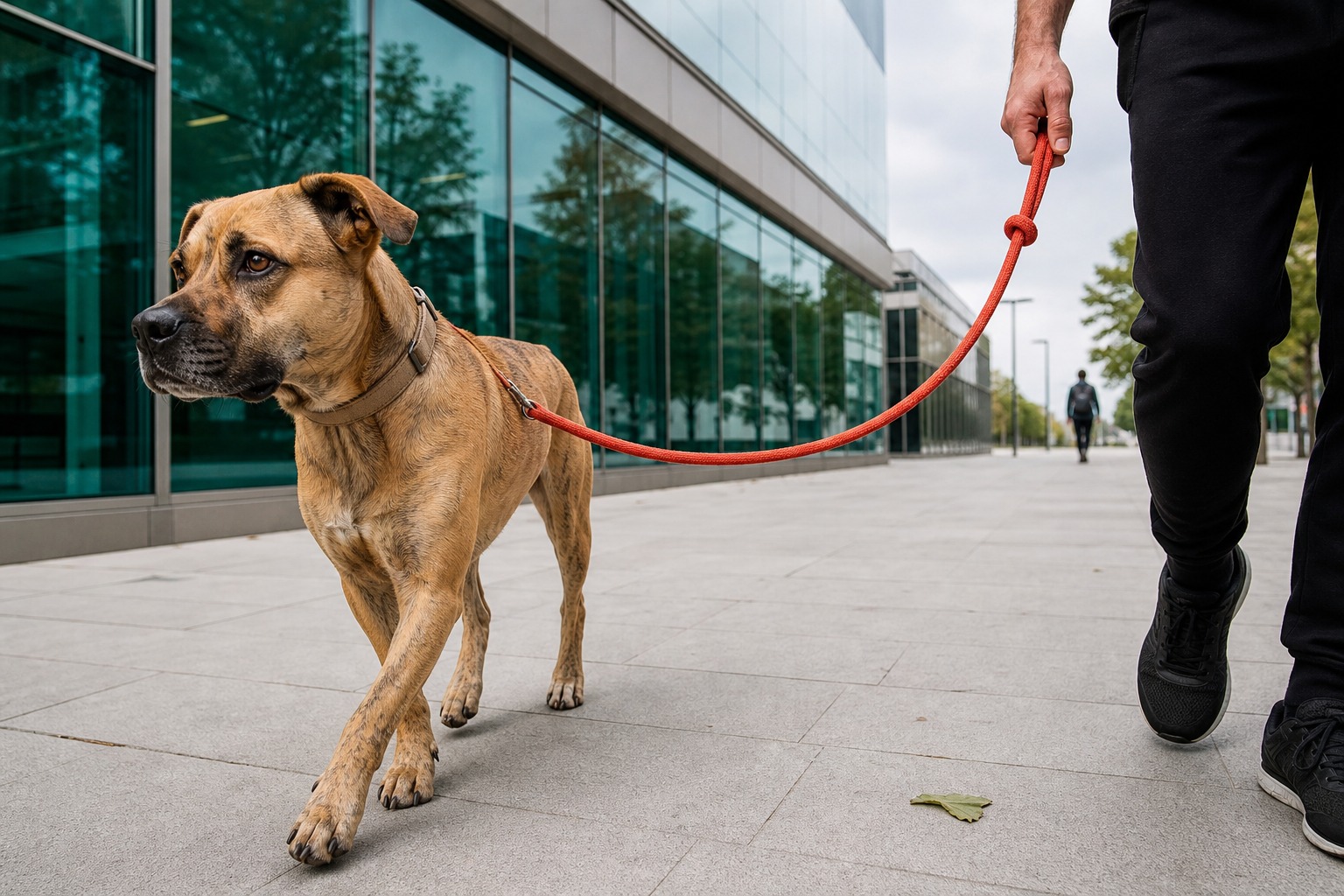
Here is the uncomfortable truth about the dog dragging you down the block: they are not defying you. They are collecting a paycheck. Every time your dog leans into the leash and the walk keeps moving forward, they just got paid for pulling. The sniff got closer. The squirrel got nearer. The pace picked up. From your dog’s point of view, pulling is the single most reliable way to make good things happen, and they are simply very good at their job.
Once you see leash pulling as a payout problem instead of a willpower problem, the fix stops being about dominance or “showing them who’s boss” and starts being about controlling what gets rewarded. That reframe is the whole game. You are not trying to overpower your dog. You are trying to make pulling stop paying, and to make walking beside you the thing that fills the bowl.
Rule one: a taut leash never gets what it wants
This is the rule everything else hangs on. The instant your dog hits the end of the line and it goes tight, the walk stops delivering. Nothing moves forward. You have two clean ways to enforce that, and combining them works best.
The first is to freeze. When the leash goes tight, plant yourself and wait. Do not tug, do not talk, do not haul them back. Just become a boring statue until the leash softens and there is slack again, then walk on. You may get four steps and have to freeze again. That is normal, and it is the point. You are teaching a simple equation: tight leash equals zero progress.
The second is to reverse. When your dog surges ahead, calmly turn and walk the other way. Suddenly they are behind you and the tension is gone. Do this unpredictably, mixing in turns, slow-downs, and speed-ups so that you, not the fire hydrant, become the most interesting thing on the sidewalk. Yes, a neighbor or two will watch you zigzag across the pavement like you have misplaced your keys. Consider it a public service.
Owners come to me convinced their dog is being defiant, and almost every time the dog is just doing math. Pulling has always moved the walk forward, so pulling is what they practice. Change what pays off, and you change the dog.
Load the payout: reward the position you actually want
If pulling should earn nothing, then walking beside you should earn a small fortune. Carry treats on every single walk, and not the dry biscuits rattling in the bottom of your bag. Use something soft, smelly, and a little ridiculous, the kind of treat that makes your dog forget the squirrel exists. When your dog is at your side with a loose leash, pay them. When they check in and glance up at you, pay them. You are building a habit by making the correct position the most rewarding place in the neighborhood.
Take the edge off before you clip the leash
Here is a move most people get backwards: they use the walk to burn off energy, then wonder why a wound-up dog pulls like a sled team. Early on, flip the order. A walk is not only exercise. It is also a rich flood of smells, sights, and sounds that can overwhelm a dog who is already vibrating. If you drain a little of that energy first, with a game of fetch in the yard or a few trips up and down the stairs, your dog starts the walk calmer and is far easier to reward for good behavior. Think of pre-walk play as lowering the volume before the concert.
Set the odds in your favor
Good training is mostly good setup. Pick your timing: many dogs are jumpiest mid-morning and late afternoon, and mellower around dawn or after dark, so walk when your particular dog is naturally calmer. Pick your route, too. An out-and-back path often beats a loop, because plenty of dogs pull hard on the way out, then walk politely on the return once the novelty has worn off. You are stacking small advantages so that success is the easy default.
Try more leash, not less
This one surprises people. Some dogs who pull relentlessly on a standard six-foot leash simply stop when handed an eight or ten-foot line. They may still walk close to you, but without that constant strain. Other dogs treat any length as a challenge and rocket straight to the end of it. You cannot know which dog you have until you test it, so before buying anything, clip two leashes together for one experimental walk and watch. If the longer line helps, it is one of the cheapest fixes there is. (Skip retractable leashes for this, though; the constant light tension teaches a dog that pulling is normal.)
Where the gear fits in
Equipment will not train your dog, but the right piece makes your job easier by deciding where all that force goes. A front-clip or well-fitted harness spreads pressure across the chest and shoulders instead of the throat, and it gives you steering: when a dog lunges against a front clip, their own momentum turns them gently back toward you, which makes pulling mechanically pointless rather than painful. A body-friendly option many trainers reach for is the Freedom No-Pull Harness by 2 Hounds Design, which uses a martingale loop on the back plus a front attachment point. For strong, determined pullers, a simple fixed-length lead in nylon, leather, or rope usually beats a bungee one, since a bungee’s stretch can quietly reward leaning into it.
Just remember the order of operations: the gear buys you a better starting position, and the training does the actual work.
The goal isn’t a show-ring heel
Somewhere along the way, “good on leash” got confused with a rigid competition heel, dog glued to your knee, eyes locked on your face. You do not need that. What you want is loose-leash walking: your dog moving with you, matching your pace enough that nobody feels tension on the line. There is slack in the leash, your dog pays attention to where you are going, and the walk is pleasant for both of you. That is it. And the payoff is real, because a dog who is genuinely nice to walk gets walked more often.
What newer research adds
Researchers have started putting real numbers on the gear-versus-training debate, and the findings back up the paycheck rule. When scientists measured pulling with leash-tension meters, front-attachment harness designs redirected and reduced forward force compared with back-clip styles, which is the mechanical reason so many trainers reach for them. But there is a useful reality check in the same body of work: untrained dogs often lean in and pull harder in a comfortable harness than in a plain collar, precisely because the harness spreads the pressure and pulling stops feeling like anything. Both findings point the same direction. Hardware changes where the force lands and makes your job easier, but it does not teach your dog a thing. The training still does all the real work.
References
- Shih, Hao-Yu, et al. “Behavioural Evaluation of a Leash Tension Meter Which Measures Pull Direction and Force During Human–Dog On-Leash Walks.” Animals, vol. 10, no. 8, 2020. Link
- Shih, Hao-Yu, et al. “Who Is Pulling the Leash? Effects of Human Gender and Dog Sex on Human–Dog Dyads When Walking On-Leash.” Animals, 2020. Link
- Grainger, Jamie, et al. “The Behavioural Effects of Walking on a Collar and Harness in Domestic Dogs.” Journal of Veterinary Behavior, 2016. Link
Common questions
How long does it take to stop a dog from pulling?
There's no fixed timeline. Most dogs improve fastest with a combination of rewarding slack and changing direction when they pull. Consistency matters more than any single session, so expect steady progress over weeks rather than an overnight fix.
What gear do I actually need to leash-train a dog?
Very little: a front-clip or well-fitted harness (or a flat collar for a dog who already walks calmly), a standard non-retractable leash, and a pouch of small, high-value treats. The treats do more work than any piece of hardware.
My dog also lunges and barks on walks. Same fix?
Not quite. Lunging and barking usually signal fear, frustration, or overexcitement rather than plain pulling, and there's no quick fix. Create distance from the trigger in the moment, and work with a qualified trainer or behaviorist for a lasting plan.
Dr. Chen is a small-animal veterinarian who leads health and safety coverage at The Pet Times. She writes and reviews the bulk of our illness, condition, and safety content, translating clinical guidance into clear, practical advice owners can act on at home.
Meet our experts ↗Keep reading
 TrainingYou Don't Have a Bad Dog. You Have a Ceiling, and Here's How to Spot ItDr. Nina Kohl · 5 min
 Training'Back Up' Is the Most Useful Trick Your Dog Doesn't KnowDr. Nina Kohl · 6 min
 Training"My Dog Only Listens When I Have a Treat." Here's the Fix You Skipped.Dr. Nina Kohl · 6 min
 TrainingYour Dog Isn't Being Stubborn About the Snow. They're Confused.Dr. Amara Solis · 7 min
 TrainingEveryone in Your Life Is Quietly Undoing Your Dog's TrainingDr. Nina Kohl · 8 min
 TrainingYou Can't Train the Bladder. Fix the 30 Seconds Before the Door.Dr. Amara Solis · 7 min