


You Can't Train the Bladder. Fix the 30 Seconds Before the Door.
Excitement pee is a reflex, not a choice, so training the dog is the wrong target. Change the greeting instead, and learn which puddle is actually a medical problem.

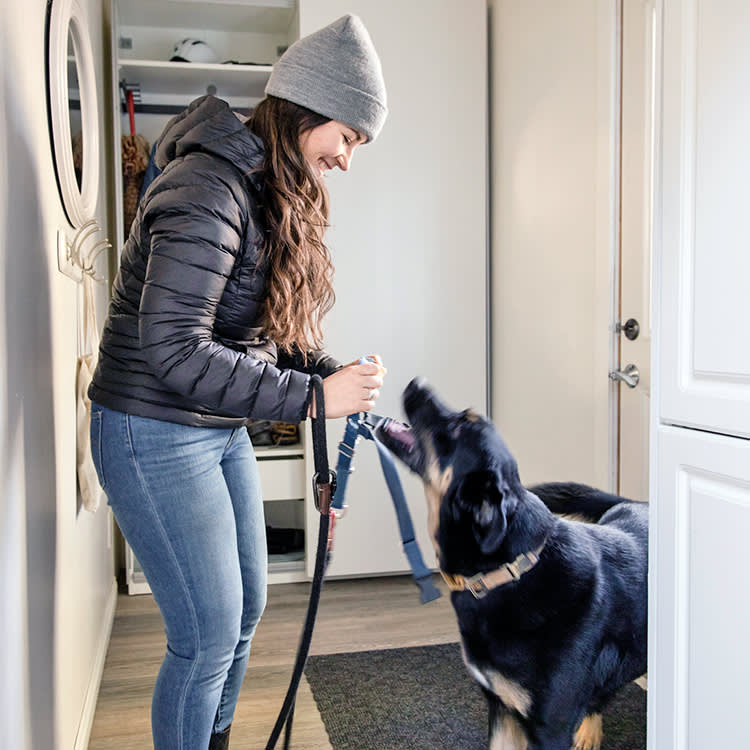
You open the door. Your dog detonates. There is a tail, there are ears, there is a body slamming into your shins, and there is, once again, a small warm puddle on the floor.
Every training article you’ve read tells you to teach your dog to control it. Here’s the thing: you can’t. Excitement urination is a reflex. It happens below the level where decisions get made, which is why it happens to dogs who know perfectly well where the bathroom is, and why scolding accomplishes exactly nothing.
So stop trying to train the bladder. Train the doorway.
First, work out which puddle you have
There are three, and they get treated completely differently. Watch the body, not the pee.
Excitement urination. The dog is delighted. Loose wiggly body, wagging tail, jumping, spinning, zero signs of worry. They lose the bladder in the middle of the joy. Common in puppies and young dogs, and usually outgrown.
Submissive or appeasement urination. The dog is not delighted, they’re managing you. Look for a crouch, a lowered body, a tucked tail, flattened ears, a turned head, avoidance of eye contact, or a roll onto the back with a leg lifted. This is a dog saying “I’m not a threat,” and it’s often triggered by someone leaning over them, reaching for their head, making direct eye contact, or speaking sharply. Confidence is the treatment. Pressure makes it worse.
Medical. Neither of the above. See the section below, and go to the vet.
Most owners describe both of the first two as “he pees when he’s excited,” and then apply advice for one to the other. If your dog is crouching, more excitement management won’t help. If your dog is bouncing off the walls, more gentleness won’t either.
The single most useful thing I do in these appointments is separate the joyful puddle from the worried puddle. They look identical on the floor and they mean opposite things about the dog.
The greeting protocol
For the excitement version, here’s the whole intervention. It is not glamorous and it works.
- Take the arousal out of your arrival. Come in, hang up your coat, put down your bag, and do not look at, speak to, or touch your dog for the first minute or two. No high-pitched hello. No “who’s a good boy.” Nothing. Wait until the wiggling has genuinely settled, then greet calmly.
- Move the greeting outside. If you can, leash up or open the back door before you interact at all, and do the real hello on the grass. A puddle outdoors is not a problem, it’s a walk.
- Empty the tank before the trigger. Guests coming at seven? Walk your dog at six-forty. A dog with an empty bladder cannot produce a puddle no matter how thrilled they are.
- Get low, get sideways, keep hands low. Crouch, turn your body slightly away, and pet under the chin or on the chest rather than reaching over the head. This matters enormously for the appeasement version and does no harm for the excited one.
- Give the excitement somewhere to go. Scatter a few treats on the floor as you come in. Sniffing and eating are incompatible with launching yourself at a human, and nose-down is a calming activity.
- Ask for an incompatible behavior. A dog who has practiced a rock-solid sit or a “go to your mat” at the door has a job to do with all that energy. Teach it when nobody is arriving, at a boring time of day, and pay it lavishly. Do not expect it to hold under the full force of your homecoming until it’s been drilled for weeks.
- Lower the stakes everywhere else. Don’t stack triggers. If your dog is easily overwhelmed, meet one new person at a time, not six. Keep introductions short and calm.
- Exercise, and the right kind. A dog with a large surplus of unspent energy has a shorter fuse for everything. Daily walks with real sniffing time, plus food puzzles and short training sessions, take the edge off the whole system.
Consistency is what makes this work, and it has to include everyone. One family member doing the shrieking-joyful-greeting thing will undo the other four.
What not to do, and why it backfires
Don’t punish. Yelling at a dog for a reflex is like yelling at someone for a sneeze. It doesn’t remove the reflex, it just adds anxiety, and anxiety makes bladder control worse, not better. For a submissive urinator, punishment is actively catastrophic: the dog is already trying to appease you, and the correction proves them right to be worried, so they appease harder, and appeasing harder is the peeing.
Don’t make a scene about the cleanup. Clean it calmly, ideally when the dog isn’t watching, with an enzymatic cleaner so the smell doesn’t mark the spot as a bathroom.
Don’t treat it as defiance. It isn’t. A dog who could stop this would stop it.
When it’s medical
Behavior explanations only apply to behavioral timing: greetings, play, meeting new people. Anything outside that window belongs to your vet.
Go in if you see:
- Leaking while asleep or lying down, especially a wet patch where your dog was napping. That’s a strong sign of urethral sphincter incompetence, which is common in spayed females and very treatable.
- Straining, frequent small amounts, or urgency
- Blood in the urine, or a change in color or smell
- Drinking noticeably more
- A housetrained adult dog who suddenly starts having accidents
- Signs of pain, or licking at the genitals
Urinary tract infections, bladder stones, kidney disease, and diabetes all cause inappropriate urination, and none of them respond to a calmer hello. Rule the body out before you commit to a training plan.
What’s normal, by age
Puppies leak. Their bladder control is a work in progress, both the muscle and the wiring, and excitement blows straight through it. It typically improves steadily as they mature, and it’s usually gone by around a year old.
Adult dogs who still do it are usually either very soft, very excitable, or both, and they can improve a great deal with the greeting protocol and confidence work. The dogs who struggle longest are the anxious and highly appeasing ones, which is precisely why the punishment route is such a trap: it turns a resolvable puppy phase into a permanent one.
What newer research adds
The cleanest recent contribution isn’t a study, it’s a distinction. Veterinary behavior services, including UC Davis, now consistently separate submissive urination from excitement urination and treat them differently, because they respond to opposite things. Excitement needs the arousal dialed down. Appeasement needs the social pressure dialed down and the dog’s confidence built up. Both are made worse by correction, but for different reasons.
The second update is a reminder that “she outgrows it” doesn’t mean “ignore it.” The behavior resolves as the dog matures provided nobody reinforces it or punishes it into permanence. That’s an active job, not a passive one. Two months of calm doorways buys you a decade of dry floors.
References
- UC Davis Veterinary Medicine, Behavior Service. “Submissive and Excitement Urination in Dogs.” https://www.vetmed.ucdavis.edu/sites/g/files/dgvnsk491/files/inline-files/Submissive_and_Excitement_Urination_in_Dogs.pdf
- San Francisco SPCA. “Submissive and Excitement Urination.” https://www.sfspca.org/resource/submissive-and-excitement-urination/
- Cornell University College of Veterinary Medicine, Riney Canine Health Center. “Urinary Incontinence.” https://www.vet.cornell.edu/departments-centers-and-institutes/riney-canine-health-center/canine-health-topics
- American Veterinary Society of Animal Behavior. “Position Statement on the Use of Punishment for Behavior Modification in Animals.” https://avsab.org/resources/position-statements/
Common questions
Do dogs grow out of excited peeing?
Most do. Excitement urination usually resolves as a dog matures and gains bladder control, often by around a year, as long as nobody makes it worse with punishment.
Why does my dog pee when I pet them?
That's often appeasement rather than excitement. If your dog crouches, tucks their tail, flattens their ears, rolls over, or avoids eye contact while they leak, they're signaling that they're not a threat. Reaching over their head makes it worse. Crouch sideways and let them come to you.
When is peeing a medical problem instead of a behavior one?
When it happens outside those emotional moments: leaking while asleep, straining, frequent small puddles, blood in the urine, or a housetrained adult who suddenly starts having accidents. Those need a vet, not a training plan.
Dr. Solis is a board-certified veterinary dermatologist with over twelve years of clinical experience. She advises on skin conditions, allergies, and grooming practices that affect coat and skin health. All dermatology and allergy content at The Pet Times is reviewed by her team before publication.
Meet our experts ↗Keep reading
 TrainingThat Bootie Wobble Isn't Funny. You Just Blindfolded Their Feet.Dr. Nina Kohl · 8 min
 TrainingYour Dog Has a Perfect Recall. It's Just Not to the Word 'Come.'Dr. Lena Park · 7 min
 Training'Back Up' Is the Most Useful Trick Your Dog Doesn't KnowDr. Nina Kohl · 6 min
 TrainingNo Dog Is "Untrainable." Some People Just Quit.Dr. Nina Kohl · 8 min
 TrainingYour Dog Doesn't Out-Muscle You. They Out-Balance You.Marcus Webb · 7 min
 TrainingYour Dog Isn't Being Bad. The Couch Is Just the Best Bed in the House.Dr. Nina Kohl · 6 min