


They Seized 305 Dogs, 30 Guns, and $40,000. The Dogs Were the Easy Part.
The largest dogfighting takedown in South Carolina's history turned up firearms and cash alongside the animals. That is not a coincidence, and it is the reason these cases matter beyond the dogs.

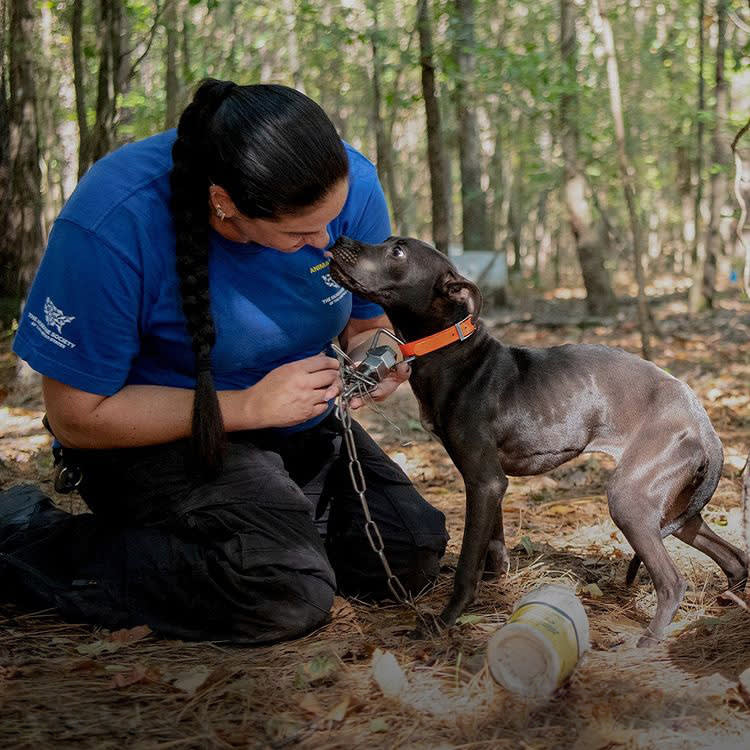
Over the weekend of September 24, 2022, more than 60 federal and state law enforcement officers moved on properties across six South Carolina counties. They interrupted a scheduled dogfight already underway in Richland County. By the time they were finished, they had executed 23 search warrants, arrested more than 20 people, and taken 305 dogs into custody, 275 of whom were believed to be connected to fighting.
It was the largest dogfighting takedown in the state’s history. And the number that tells you the most about what dogfighting actually is does not involve dogs at all.
Officers also seized roughly 30 firearms and $40,000 in cash.
Dogfighting is rarely just dogfighting
That combination is not incidental, and law enforcement has stopped treating it as such.
Mark Keel, chief of the South Carolina Law Enforcement Division, told the local station WYFF that investigators working animal abuse cases routinely turn up firearms, narcotics, human trafficking, and child abuse alongside them. The animals are the entry point. They are rarely the whole file.
U.S. Attorney Adair F. Boroughs made the same argument from the prosecution side when the arrests were announced, describing the practice of forcing dogs to fight, frequently to the death, for other people’s entertainment as both cruel and sadistic, and noting that it tends to create cover for other criminal activity involving drugs and guns.
This is the piece most coverage misses, because photographs of rescued dogs are more compelling than an evidence table. But it is why these operations draw federal resources at all. A dogfighting ring is an unregulated cash economy with a built-in gambling operation, and the things that grow around unregulated cash economies grow around this one too. Pull the thread and you frequently find the rest.
The crime that never actually went away
Dogfighting in America predates the Civil War. Most states outlawed it around that time, and it promptly found new life in the twentieth century anyway.
It entered mainstream awareness in 2007, when NFL quarterback Michael Vick pleaded guilty to bankrolling a dogfighting ring and its associated gambling operation, and admitted complicity in the deaths of six dogs. He was released from federal prison in 2009.
The reaction from animal welfare leadership at the time is a useful measure of how low the bar sat. Ed Sayres, then the ASPCA’s president and CEO, publicly welcomed the conviction by pointing out that federal charges in dogfighting cases were extremely rare, and thanking the authorities for treating the crime as though it mattered. Dogfighting was already a felony in 48 states. What was unusual was anyone at the federal level bothering.
Two things have changed since. Dogfighting is now a felony in all 50 states, and under the Animal Welfare Act it is a federal crime as well. Federal charges are no longer rare.
What has not changed is the scale. By the Humane Society of the United States’s estimate, upwards of 40,000 Americans take part in organized dogfighting. The ASPCA’s position is that no region and no kind of community is exempt from it, urban, rural, wealthy, or poor.
Forty thousand people is not a fringe. It is a subculture with a supply chain.
The dogs are not the hard part
Here is the thing that people who have never worked one of these cases consistently get wrong.
The overwhelming majority of dogs seized from fighting operations can be rehabilitated. They were forced into it. Removed from it, given time and competent behavioral care, most of them turn out to be exactly what they always were, which is dogs.
The clearest proof is the Vicktory Dogs, the animals seized from Michael Vick’s operation, who were evaluated individually rather than written off as a group. Most were placed. Many became family pets. Some became therapy dogs. Their story was documented in the 2015 film The Champions, and it permanently changed the legal and behavioral default for fighting-bust dogs from “destroy” to “assess.”
The assumption that a dog seized from a fighting ring is ruined is a hangover from a time when nobody bothered to check. When people did check, the dogs kept passing. It is the humans in these cases who reoffend.
In South Carolina, the animals went to organizations built for exactly this. The Humane Society of the United States moved in alongside Bark Nation, a Michigan-based nonprofit that works with law enforcement on dogfighting and cruelty cases and operates entirely on donations, with no federal funding. Bark Nation took on 26 dogs from one raided property, handling their medical and behavioral care with a volunteer crew of about 70. Red Rover, an emergency animal care organization, assisted HSUS with 45 more.
This is the unglamorous middle of a case like this: months of daily care for hundreds of animals who are legally evidence, and who cannot be adopted out until the courts release them.
How to help, and who to call
Bark Nation, Red Rover, and the Humane Society of the United States all take donations directly, and in a case of this size that funding is what pays for the veterinary and behavioral work.
If you have information about dogfighting anywhere in the country, the U.S. Department of Agriculture enforces the Animal Welfare Act and takes tips at 1-800-424-9121.
And if you want the single highest-leverage thing an ordinary person can do: report it. These rings are not invisible to their neighbors. Chained dogs with heavy collars and scarring, unusual traffic at odd hours, treadmills and weighted equipment in a yard with no runner in the house. Cases like this one begin with somebody who noticed and made a call.
What’s new since this was written
The prosecutions took years, and they landed.
The South Carolina case fed into a broader federal push against organized dogfighting, and separately, a multi-jurisdictional federal investigation known as Operation Grand Champion concluded in July 2024 with the last of its 12 defendants sentenced. Federal sentences in dogfighting cases have become routine rather than exceptional: in one South Carolina federal case, a Leesville man was sentenced to 15 months in federal prison followed by three years of supervised release after pleading guilty to operating a dogfighting venture and to firearms charges.
That is the shift worth registering. In 2007, an ASPCA executive publicly thanked federal authorities for bothering. Fewer than twenty years later, federal dogfighting prosecutions run to conclusion as a matter of course, with prison time attached, and the firearms charges that ride alongside them do a lot of the sentencing work.
The dogs from the 2022 South Carolina seizure went through the long process these cases require: custody, evidence status, medical care, behavioral evaluation, and eventually, for most, placement. The organizations that carried that load are still doing it, on donations, for the next case. There is always a next case.
References
- U.S. Department of Justice, District of South Carolina. “Joint Operation Targets Massive Dogfighting Conspiracy.” justice.gov/usao-sc/pr/joint-operation-targets-massive-dogfighting-conspiracy
- Humane Society of the United States. “Dogfighting Fact Sheet.” humanesociety.org/resources/dogfighting-fact-sheet
- ASPCA. “Dogfighting.” aspca.org/investigations-rescue/dogfighting
- U.S. Department of Agriculture. Animal Welfare Act enforcement and tip line. aphis.usda.gov
- Bark Nation. barknation.org
- Red Rover. redrover.org
Nina Vasquez writes about life at home with pets and the relationships at the heart of it. Her work covers day-to-day living, people-and-pet stories, and the products that fit into a real household, with a warm, grounded take on everyday pet ownership.
Meet our experts ↗Keep reading
 LivingL.A. Just Slammed the Brakes on New Dog Breeding. Here's the Fight Behind It.James Okafor · 4 min
 LivingThey Came to Shoot a TV Show. They Left Having Saved 14 Dogs.Sara Lim · 6 min
 LivingHe Left Jail After Five Days. One of His Dogs Was Already Dead.Sasha Ford · 4 min
 LivingThe Blue Dogs of Chernobyl Aren't Radioactive. The Truth Is Grosser.James Okafor · 5 min
 LivingThe Rescue-Chihuahua Coincidence That Built a Cult Leash BrandMarcus Webb · 5 min
 LivingHe Left 11 Dogs to Die in a Hot Van, Then Cremated the Evidence. A Jury Convicted Him.Nina Vasquez · 5 min