


They Came to Shoot a TV Show. They Left Having Saved 14 Dogs.
On the Oklahoma set of 'Reservation Dogs,' sisters Brit and Taylor Hensel turned a run of stray sightings into a grassroots rescue rooted in Cherokee community care.

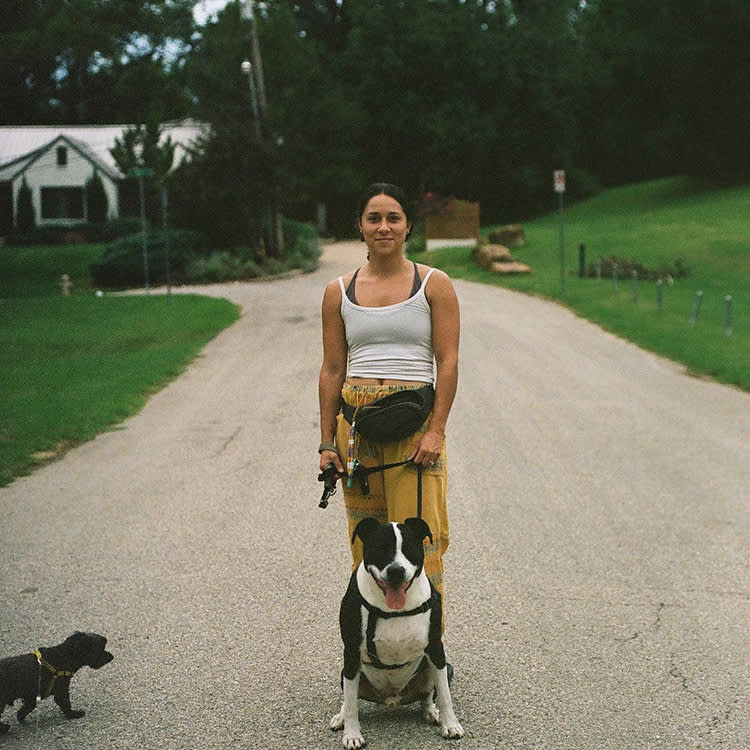
The strays kept turning up. Working in the camera department on FX’s Reservation Dogs around Tulsa, Oklahoma, sisters Brit and Taylor Hensel couldn’t stop noticing the dogs wandering the neighborhoods where the crew was filming. Both are Cherokee Nation citizens and filmmakers in their own right, and both kept asking the same practical question between takes: what’s the actual plan for this one? Out of that question, run over and over during a working production, came Rez Dog Rescue.
What makes the story worth telling isn’t just the animals saved, though there were plenty. It’s that the rescue grew out of a specific idea of belonging. The sisters weren’t parachuting in. They were guests in communities that had opened their homes and land for the shoot, and helping the local dogs was simply how you show care for a place that’s caring for you.
A rescue built out of a group chat
There was nothing polished about the operation, at least at first. The whole crew became the network. The locations team, who spend their days building relationships with property owners and knew every corner of the neighborhoods, usually spotted the animals first. Rocky Harjo, brother of series co-creator Sterlin Harjo, was one of the most reliable finders. A group text tied it all together: someone would report a dog, and the message would go out asking what everyone could pull together.
They kept supplies in their trunks and on set, leashes, collars, food, and for a while had an animal wrangler on hand to help. Whoever found a dog would stabilize it, then call the Tulsa SPCA to ask if there was space that day. The answer was usually yes. Across the show’s second season, that improvised pipeline rescued 14 animals.
For the Hensels, the work sat naturally alongside the storytelling. As Brit has put it, animals hold a special place in Cherokee tradition, where many of the oldest teachings arrive as animal stories, parables with four legs. Helping the strays wasn’t a distraction from the show’s world. It was of a piece with it.
Why the need runs so deep in Oklahoma
Brit doesn’t soften the context. Oklahoma, she has said plainly, ranks among the hardest places in the country to be a companion animal. She ties it to the state’s economy: where heavy industry sets the tone and animal-agriculture interests shape the rules, the laws protecting companion animals stay thin. On paper, an animal needs shelter and water. But the statutes don’t define what counts as adequate shelter, and that vagueness leaves a lot of dogs exposed.
There’s a bigger picture, too. Oklahoma is home to 39 federally recognized tribes, one of the highest concentrations anywhere, and almost every one of them was forced onto this land. Drive 20 minutes in any direction, Brit notes, and you cross into another tribal territory, with its own language and customs. What binds it together is a shared understanding between people who know that history in their bones. Rez Dog Rescue was designed to work with that grain, not against it, animal welfare as an extension of taking care of your own community.
Paying for it, five dollars at a time
Rescue costs money, roughly $750 per animal by the sisters’ accounting, and in the beginning they simply paid it themselves. Then they got organized. They reached out to the Tulsa SPCA, partly because the shelter was already in on the spirit of things, having named some of its dogs after Reservation Dogs characters, and partly because it was one of the biggest animal-welfare players in the state. On set, they instituted “$5 Fridays,” passing the hat to the cast and crew, and raised around $2,200. Sterlin Harjo’s company, Crazy Eagle Media, became their largest funder.
Some of the animals arrived in heartbreaking shape. Brit describes one young dog, not yet a year old, so overtaken by mange and open sores that he couldn’t stand; a crew member who found him first assumed he was already gone. He wasn’t. He recovered fully, and his coat grew back silky. Most of the dogs, the sisters found, were pit-bull types and larger mixed breeds, and once the animals reached the Tulsa SPCA, the sisters handed off custody entirely, following the updates from a distance as the dogs healed and found homes, mostly in-state.
From strays on set to a mobile clinic
The work didn’t stop when the cameras did. After season two wrapped, the Hensels partnered with the Tulsa SPCA to run a mobile clinic, renting one of the shelter’s units and taking it directly to residents. They papered the neighborhoods with flyers and went door to door offering flea and tick prevention, on-site spay and neuter surgeries, grooming, heartworm testing, even help building fences, plus ramps, gates, scratchers, and toys. The gratitude, Brit has said, was immediate and visible.
Taylor’s earlier stint working for a humane society gave the pair a head start on how the rescue world actually operates, and the SPCA’s professional infrastructure gave their scrappy effort somewhere solid to land. Brit’s ambitions run bigger from here: a whole fleet of mobile units able to reach people wherever the need runs deepest, and formal partnerships with tribes to build lasting infrastructure rather than reinventing it each time. The mobile clinic, she’s said, was proof of concept. The goal now is to do it more often.
If you want to support the work that started on a film set, the Tulsa SPCA is where the sisters have long directed help, and where the dogs they pulled from the roadside ended up getting their second chance.
Sara Lim leads our Product Picks coverage, testing and comparing the things pets and their owners actually use. From everyday essentials to home-and-style finds, she focuses on honest, useful recommendations rather than hype.
Meet our experts ↗Keep reading
 LivingA Comment on Instagram Got a Two-Legged Street Dog a Mercedes WheelchairJames Okafor · 5 min
 LivingShe's Fostering 23 Dogs. Nobody Posts the Rest of It.Leila Torres · 6 min
 LivingSome States Once Banned Black Families From Owning Dogs. A Yale Scholar on Why That Still Echoes.Leila Torres · 6 min
 LivingA Comedian Built a Movement Around the Dogs Nobody WantedLeila Torres · 5 min
 LivingHe's Fostered Almost 40 Pit Bulls. The Stigma Is the Only Thing He Can't Rehome.Leila Torres · 8 min
 LivingMissouri Tops the 'Horrible Hundred' for a 14th Year. The 2026 Report Is Grim.Nina Vasquez · 6 min