


A Comedian Built a Movement Around the Dogs Nobody Wanted
Rebecca Corry made a living making people laugh. Then a scarred rescue named Angel pointed her at the ugliest corner of animal welfare, and she has spent more than a decade there since.

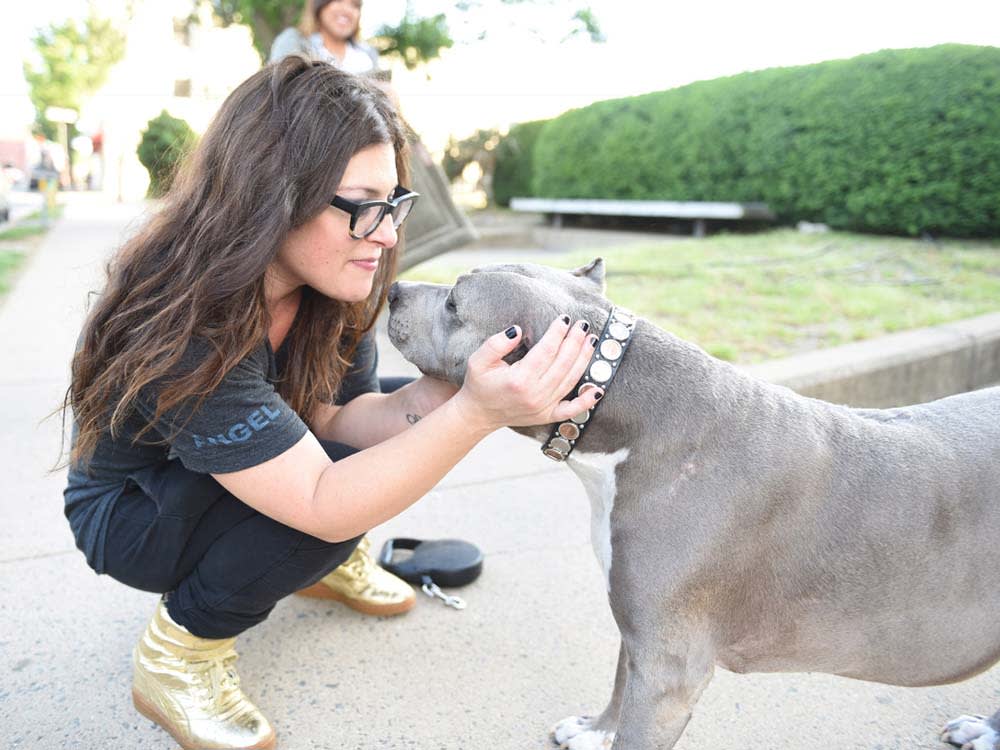
There is a version of the celebrity-and-their-cause story that stays comfortable. A famous person lends a name, poses for a photo, moves on. Rebecca Corry’s version is not that story. The comedian and actor has spent more than a decade planted in the single most polarizing corner of animal rescue, working on behalf of the dogs most likely to be feared, mislabeled, and killed: the ones people call pit bulls.
What makes her worth writing about is not that she cares. Plenty of people care. It is that she built something durable out of caring, and that she did it around an animal most public figures would rather not attach their name to.
It started with a dog named Angel
Corry’s turn toward advocacy traces back to a single foster dog. Angel came to her already carrying the evidence of human cruelty: cropped-off ears and a chemical burn running down her back. She had recently had knee surgery and needed a quiet place to recover away from other animals. The temporary arrangement did what temporary arrangements so often do, and Angel stayed.
Living with a dog that had survived that kind of treatment, and watching how strangers reacted to a dog that merely looked a certain way, taught Corry the shape of the problem firsthand. People crossed the street. People assumed the worst. The gap between the animal in front of her and the reputation she was expected to fear became the thing she could not stop thinking about.
What “pit bull” actually means, and why it matters
One of the points Corry has spent years trying to drive home is deceptively simple: “pit bull” is not a breed. An American Pit Bull Terrier is a real, recognized breed, yet the enormous population of shelter dogs stamped with that label are, overwhelmingly, mixed-breed animals sorted into one bucket by appearance alone. A short coat and a blocky head are enough to earn the tag, and the tag then follows the dog into statistics, insurance policies, rental applications, and municipal law.
That labeling is not a harmless quirk of paperwork. When a loose visual category gets treated as a breed, and that category is singled out by breed-specific legislation, the result is a self-reinforcing loop: more dogs get counted as “pit bulls,” the numbers look scarier, and the laws that skew the numbers get defended with the numbers they skewed. Corry’s argument against that machinery is less about dog science than about basic fairness, that punishing an animal for its appearance is discrimination dressed up as public safety.
From a comedy show to a national foundation
Corry did not start with a nonprofit. She started with a show. In 2011 she began producing live comedy events under the Stand Up For Pits banner, using the thing she already knew how to do, make a room laugh, to pull people toward a cause most of them would otherwise flinch from. The humor was strategic. Advocacy for these dogs can be relentlessly dark, and a night that lets people laugh and then learn holds an audience that a lecture would lose.
By 2013 the events had incorporated into a registered nonprofit, the Stand Up For Pits Foundation, devoted to education, advocacy, and direct rescue. The organization has funded free spay and neuter clinics in underserved communities, run donation drives for shelters, awarded grants to frontline rescue groups, and used social media to network thousands of adoptable dogs into homes. In 2014, Corry organized the first One Million Pibble March in Washington, D.C., largely from her own apartment, unsure anyone would come. Thousands did.
Todd, Sally, and a purpose that outgrew the joke
Angel died in 2016, a loss Corry has been open about carrying heavily. The work, though, had already outgrown any single dog. Today she shares her life with two more rescued pit-bull-type dogs, Todd and Sally, animals she has described as goofy, sensitive, and startlingly resilient given what such dogs often endure before they land somewhere safe. Her through-line, across interviews and stages and marches, is consistent: the comedy is what she does, but the dogs are what she is for.
What newer research adds
Corry’s central complaint, that visual breed labels are unreliable and unfair, has only gained scientific backing in recent years. Studies using DNA testing have repeatedly found that shelter staff guessing a dog’s breed by appearance get it wrong a large share of the time, and that dogs labeled “pit bull” frequently have little or no detectable ancestry from the breeds the label implies. That research is part of why a growing number of shelters have stopped listing breed guesses on kennel cards at all, judging dogs as individuals instead. The shift is exactly the one Corry has argued for.
Her documentary, Saving Jones, which she wrote and directed, brought that argument to a wider audience. The film had its world premiere at the Dances With Films festival in 2024, where it won the festival’s Audience Award, and it has since screened around the country and had limited streaming and rental windows. Named for a dog from Corry’s childhood, it frames the treatment of these dogs less as an animal problem than as a mirror held up to the people around them, which is, more or less, the case she has been making all along.
References
Leila Torres leads our Living coverage, from home life and travel to the products and rescue stories that come with sharing a life with animals. She edits and writes across the section, with a soft spot for pieces about the bond between people and their pets.
Meet our experts ↗Keep reading
 LivingThe Rescue That Saved His Life Nearly Went Under Without HimJames Okafor · 9 min
 LivingA Layoff, a Pregnant Street Dog, and 4,500 Rescues LaterLeila Torres · 5 min
 LivingThey Came to Shoot a TV Show. They Left Having Saved 14 Dogs.Sara Lim · 6 min
 LivingSome States Once Banned Black Families From Owning Dogs. A Yale Scholar on Why That Still Echoes.Leila Torres · 6 min
 LivingA Comment on Instagram Got a Two-Legged Street Dog a Mercedes WheelchairJames Okafor · 5 min
 LivingShe's Fostering 23 Dogs. Nobody Posts the Rest of It.Leila Torres · 6 min