


Snake Plant and Cats: A Bitter Plant Cats Reject, and the One Reason to Still Move It
Snake plants are toxic to cats, but they taste so bitter that most cats quit after a lick. The reason to keep one out of reach anyway is the rare, quieter risk that bitterness can't warn you about.

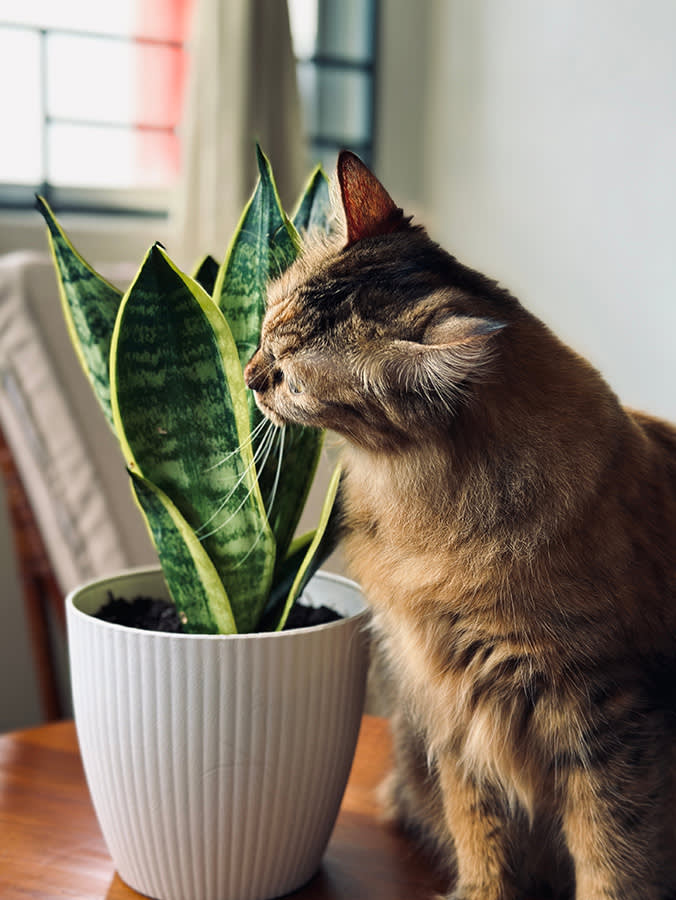
The snake plant has a reputation as the houseplant you cannot kill: drought-proof, low-light-proof, neglect-proof, the architectural green spike that survives in the corner of every office and apartment. The same toughness that makes it bulletproof against forgetful owners is built on a chemical that makes it mildly toxic to cats. But the more interesting fact, the one that should actually shape how you respond, is that cats themselves want very little to do with it.
Snake plant tastes terrible. The bitterness is not incidental; it is the toxin announcing itself. And that changes the question from “is it dangerous” to something more practical: if cats naturally reject it, why bother moving it? The answer is a single, quieter risk that the bitter taste cannot protect against, and it is the reason this plant still does not belong where a determined or bored cat can reach it.
Meet the plant, and its built-in alarm
The snake plant has been renamed by botanists from Sansevieria trifasciata to Dracaena trifasciata, though garden centers still use both. It is a tropical native of West Africa, comes in more than 70 varieties ranging from six-inch dwarfs to eight-foot spears, and earns its keep as a hardy, slow-growing, near-indestructible air-filtering houseplant. The common compact types you will see at home are varieties like laurentii, with its yellow-edged blades, and the cylindrical ‘Boncel.’
What makes it toxic is a group of compounds called saponins, which the plant produces throughout every part, leaves, stems, and roots, to defend itself against insects, fungi, and bacteria. Saponins are natural detergents; the name comes from the same root as “soap,” and in high concentration they foam in water. In a cat, they do two things. In the mouth and gut, they irritate the tissue lining, which is what produces the nausea, drooling, vomiting, and diarrhea. And critically, saponins can disrupt the membrane of red blood cells, increasing its permeability so that, in sufficient quantity, red blood cells rupture.
Here is the feature that defines the whole risk: those same saponins are powerfully bitter. The toxin is also the deterrent. A cat that bites a snake plant gets an immediate mouthful of soapy bitterness and, in the large majority of cases, decides the experiment is over.
“Snake plant has a flavor working against the cat’s curiosity, which is unusual and genuinely helpful,” says Dr. Amara Solis, a veterinarian who writes for Pet Times. “Most cats reject it after a lick. What I make sure owners understand is that ‘most’ is not ‘all,’ and the reason I still want it out of reach is not the sore mouth, it is the blood-cell effect if a cat ignores the taste and keeps going.”
The mild story versus the rare story
Almost every snake-plant encounter follows the mild script, and it is worth describing plainly so you do not over-react to a nibble. A curious cat licks or chews a leaf, hits the bitterness, and stops. Over the next hours you may see:
- Drooling or oral irritation
- Nausea and reduced appetite (anorexia)
- Vomiting
- Diarrhea
This typically passes within a day or so with nothing more than monitoring. The bitterness usually keeps the quantity low, which keeps the toxicity in the nuisance range.
The rare story is what justifies the caution, and it hinges on dose. If a cat eats a genuinely large amount, enough saponin can reach the bloodstream to damage red blood cells, and if enough cells are destroyed the cat can become anemic. The signs of that move beyond the stomach:
- Pale gums (a key tell, check by lifting the lip)
- Dilated pupils
- Marked weakness or lethargy that does not lift
- Collapse in a severe case
This outcome is uncommon precisely because the taste usually prevents the dose. But it is the answer to “why move a plant cats already avoid”: the bitterness defends the mouth, not the blood, and you cannot count on a bored, anxious, or unusually undeterred cat to stop in time.
A simple way to think about toxic houseplants
It helps to sort cat-toxic plants by how they hurt, because the mechanism tells you what to expect and how fast.
- Contact irritants (calcium oxalate plants like pothos, philodendron, dieffenbachia): instant mouth-burning sting, immediate drooling and pawing, self-limiting because it hurts on the spot.
- Saponin plants (snake plant): bitter taste plus delayed gut upset, with a rare large-dose risk to red blood cells.
- Systemic killers (true lilies and daylilies for cats): the dangerous category, because there may be no immediate reaction at all while the toxin silently attacks the kidneys.
Snake plant sits squarely in the middle tier: more forgiving than it sounds, but not in the “wait and see” comfort zone of a truly trivial plant, and nowhere near the silent lethality of a lily. Filing it correctly keeps you from both panic and complacency.
What to do if your cat tangles with one
For the common small-nibble case:
- Remove the plant and clear away any chewed pieces so there is nothing to return to.
- Wipe the mouth gently with a damp cloth if your cat allows it, and offer fresh water.
- Watch for several hours. Mild drooling and one or two episodes of vomiting in an otherwise bright, normal cat usually just need monitoring.
- Call your vet or the ASPCA Animal Poison Control Center at (888) 426-4435 if you are unsure how much was eaten or want guidance.
Escalate to in-person care without delay if vomiting or diarrhea is severe or persistent, or if you see the blood-cell warning signs, pale gums, real weakness, or stubborn lethargy. Tell the veterinary team that a snake plant was involved, because vomiting and diarrhea are non-specific and that history puts saponin toxicity on their list. If you arrive early after a large ingestion, a vet may induce vomiting or give activated charcoal; symptomatic cats are treated with fluids and anti-nausea and anti-diarrheal medication, and severe cases may warrant bloodwork to check for anemia and a short hospital stay.
Why bitterness is not a substitute for placement
The bitter taste is a real safety margin, but not a fence. Some cats chew plants out of boredom or anxiety and will tolerate a flavor a content cat would reject. Bitter-spray deterrents add little here, since the plant is already bitter and that is precisely the cat you are worried about. So the durable fix is the boring one: put the snake plant somewhere a cat truly cannot get to, a closed room or a genuinely out-of-reach spot, or rehome it, and give the underlying chewing urge a better target with cat grass, more play, and food puzzles.
Cat-safe plants with the same sculptural look
If it was the snake plant’s bold, upright silhouette you loved, you can keep the aesthetic and lose the risk:
- Rattlesnake plant (Goeppertia insignis, formerly Calathea): upright, dramatically patterned, and non-toxic to cats.
- Areca palm (Dypsis lutescens): tall and architectural with feathery fronds, pet-safe.
- Parlor palm (Chamaedorea elegans): an easy, low-light, cat-safe floor plant.
- African violet (Saintpaulia ionantha): small and flowering, safe even if a cat samples it.
- Spider plant (Chlorophytum comosum): tough and forgiving, the closest thing to a no-kill, cat-safe houseplant.
The bottom line
Snake plants are mildly to moderately toxic to cats thanks to saponins, but those same saponins taste so bitter that most cats self-limit to a harmless nibble and a sour expression. Treat a single bite as a monitor-at-home event, and reserve urgency for severe gut signs or the rare red-blood-cell picture of pale gums, weakness, and lethargy. The bitterness protects the mouth but not the blood, so the plant still earns a spot a cat cannot reach, or a cat-safe stand-in that gives you the same architectural lines without the chemistry.
References
- “Snake Plant (Mother-in-Law’s Tongue).” ASPCA Animal Poison Control Center, Toxic and Non-Toxic Plants. https://www.aspca.org/pet-care/animal-poison-control/toxic-and-non-toxic-plants/mother-laws-tongue
- “Saponins.” Cornell University, Department of Animal Science, Plants Poisonous to Livestock. https://poisonousplants.ansci.cornell.edu/toxicagents/saponin.html
- “Anemia.” Cornell Feline Health Center. https://www.vet.cornell.edu/departments-centers-and-institutes/cornell-feline-health-center/health-information/feline-health-topics/anemia
- Siroka, Zuzana. “Toxicity of House Plants to Pet Animals.” Toxins, vol. 15, no. 5, 19 May 2023, p. 346. https://doi.org/10.3390/toxins15050346
Common questions
What happens if a cat eats a snake plant?
A typical small nibble causes drooling, nausea, maybe some vomiting or diarrhea, and a generally grumpy cat for a day or so. The picture only becomes concerning if a cat somehow eats a large amount, which is rare given the bitterness, in which case the saponins can affect red blood cells. Watch for pale gums, weakness, or lingering lethargy, and call your vet if any of those appear.
Why does a snake plant taste bad to cats?
The saponins that make the plant toxic are the same compounds that make it taste bitter and soapy. It is the same class of natural chemical that makes soapwort foam. That built-in bad taste is the plant's defense, and it is why most cats self-limit and why serious snake-plant poisoning is uncommon, though never something to rely on completely.
Is the snake plant or the pothos worse for cats?
They hurt differently. Pothos injures on contact with calcium oxalate crystals, so the pain is instant and the cat stops fast. Snake plant works through saponins, so the response is bitter taste plus delayed stomach upset, and the rare worst case is red-blood-cell damage rather than mouth swelling. Neither is usually an emergency from a small bite, but both belong out of a cat's reach.
When should I take my cat to the vet for a snake plant?
Go in if vomiting or diarrhea is severe or will not stop, or if you see pale gums, marked weakness, or persistent lethargy, which can signal the red-blood-cell effect. Also call if you know your cat ate a large amount even without symptoms yet. For a single curious nibble in an otherwise well cat, monitoring at home and a call to your vet or the ASPCA Animal Poison Control Center at (888) 426-4435 is usually enough.
Not a substitute for your vet. Our guidance is educational. For urgent symptoms, contact a vet or emergency clinic right away. Editorial standards
Dr. Chen is a small-animal veterinarian who leads health and safety coverage at The Pet Times. She writes and reviews the bulk of our illness, condition, and safety content, translating clinical guidance into clear, practical advice owners can act on at home.
Meet our experts ↗Keep reading
 Health & WellnessBringing an Outdoor Cat Inside Isn't Cruel. Doing It All at Once Is.Dr. Nina Kohl · 8 min
 LivingA Robotaxi Killed a Beloved Bodega Cat. Five Weeks Later It Ran Over a Dog.Nina Vasquez · 4 min
 Health & WellnessThe Daisy Problem Is a Naming Problem: Which 'Daisies' Actually Hurt CatsDr. Mara Chen · 6 min
 Health & Wellness"Keep Cats Indoors" Is Only Half the Bird Flu Advice. The Other Half Is the BowlDr. Nina Kohl · 4 min
 Health & WellnessOne Common Bouquet Flower Can Put a Cat in Kidney Failure. Here's the Full List.Dr. Amara Solis · 8 min
 LivingHis Cat Vanished in Yellowstone. Two Months Later, a Chip Pinged 900 Miles Away.Dr. Lena Park · 5 min