


A Robotaxi Killed a Beloved Bodega Cat. Five Weeks Later It Ran Over a Dog.
KitKat was the 'mayor of 16th Street.' A Waymo killed him in October. By December, another Waymo had struck a dog in front of a screaming family. The pattern is forcing a hard question about small animals and self-driving cars.
On a Sunday night in late November, a family was riding home from a tree-lighting event in a Waymo when the driverless car ran over a dog. The father later described the scene on Reddit in real time, under the flat, awful title “Our Waymo Just Ran Over a Dog”: a small dog in the middle of the road, the car rolling right over it, the animal screaming, his kids sobbing, a crowd forming, and him trying to figure out who to call while the car’s screen thanked him for the ride. The dog’s injuries were severe enough that it had to be put down.
The company confirmed the collision, saying one of its vehicles had made contact with a small, unleashed dog in the roadway around 8 p.m., and said it was committed to learning from the incident as it works to improve road safety. A manager called the shaken passenger to check on the family and file a report.
If this were an isolated accident, it would still be grim. It is not isolated. It came about five weeks after a death that had already turned San Francisco against its robotaxis.
KitKat, the mayor of 16th Street
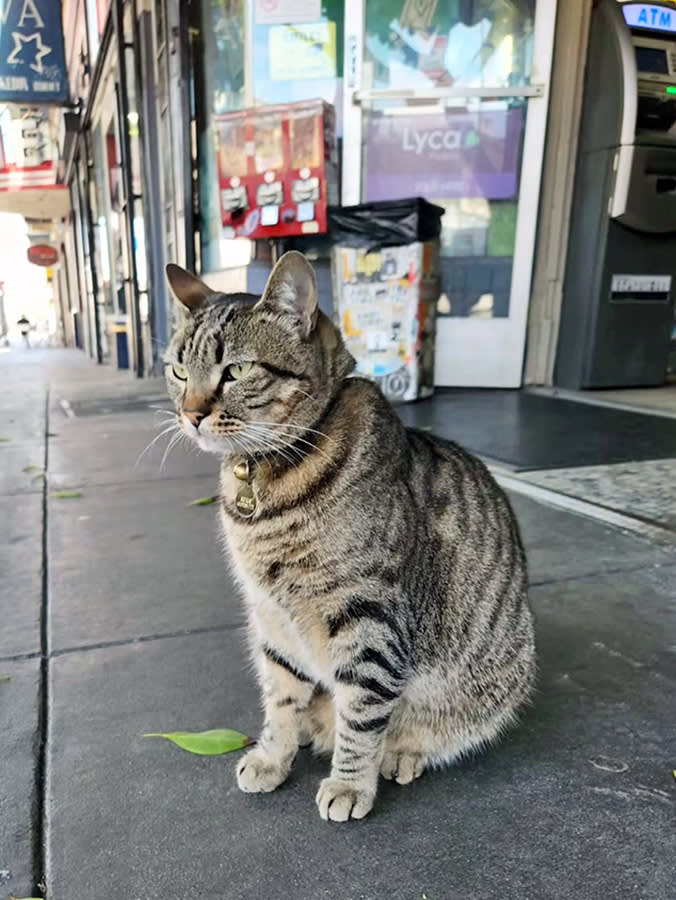
In late October, a Waymo killed KitKat, a bodega cat so woven into his corner of the Mission District that locals called him the mayor of 16th Street. He lived at Randa’s Market, where he had arrived years earlier as the neighborhood’s answer to a rodent problem, given to the store by a neighbor whose relative was allergic to cats. He became a fixture, friendly with everyone, unbothered by dogs, and a regular star of the store’s social media.
According to reporting by local outlets, the robotaxi struck him late at night near a transit lane, and a 311 complaint alleged the car neither slowed nor tried to avoid him. A driver behind the Waymo described people on the sidewalk shouting and grabbing the cat. Within a day, a memorial of candles, flowers, and photos had gone up outside Randa’s Market, and the neighborhood was mourning, and demanding accountability.
The grief was specific and communal. One woman who works at a nearby bar described walking through the neighborhood the next morning with candles and flowers and finding that everyone already knew who they were for.
Waymo, for its part, offered condolences and said its review found that a cat had darted under the vehicle as it pulled away from a passenger pickup, and that it would donate to a local animal organization in KitKat’s honor.
The uncomfortable question underneath
The two incidents together crystallize a problem that is easy to wave away one death at a time: whether self-driving systems reliably detect small animals, especially in the dark and at close range.
The timing around KitKat’s death made the question unavoidable. Just before it, Waymo’s CEO, Tekedra Mawakana, had been in San Francisco for a tech conference, where a journalist asked her directly whether the public would ultimately accept a death caused by a machine. Mawakana said she believed it would, and framed the real challenge as making sure the safety bar stays high enough to hold companies to account. Days later, a cat the whole block loved was dead, and the abstraction had a name and a memorial.
This is not brand new, and it is being tracked
Waymo has offered public rides in San Francisco since 2021, and pets have been hurt before. Back in 2023, one of the company’s cars struck and killed a dog in the city. Earlier in 2025, a multi-car crash that involved a driverless Waymo left a man and his dog dead. Federal regulators require self-driving companies to report every crash, so these events do enter an official record, which is part of how the public is able to connect them at all.
That reporting is a floor, not a solution. It documents what happened; it does not by itself prove the systems can be trusted to see a cat sitting near the curb or a small dog loose in the road.
What it means for people with pets
None of this should push anyone toward vigilante conclusions about robotaxis, and it is worth being clear that human drivers kill enormous numbers of animals too. But the pattern is a concrete reminder for anyone living in a city where driverless cars now share the streets.
Small animals are the hardest cases for these systems, and the two most exposed are exactly the pets involved here: outdoor and community cats who treat the sidewalk as home, and dogs off leash near traffic. The practical takeaways are old advice with new urgency. Keep dogs leashed near any roadway. Think hard about the risks an outdoor cat faces in a neighborhood with autonomous vehicles, and know that even a cat who is streetwise around human drivers is facing a different kind of machine now.
The people of 16th Street are not wrong to want more than condolences and a donation. A cat everyone knew is gone, a family is rattled, and a dog is dead, and the question they are all really asking is whether the bar for putting these cars on the road is high enough yet. Right now, the street does not feel convinced.
Nina Vasquez writes about life at home with pets and the relationships at the heart of it. Her work covers day-to-day living, people-and-pet stories, and the products that fit into a real household, with a warm, grounded take on everyday pet ownership.
Meet our experts ↗Keep reading
 LivingYour Pet Dreads Thanksgiving More Than You Do. Here Are the 8 Relatives to Blame.Jordan Ellis · 7 min
 Health & WellnessMost 'Toxic' Plants Just Make Your Cat Drool. Two Genera Actually Kill.Dr. Nina Kohl · 9 min
 LivingShe Keeps 200 Houseplants and One Curious Cat. The Plants Are Winning.Leila Torres · 5 min
 Health & WellnessYour Cat vs. the Christmas Tree: The Climbing Isn't the Real DangerDr. Ravi Mehta · 6 min
 Health & WellnessThe 'Stray Cat Telegraph' Is Nonsense. It Still Beats Standing on the Porch Yelling.Dr. Nina Kohl · 7 min
 Health & WellnessBringing an Outdoor Cat Inside Isn't Cruel. Doing It All at Once Is.Dr. Nina Kohl · 8 min