


She Keeps 200 Houseplants and One Curious Cat. The Plants Are Winning.
A Brooklyn plant collector turned her apartment into an indoor jungle and taught her cat to leave every leaf alone. Her methods are charming, but one of the folk tricks she leaned on is riskier for cats than most owners realize. Here's the coexistence playbook, with the safety part fixed.

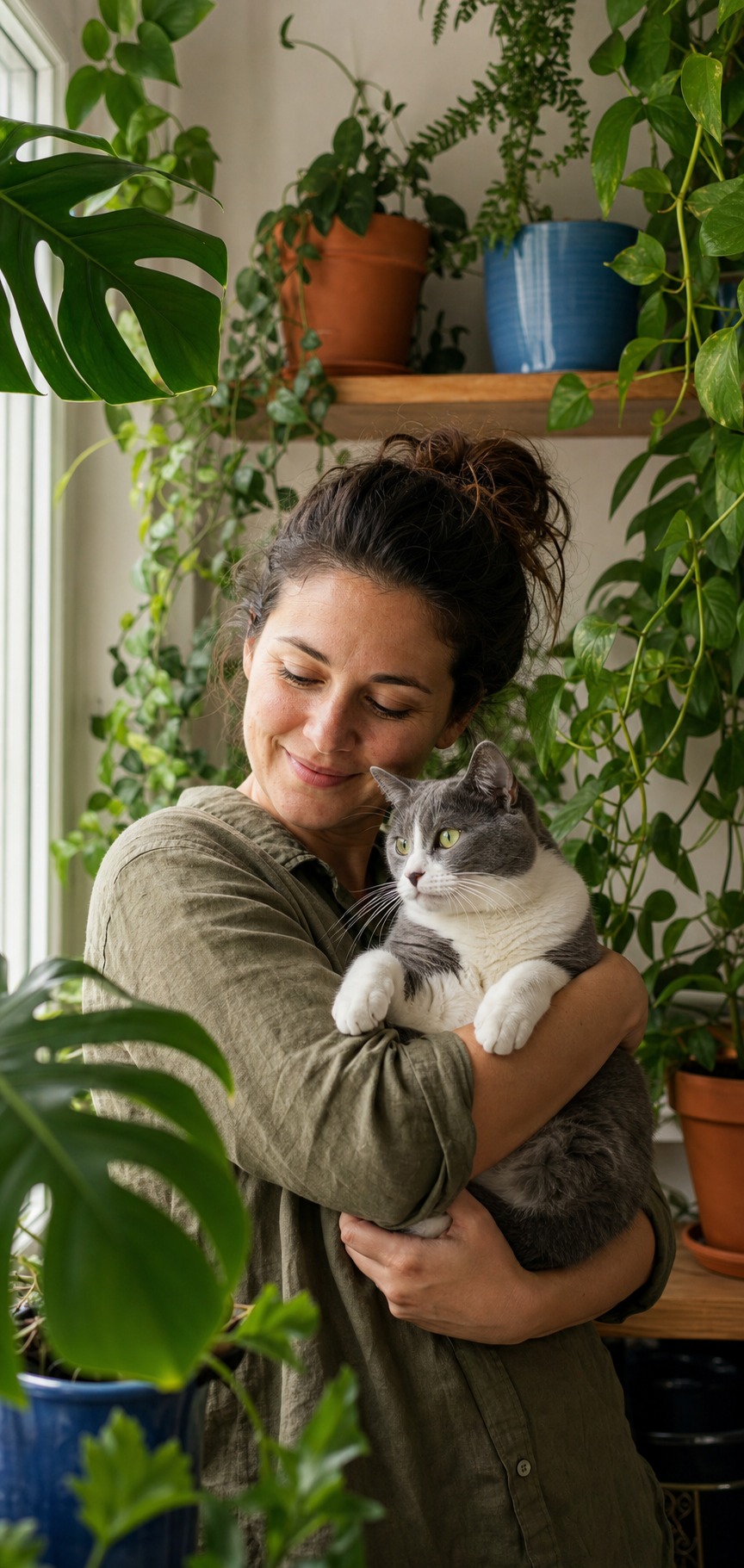
Ask any plant-obsessed cat owner what keeps them up at night, and it isn’t spider mites. It’s the cat. A single houseplant is a chew toy. Two hundred of them is a salad bar with a view. So when a home holds a couple hundred plants and a young, adventurous cat, and the plants are thriving and untouched, people want to know the secret.
Photographer Phoebe Cheong’s Brooklyn apartment is that home. Her account, Welcome to the Jungle Home, documents a verdant indoor landscape of more than 200 plants, and her tabby, Pixel, is the co-star who lounges among them without treating them as a snack. The most common question her followers send isn’t about the plants. It’s how the cat leaves them alone.
The honest answer is less about any single trick and more about timing, redirection, and one folk remedy that’s worth swapping out. Let’s walk through what works, and fix the one thing that could hurt a cat.
Start before the cat decides the plants are toys
Cheong got Pixel as a roughly 10-month-old kitten, right when a cat is small enough to be managed and young enough to form habits. Early on, the plants simply lived out of reach, up on shelves and counters a kitten couldn’t get to. That head start matters more than any deterrent. A cat who grows up treating the greenery as ordinary background, rather than an exciting new arrival to investigate, is a cat who mostly ignores it for life.
The lesson generalizes even if your cat is already an adult: don’t introduce a full jungle overnight. Add plants gradually, keep the most tempting ones elevated at first, and let the novelty wear off before you lower the stakes.
Give the cat its own plants to wreck
The single most effective redirection Cheong used was giving Pixel greenery of his own: cat grass, wheatgrass, and catnip. This is the move most owners skip. A cat’s urge to bite and bat at leaves is real, and a plant-free apartment just aims that urge at your monstera. Offer a dedicated pot the cat is allowed to chew, and you give the instinct somewhere harmless to go.
Toys help too. Pixel reportedly liked to bat around a ponytail palm like it was a ball, never chewing it, which is a useful reminder that not all plant contact is a threat. Some cats want to play with a plant, not eat it, and a sturdy, non-toxic plant can absorb that.
The deterrent to skip: citrus oils
Here’s where the popular version of this advice needs a correction. A widely shared tip, and one Cheong tried early, is tucking lemon and orange peels into the soil, because cats dislike citrus. Peels themselves are a mild, generally low-risk aversive. The problem is what people do next: they reach for a citrus essential oil spray, assuming a stronger dose of the same idea is safer because it’s “natural.”
It isn’t. Concentrated citrus and other essential oils are toxic to cats, who can’t efficiently process the compounds in them, and exposure can cause drooling, vomiting, tremors, or worse. So the folk logic quietly leads owners toward the one version of the trick that’s genuinely dangerous.
“Peels in the soil, fine, most cats just find them annoying,” says Dr. Mara Chen. “But please don’t graduate to citrus essential-oil sprays around a cat. Those oils are exactly the kind of thing a cat’s liver can’t clear, and I’ve treated the aftermath. If a deterrent needs a warning label, the better move is redirection, not a stronger chemical.”
The vet-endorsed toolkit is gentler and works: physical distance while a cat is young, a spray bottle of plain water reserved for the rare real misbehavior, plenty of the cat’s own chewable greenery, and, crucially, making sure every plant within reach is non-toxic in the first place. Which brings us to the part no deterrent can substitute for.
Know which plants would actually poison your cat
Training a cat to ignore your plants is a nice-to-have. Keeping toxic plants out of a cat’s space is a must-have. Even a well-trained cat has an off day, and some common houseplants, lilies above all for cats, along with pothos, philodendron, dieffenbachia, and sago palm, range from irritating to deadly. Before you worry about whether your cat will nibble, make sure the thing they might nibble can’t seriously hurt them. Build the jungle out of cat-safe species where the cat can reach, and reserve the risky beauties for a closed room or a truly unreachable spot.
The real “secret,” if there is one
There’s a temptation to look for a single hack, a magic peel or spray that flips a cat from destroyer to respecter of plants. Cheong’s story doesn’t offer that, and neither does any honest expert. What actually happened is unglamorous and repeatable: she got the cat young, kept temptation out of reach while habits formed, gave him his own greenery, corrected sparingly, and let the plants become boring furniture instead of thrilling new prey. Do that, choose non-toxic species, and skip the essential oils, and you can have the jungle and the cat both.
References
Leila Torres leads our Living coverage, from home life and travel to the products and rescue stories that come with sharing a life with animals. She edits and writes across the section, with a soft spot for pieces about the bond between people and their pets.
Meet our experts ↗Keep reading
 TrainingPaper Is the Best Cat Toy in Your House. It's Also a Trap.Dr. Ravi Mehta · 7 min
 Health & Wellness45 Degrees Is the Number That Should Bring Your Cat InsideDr. Nina Kohl · 7 min
 Health & WellnessCats Don't Always Land on Their Feet. Scientists Just Found the Part That Does the WorkDr. Priya Nair · 6 min
 LivingA Five-Month-Old Kitten Turned On a Faucet, Blocked a Drain, and Closed a Cat CafeSara Lim · 6 min
 Health & WellnessBringing an Outdoor Cat Inside Isn't Cruel. Doing It All at Once Is.Dr. Nina Kohl · 8 min
 Health & WellnessHalloween Is Your Cat's Least Favorite Night. Six Ways to Fix That.Dr. Lena Park · 5 min