


Cats Don't Always Land on Their Feet. Scientists Just Found the Part That Does the Work
The famous twist isn't magic, and it isn't the tail. A 2026 study finally measured the two halves of a cat's spine and found one is triple-jointed while the other is a brick. Here's what that means, and why the reflex still fails.

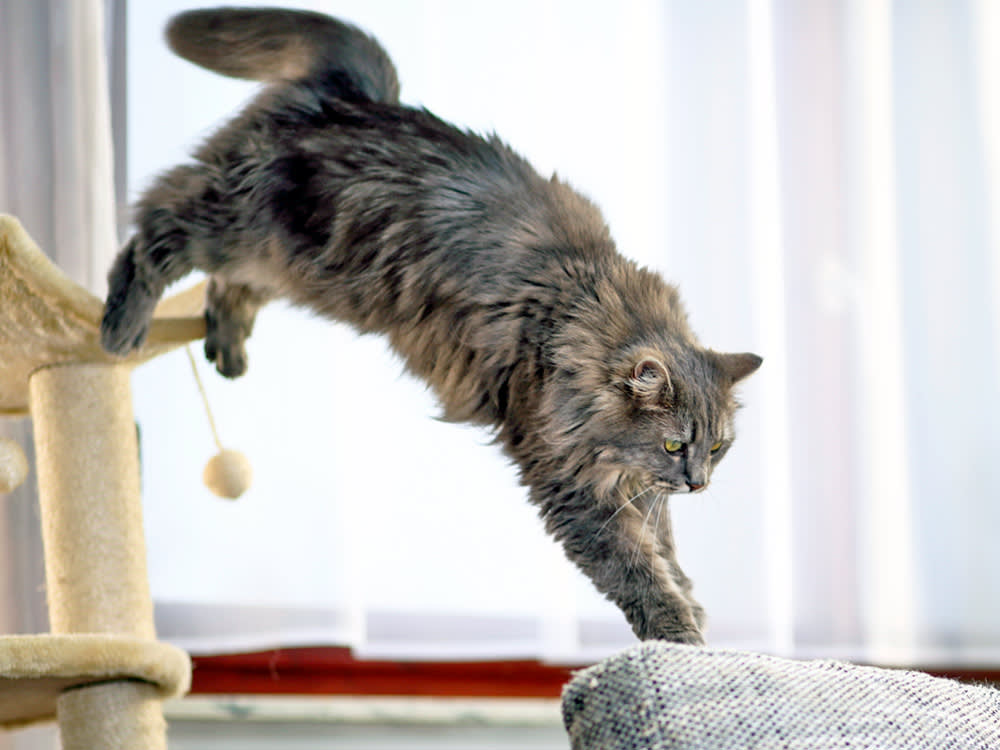
Drop a cat and it lands on its feet. Everyone knows this. It is one of the few things people believe about cats that is mostly true, and it has been photographed, filmed, and argued over for more than a century.
What nobody could explain was the mechanism. A falling cat has nothing to push against. It cannot shove off the air. Physics says you cannot simply rotate yourself in freefall without something to twist against, and yet the cat arrives feet-down anyway, every time, in under a second.
In March 2026, a team at Yamaguchi University published the measurement that had been missing. And it points at a part of the cat almost nobody suspected.
The answer is a spine that is two different animals
The researchers, led by Dr. Yasuo Higurashi, took apart the question in the most literal way available. They separated the spines of five cats into two sections, the thoracic spine that runs through the chest and upper back, and the lumbar spine of the lower back. Then they twisted each one on a rig and measured what it took to move it, how far it went, and how hard it fought back.
The two halves behaved like completely different pieces of hardware.
The thoracic spine turned out to be roughly three times more mobile in rotation than the lumbar spine, and about a third less stiff. The chest section is the twister. The lower back barely moves at all.
That asymmetry is the whole trick. A cat in the air does not rotate as one unit. It rotates in sequence: the front half whips around first while the rigid back half hangs behind as an anchor, and only then does the rear follow. Because the two halves are mechanically unequal, the cat can turn its front end without the back end simply spinning the other way and cancelling it out. The rigid lumbar spine is not a design flaw. It is the thing the front half pushes against.
Filming two live cats dropped a short distance onto a thick cushion confirmed the order of operations: front first, back second, exactly as the mechanical tests predicted.
People always credit the tail, and the tail is barely a footnote. The real story is that your cat is carrying around a flexible front half and a stiff back half, and the mismatch between them is what buys the landing.
The 130-year-old problem this finally closes
The question is old enough to have its own name in physics: the falling cat problem.
In 1894, the French scientist Étienne-Jules Marey pointed an early high-speed camera at a falling cat and produced a strip of images showing the animal rotating in midair with nothing to push off of. The pictures were unambiguous and deeply annoying. They appeared to show an animal generating rotation out of nothing, which is not allowed.
The resolution, worked out over the following century, is that the cat is not creating angular momentum, it is redistributing it, changing the shape of its body so different sections can turn at different rates. That was the theory. What nobody had done was go into the actual animal and check whether its skeleton has the specific properties the theory requires.
That is what this study did. The bend-and-tuck model finally has the anatomy underneath it.
An odd detail: cats appear to be right-handed about it
One small finding is going to bother people, in a good way. The cats did not twist randomly. One of the two cats turned to the right on all eight drops. The other turned right six times out of eight.
A side preference like this shows up across a lot of animals and nobody is sure why. It is a small sample, so treat it as a curiosity rather than a fact about cats in general. But it hints that the righting reflex may not be perfectly symmetrical, and that your cat might have a favored direction the way you have a dominant hand.
Now the part the headlines leave out
Here is where a fun science story turns into a safety story, and it is the reason this article exists.
“Cats always land on their feet” is false, and believing it gets cats killed.
The righting reflex is real, it is fast, and it is not enough. Veterinarians see the consequences often enough to have a name for it: high-rise syndrome, the cluster of injuries cats arrive with after falling from a window, a balcony, or a fire escape. Landing feet-first does not mean landing safely. A cat that rotates perfectly can still shatter a jaw on impact, split a hard palate, blow out a chest, or break the legs it landed on.
There are two ways the reflex fails.
Too little height. The twist takes time. A cat that slips from a low ledge or is dropped from just above the floor may not have enough airtime to finish rotating, and lands badly, sometimes on its back or side.
Too much height. This is the counterintuitive one. Cats that fall from very high floors sometimes arrive with injuries as bad as or worse than cats from the middle floors. A cat that has fully rotated and spread out is stable, but it is still falling, and past a certain point it is simply moving very fast when it meets the ground.
The reflex is a landing system, not a parachute. It has a floor and a ceiling.
The reflex buys the cat orientation, not immunity. I have treated cats that landed on all four feet, exactly as advertised, and still came in with a broken jaw and a chest full of air. Any fall from a window is an emergency visit, even when the cat gets up and walks away, because the worst of it is often internal and does not show for hours.
What to actually do about it
The practical takeaway is short and worth more than the physics.
- Screen the windows. Not the flimsy pop-in kind. Cats lean on screens. Use screens that are properly fixed in the frame, and check them.
- Assume the balcony is not cat-proof. Railings are for humans. A cat will fit through the gap, and a bird or a moth is all the motivation required.
- Watch the tilted window. A window cracked open at an angle at the top is a well-documented way for a cat to get wedged and badly hurt trying to squeeze through.
- Go to the vet after any fall, even a good-looking one. Chest injuries and internal bleeding are quiet at first. A cat that seems fine an hour later may not be fine.
What newer research adds
This study is itself the new thing, published in The Anatomical Record in 2026, and it is worth saying what it does and does not settle.
It settles the mechanics. We now have real numbers on how much each part of the spine twists, and the sequence has been filmed and matched to those numbers. That is a genuine step past a century of well-argued theory.
It does not change any advice about keeping your cat safe, and it was never going to. The researchers are already pointing the work somewhere more useful, which is medicine and engineering rather than cat trivia. If you know precisely how a healthy feline spine handles torsion, you have a baseline for treating an injured one, and a blueprint for robots that need to reorient themselves in the air.
Your cat has been running this software the whole time. We are only now reading the source code.
References
- Higurashi, Y., et al. “Torsional flexibility of the thoracic spine is superior to that of the lumbar spine in cats: Implications for the falling cat problem.” The Anatomical Record, 2026.
- Whitney, W. O., & Mehlhaff, C. J. “High-rise syndrome in cats.” Journal of the American Veterinary Medical Association.
- “Japanese scientists discover how falling cats almost always make perfect landings.” Phys.org, March 2026.
Not a substitute for your vet. Our guidance is educational. For urgent symptoms, contact a vet or emergency clinic right away. Editorial standards
Dr. Nair is a veterinarian focused on diet and feeding. She covers everyday nutrition, treats, and the many "can they eat this?" questions owners ask, grounding each answer in what is actually safe and sensible for dogs and cats.
Meet our experts ↗Keep reading
 Health & WellnessYour Cat Begs to Go Outside. The Honest Case for Keeping Them In.Dr. Priya Nair · 8 min
 Health & WellnessMost 'Toxic' Plants Just Make Your Cat Drool. Two Genera Actually Kill.Dr. Nina Kohl · 9 min
 Health & WellnessFoxtails Aren't Just a Dog Problem. For Cats They Can Be Deadly.Dr. Amara Solis · 5 min
 LivingWhether a Cat Tolerates Water Is a Coat Question, Not a Willpower OneDr. Ravi Mehta · 8 min
 Health & WellnessOne Common Bouquet Flower Can Put a Cat in Kidney Failure. Here's the Full List.Dr. Amara Solis · 8 min
 Health & WellnessBringing an Outdoor Cat Inside Isn't Cruel. Doing It All at Once Is.Dr. Nina Kohl · 8 min