


Halloween Is Your Cat's Least Favorite Night. Six Ways to Fix That.
Cats are the mascot of Halloween and, quietly, one of its biggest casualties. The holiday is built almost entirely out of things cats hate: doorbells, strangers, open doors, and shiny hazards. Here are the six real risks worth planning around, from candy to glow sticks.

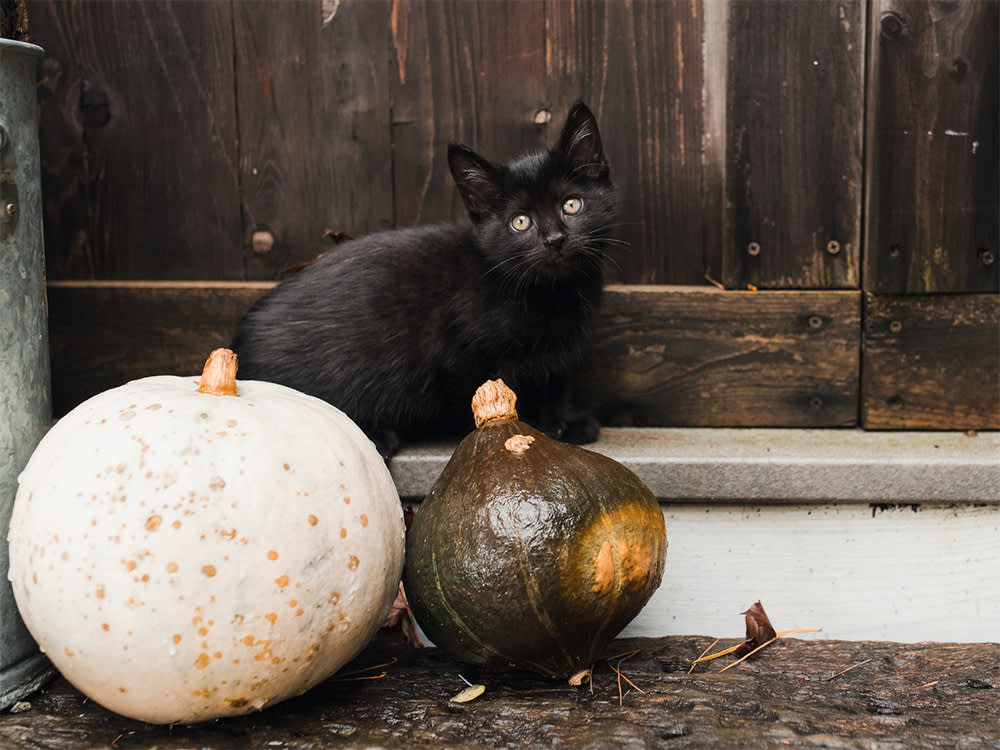
Cats are everywhere at Halloween. They are on the decorations, the candy wrappers, the greeting cards, the porch. And then there is the actual cat in your actual house, who would like it on the record that being a holiday symbol is where the relationship ends.
It is worth sitting with the irony. Nearly every element of Halloween is a thing cats specifically dislike: a doorbell ringing all night, a parade of costumed strangers, the front door swinging open every four minutes, loud music, and a floor suddenly littered with crinkly, shiny, dangerous novelties. Your cat did not sign up to host a party. The kind move, then, is not to dress them up for the occasion. It is to plan their safe exit from it. Here are the six risks actually worth managing.
1. The candy bowl
Dogs get the reputation for raiding sweets, but cats are perfectly willing to investigate a bowl of candy too. The reassuring part is that the cocoa content in most mass-market candy runs low enough that a stolen nibble usually amounts to nothing worse than a queasy stomach. Push past a nibble, or reach for darker chocolate, and it turns into a real danger, so keep the stash somewhere genuinely out of reach, not a bookshelf your cat treats as a staircase, but a closed cabinet. And deal with the wrappers. A foil or cellophane wrapper reads to a cat as a crinkly toy, and a swallowed one is a choking and intestinal hazard.
2. The noise and the crowd
Many cats are deeply sound-sensitive, and a night of children shrieking “trick or treat” at your doorstep can tip them into a genuine stress response, as can thumping party music and motion-activated decorations that lurch to life. A stressed cat looks for somewhere to hide, and may decide the litter box no longer counts as safe, which means you could be cleaning up an accident you did not expect.
Give your cat a room of their own for the night, well away from the front door, with their litter box, water, and a place to hide. Check on them now and then, but resist the urge to keep introducing them to guests. A quiet, boring evening in the back bedroom is the best gift you can give a cat on Halloween.
This matters even more at a party, where some guests will have no idea how to read a frightened cat, and a cornered animal can lash out.
3. The revolving front door
If your street draws trick-or-treaters, you will be opening and closing that door all evening, and each swing is an invitation for an escape artist. A cat already rattled by the noise is primed to bolt for somewhere calmer, straight past your ankles and into the dark. Two defenses: make sure your cat is microchipped and wearing a current ID tag, and sidestep the problem entirely by setting the candy bowl out on the front step so you are not opening the door for every group.
4. The costume
We love a cat in a costume as much as anyone, but cats have opinions, and they are usually “no.” Before you strap your cat into anything, weigh their personality honestly. If you proceed, watch closely for signs of distress and take the outfit off the instant you see stress, frustration, or irritation. Make sure nothing blocks their senses, that they can move and use the litter box freely, and never leave a costumed cat alone. If your cat tolerates the whole thing and still lets you take a photo, congratulations: your cat is a rare and magnificent weirdo.
5. The jack-o’-lantern
A carved pumpkin with a live candle inside is a Halloween staple and, to a curious cat, a glowing new toy to bat at. That is a problem for flammable fur and, frankly, for your whole house. According to the National Fire Protection Association, pets are responsible for hundreds of accidental home fires every year, so keep open flames supervised or, better, swap in a flameless LED candle. The pumpkin looks the same. It just can’t set your cat alight.
6. The shiny little extras (the one people miss)
Here is the risk that rarely makes the safety lists and probably should. Halloween scatters exactly the kinds of small, glittery, stringy objects cats cannot resist. Glow sticks and glow jewelry are a common culprit: the liquid inside is intensely bitter, so a cat who punctures one will usually drool, foam, and act miserable. It is generally low in real toxicity, but it is alarming, and the fix is to offer food or water to cut the taste, wipe any glowing liquid off the fur before they groom it in, and call your vet if the reaction seems severe.
The quieter danger is anything string-like: fake spider webbing, tinsel, ribbon, and the elastic on costumes. Cats are drawn to these, and a swallowed strand can become a linear foreign body, a genuine surgical emergency where the string bunches the intestine. Keep the fake cobwebs strung high and out of paw’s reach, and pick up loose ribbon and elastic before your cat finds it first.
Do all six and you have given your cat the Halloween they actually want: a locked door, a quiet room, and a household that respects the wishes of the holiday’s true mascot.
References
- National Fire Protection Association. “Pet Fire Safety.”
- ASPCA Animal Poison Control Center. “Halloween Safety Tips.”
Common questions
How do I keep my cat from escaping on Halloween?
The constant open-and-shut of the front door is the biggest escape risk of the night. Set your cat up in a closed, quiet room away from the entryway, make sure they're microchipped and wearing an ID tag, and consider leaving the candy bowl on the front step so you're not opening the door at all.
Are glow sticks poisonous to cats?
The liquid inside glow sticks is intensely bitter but generally low in toxicity. A cat who bites one will usually drool, foam, and act distressed rather than become seriously ill. Offer food or water to clear the taste and wipe any liquid off their fur, and call your vet if the reaction seems severe.
Not a substitute for your vet. Our guidance is educational. For urgent symptoms, contact a vet or emergency clinic right away. Editorial standards
Dr. Park is a board-certified emergency and critical care specialist. She reviews our health and safety content for clinical accuracy and contributes guides on recognising urgent conditions. Her focus is helping owners act quickly and correctly when it matters most.
Meet our experts ↗Keep reading
 TrainingPaper Is the Best Cat Toy in Your House. It's Also a Trap.Dr. Ravi Mehta · 7 min
 TrainingThat 'Come Here' Cat Video Works. Your Own Voice Works Better.Dr. Lena Park · 7 min
 Health & WellnessCats Don't Always Land on Their Feet. Scientists Just Found the Part That Does the WorkDr. Priya Nair · 6 min
 Health & WellnessThe 'Stray Cat Telegraph' Is Nonsense. It Still Beats Standing on the Porch Yelling.Dr. Nina Kohl · 7 min
 Health & WellnessYour Cat Begs to Go Outside. The Honest Case for Keeping Them In.Dr. Priya Nair · 8 min
 Health & WellnessYou're Decorating Your Cat's World With Smells It Can't StandDr. Lena Park · 6 min